Newton: 316.283.6655
Andover: 316.202.9990
.jpg)
Newton: 316.283.6655
Andover: 316.202.9990
By Robert Roeser, DO, board-certified Internal Medicine
Many physicians assume that leaving a health-system job means giving up hospital work. Privileges get reviewed. Call schedules change. The dynamic between employed and independent physicians can shift once a physician is no longer on the system payroll.
That outcome isn't necessary. Employment contracts and medical staff privileges are separate.
At Integrity Medicine, a pure Direct Primary Care practice in Newton, Kansas, our physicians left traditional system employment and retained active medical staff status at Newton Medical Center. Integrity Medicine physicians continue to see their own hospitalized patients while practicing Direct Primary Care every day.
This article explains what actually controls hospital privileges, how Direct Primary Care changes the sustainability of inpatient work, the practical steps that protect the work a physician wants to keep, and why the combination still matters for both physicians and patients.
If you are a physician considering a move that still includes hospital work, Integrity Medicine is open to a conversation about how the model works. Reach out through the contact page.

Hospital privileges are granted by the medical staff and the hospital board under the medical staff bylaws. Employment is a separate contractual relationship with a health system or group.
The AMA Principles for Physician Employment make this distinction clear. Upon termination of employment, a physician generally should not be required to resign medical staff membership or clinical privileges unless an independent action of the medical staff calls for it and full due process under the bylaws is provided.
Automatic rescission is tolerable only under narrow conditions involving exclusive contracts and a medical staff hearing.
In practice the real risks are softer. Delayed renewals. Narrowed privileges at the next reappointment cycle. Loss of preferred call slots. Reduced access to procedural time. These outcomes depend more on relationships, demonstrated competence, and the hospital’s current stance toward independent physicians than on the simple fact of leaving employment.
At Integrity Medicine, our physicians left the traditional employed model and built a pure Direct Primary Care practice. Integrity Medicine retained active medical staff status at Newton Medical Center. I continue to practice both in the clinic and in the inpatient setting.
The same is true for the other Newton physicians at Integrity Medicine. Employment ended. The hospital work at Newton Medical Center did not have to end with the employment relationship. You can learn more about the Newton Direct Primary Care location and how the model supports this dual practice.
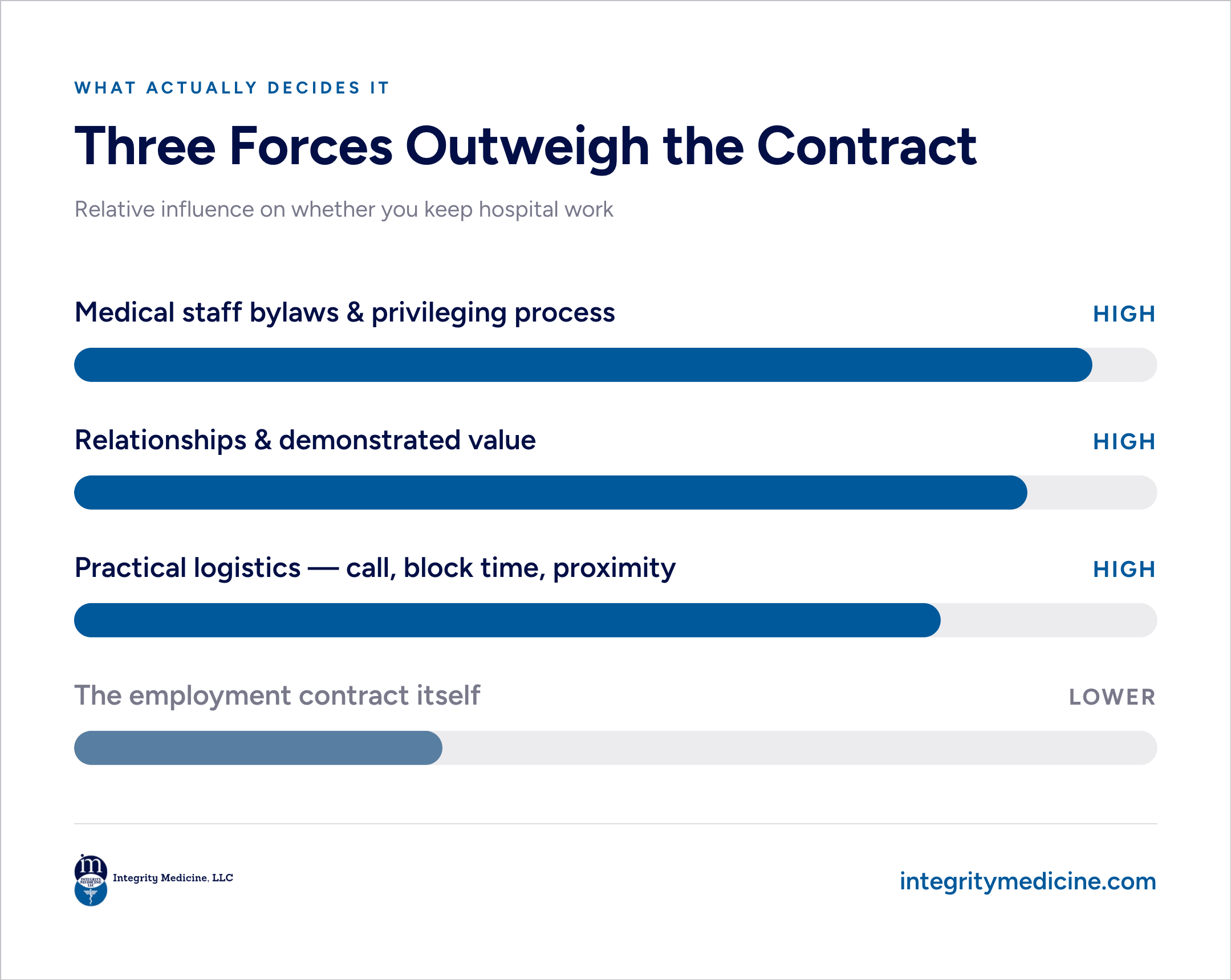
Three forces matter more than the employment contract itself when the goal is to keep hospital work after leaving a health system.
First, the medical staff bylaws and the hospital’s privileging process. Physicians should read them carefully before giving notice. They should understand the categories of privileges, the reappointment cycle, any focused professional practice evaluation requirements, and whether the bylaws contain language that ties privileges to employment status. The American Academy of Family Physicians provides practical steps to hospital credentialing and privileges that independent physicians often use as a reference.
Second, relationships and demonstrated value. Hospitals still need physicians who bring admissions, provide continuity, and participate constructively in medical staff life. Independent physicians who maintain competence logs, respond to calls, and treat the hospital as a partner rather than an adversary tend to keep access. The “us versus them” problem is real when systems prioritize employed physicians, but it is not universal.
Third, practical logistics. Call participation, block time, and geographic proximity affect whether the work remains sustainable once a physician is independent. These items are negotiable in many settings if they are addressed before the physician leaves rather than after.
Integrity Medicine did not invent a new process. The practice simply built a model in which hospital work remained possible. The Newton Direct Primary Care clinic of Integrity Medicine sits at 715 Medical Center Drive, Suite 200, immediately adjacent to Newton Medical Center. That physical proximity removes friction. Smaller panels and personal appointment booking create the schedule flexibility required for inpatient work alongside same-day outpatient access.
For a deeper look at how the outpatient and inpatient sides fit together inside the Integrity Medicine practice, see the article on hospital continuity in Direct Primary Care.
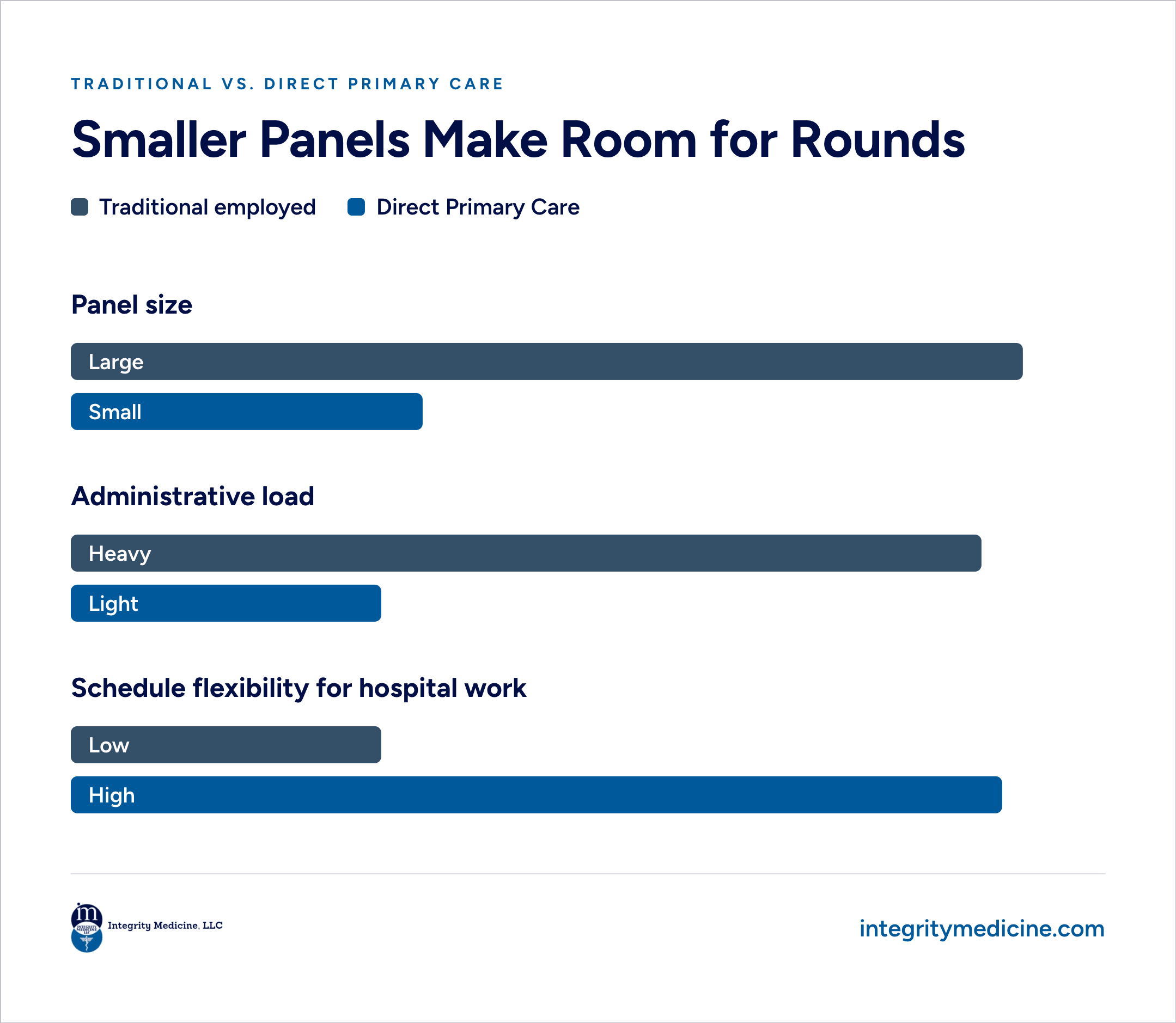
The traditional employed primary care model made hospital work hard to sustain. Large panels, heavy administrative load, and rigid templates left little room for morning rounds or unexpected inpatient needs.
Direct Primary Care changes the equation. Panels are intentionally smaller. Insurance billing for primary care services is removed. The recovered hours and the flexibility of personal scheduling make it possible for a physician who wants inpatient work to keep it without sacrificing the access that patients expect.
At Integrity Medicine this is the mechanism that allows hospital continuity to survive the move out of a health system. The same design that protects zero-wait outpatient care also supports inpatient involvement. Location helps, but the real foundation is the smaller panel.
For the full operational picture, see the detailed guide to hospital continuity in Direct Primary Care.
I still make nearly all of my own appointments. When a patient needs to be seen the same day or when a hospitalized member needs attention, I can change my schedule without layered call centers or rigid templates. Most patients check in and walk straight back.
That same flexibility that supports same-day sick visits also leaves room for hospital work. It is the same access culture that distinguishes Direct Primary Care from traditional urgent care models.
Integrity Medicine is not the only practice that has chosen this path, but the combination remains uncommon in pure Direct Primary Care. Many Direct Primary Care clinics operate entirely outpatient and coordinate closely with hospitalists. Both models are legitimate.
The choice depends on training, local hospital environment, and the physician’s priorities. From lived experience at Integrity Medicine, I can tell you that the pure outpatient path is one option among others that can still work.
All three of the Newton physicians at Integrity Medicine see their own hospitalized patients. To my knowledge, no other practice in town does this. That culture of continuity is one reason the model continues to work at Newton Medical Center.
You can learn more about the Newton Direct Primary Care location and how the day-to-day practice is structured. The About page also describes the team culture that makes this possible.
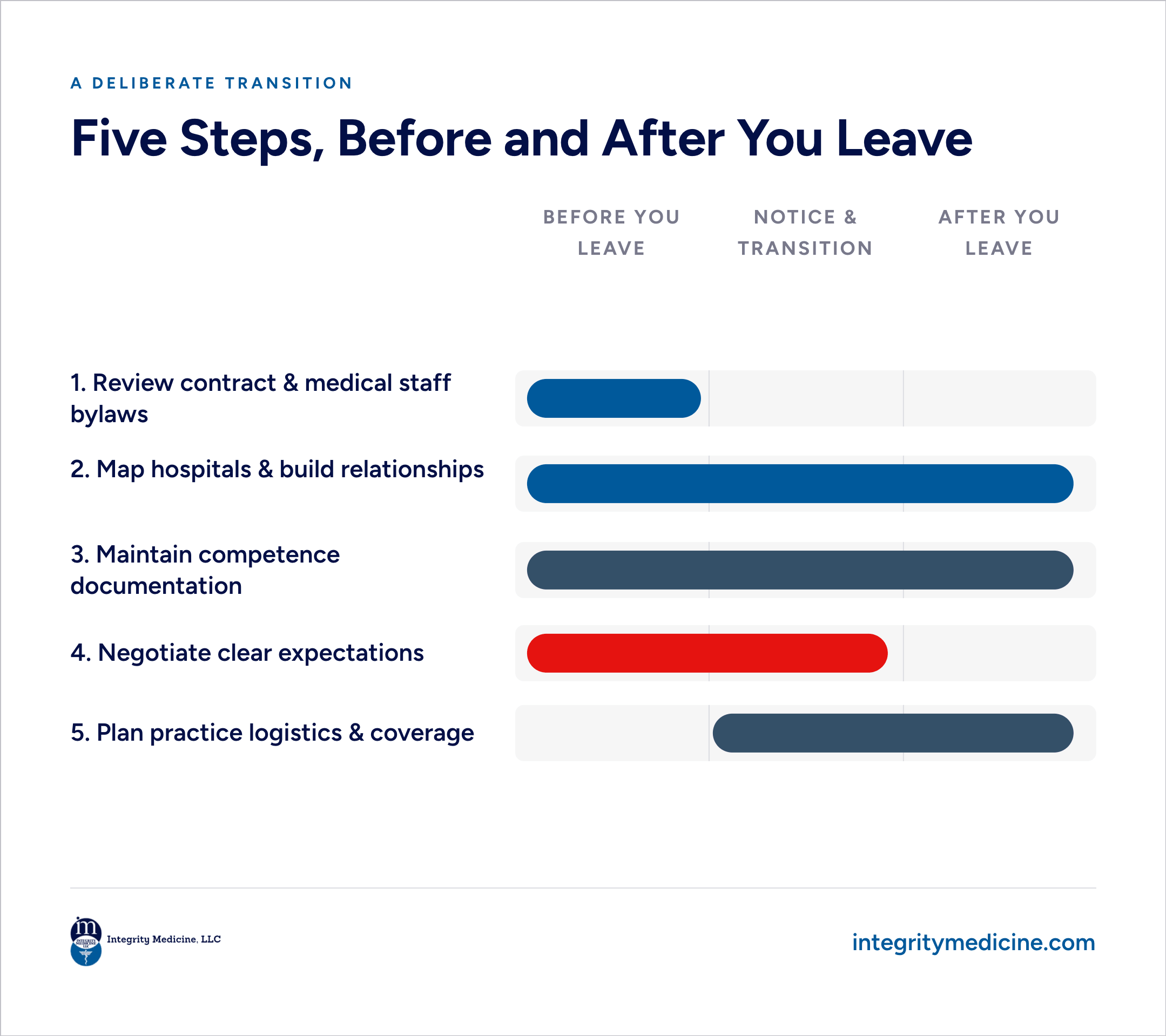
At Integrity Medicine the transition out of system employment is treated as a deliberate process so that hospital work can continue at Newton Medical Center. The same principles apply whether a physician is moving into pure Direct Primary Care or another independent model.
Review the employment contract and the medical staff bylaws with counsel who understands physician employment. Look specifically for co-terminus language that attempts to tie privileges to employment status, non-compete provisions, notice requirements, and any obligations around medical records or patient notification.
Map the hospitals that matter to the future practice. Understand their current stance toward independent physicians. Build or maintain relationships with medical staff leaders before they are needed.
Maintain competence documentation. Procedural logs, volume data, and clean peer-review history matter at reappointment. Gaps become harder to explain once a physician is outside the system’s data systems.
Negotiate clear expectations while leverage still exists. Written understanding of continued call participation, access to facilities, or support for independent status is more useful than verbal assurances.
Plan the logistics of the new practice so that hospital work remains realistic. Adjacent location, controlled panel size, and a team culture that shares coverage all reduce the risk that inpatient work becomes unsustainable after the transition. Transparent pricing is part of the model that makes the approach workable for both physicians and patients.
None of these steps guarantee a specific outcome. Hospitals differ. Local politics differ. The steps reduce avoidable risk and keep the option open.
If a physician is already exploring the move to Direct Primary Care, the structural changes that free capacity for hospital work are the same ones that reduce administrative burden overall. The article on why Kansas physicians are choosing Direct Primary Care covers those broader reasons in more detail. Physicians can also contact us if they want to discuss how the model works at Newton Medical Center.
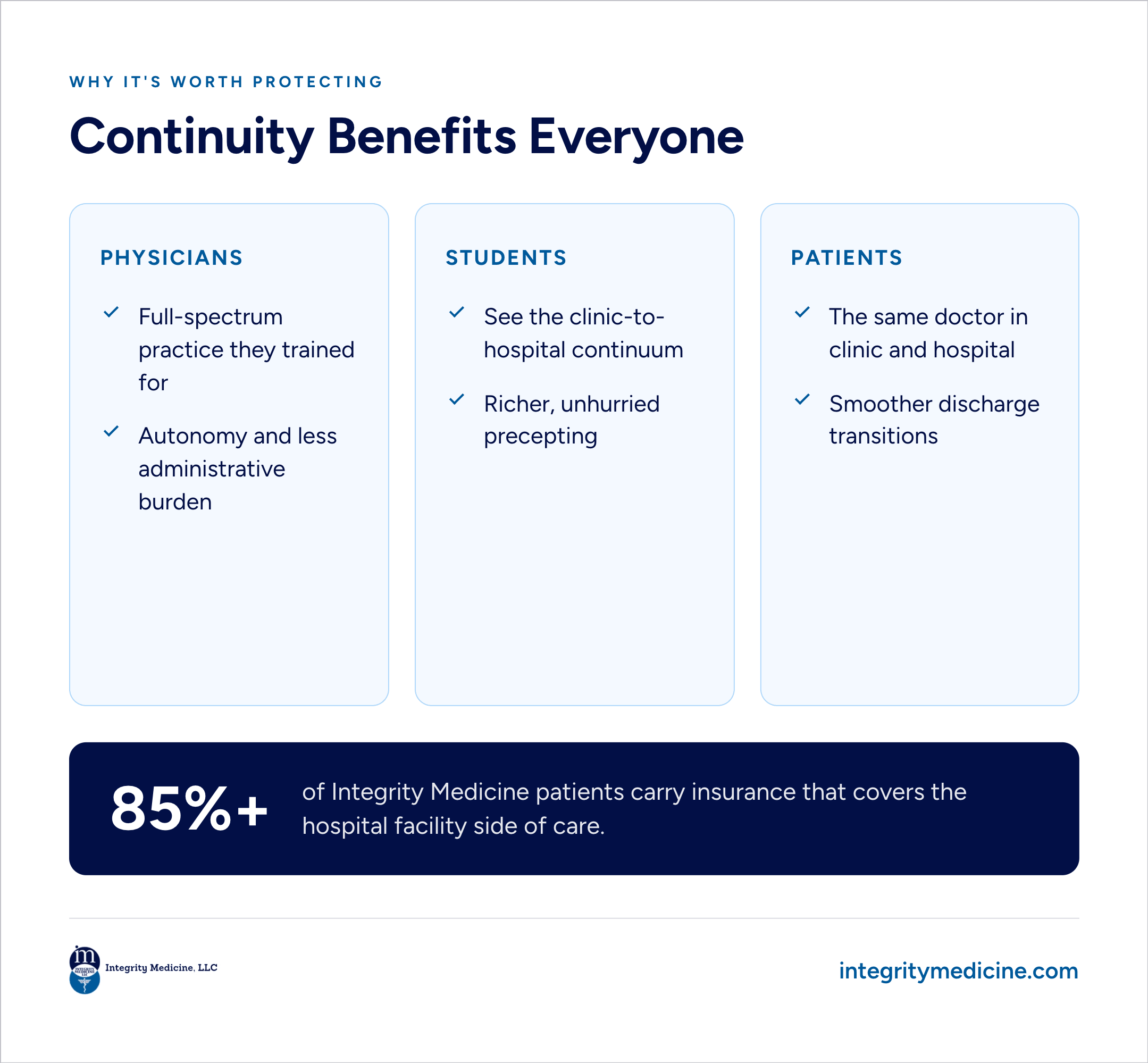
At Integrity Medicine full-spectrum practice remains a source of professional satisfaction for the physicians. Many physicians entered medicine to care for patients across settings, not only in the clinic.
Mentoring medical students is more complete when the students can see both the outpatient relationship and the inpatient decisions that follow from it. Autonomy and reduced administrative burden in Direct Primary Care free the capacity that hospital work requires.
I serve as a preceptor for medical students. The Integrity Medicine model leaves space for teaching the next generation without the volume pressure that makes precepting nearly impossible in high-panel traditional practices. That teaching role is richer when students can observe the continuum from clinic through hospital and back again.
For patients, continuity at the moment of hospitalization can be life-changing. The physician who already knows the long-term plan, medication responses, and family context starts from a different place than a hospitalist meeting the patient for the first time. Discharge transitions are smoother when the same physician continues the care on the outpatient side.
At Integrity Medicine the physicians chose to keep both sides of that continuity. Over 85 percent of Integrity Medicine patients carry insurance that covers the facility side of hospitalization.
The Direct Primary Care membership keeps the primary care relationship intact whether the patient is in the clinic or in the hospital. This same continuity supports the approach to chronic disease management for patients who need ongoing attention across settings.
This is one reason some Kansas physicians are looking closely at Direct Primary Care opportunities that still include hospital involvement. The model does not require a physician to abandon the inpatient work they trained to do.
For local context on how Integrity Medicine evaluates primary care options in this region, see the guide to the best Direct Primary Care in Harvey County. The article on why Kansas physicians are choosing Direct Primary Care explores the broader professional reasons in more depth.
No. Employment and medical staff privileges are separate. The AMA Principles for Physician Employment state that termination of employment should not automatically force resignation of medical staff membership or clinical privileges except under narrow exclusive-contract conditions with due process. Real-world outcomes still depend on bylaws, relationships, and reappointment processes.
Co-terminus language attempts to make medical staff membership or clinical privileges end automatically when employment ends. Review any such language carefully with counsel. AMA principles limit the conditions under which automatic rescission is considered tolerable.
Yes. Some pure Direct Primary Care practices maintain active medical staff membership and continue inpatient care. Others coordinate with hospitalists and remain purely outpatient. Both approaches exist. Sustainability depends on panel size, location, hospital environment, and the physician’s priorities. At Integrity Medicine the physicians maintain medical staff membership at Newton Medical Center and continue to see their own hospitalized members.
Smaller panels create the schedule flexibility required for inpatient work without sacrificing same-day outpatient access. That recovered capacity is one of the practical reasons hospital continuity remains possible inside Direct Primary Care after leaving a high-volume employed model. At Integrity Medicine the smaller panels are part of what makes the dual outpatient-and-inpatient practice sustainable.
Yes. The physicians at Integrity Medicine maintain medical staff membership at Newton Medical Center and continue to see their own hospitalized members there. The Newton clinic is adjacent to the hospital, which simplifies the logistics. For the full picture of how Integrity Medicine practices this, see the hospital continuity article.
Leaving a health system does not have to mean leaving hospital work behind. Privileges are controlled by medical staff processes, not solely by the employment contract. Direct Primary Care changes the sustainability math by reducing panel size and administrative load.
At Integrity Medicine the physicians made that choice deliberately. Integrity Medicine practices pure Direct Primary Care and continues active inpatient work at Newton Medical Center. The smaller panels, the adjacent clinic location at 715 Medical Center Drive Suite 200, and the team culture that keeps all Newton physicians seeing their own hospitalized patients make the work sustainable.
For the physicians and patients who value full-spectrum continuity, that is worth protecting.
If you are a physician considering a move that still includes hospital work, Integrity Medicine is always open to conversation about how the model works in practice. Reach out through the contact page. You can also learn more about the team and the approach on the About page.