Newton: 316.283.6655
Andover: 316.202.9990
.jpg)
Newton: 316.283.6655
Andover: 316.202.9990

By Robert Roeser, DO, board-certified Internal Medicine physician
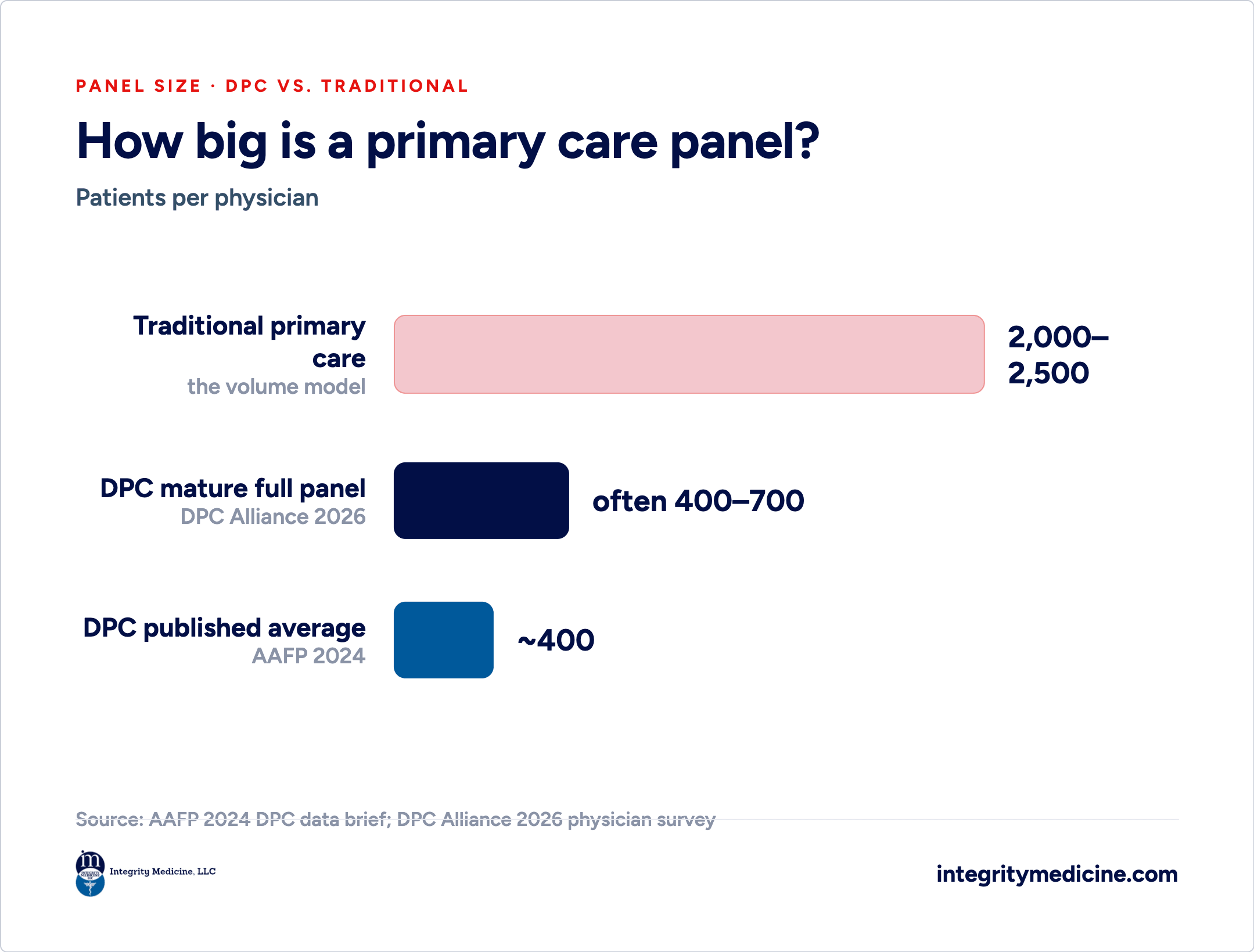
Published national data puts the average Direct Primary Care panel near 400 patients, with mature full panels often clustering between 400 and 700. Traditional primary care commonly runs 2,000 to 2,500. The right Kansas number is the panel that still allows same-day access, unhurried visits, and, in practices that keep privileges, hospital continuity.
I am Dr. Robert Roeser. I founded Integrity Medicine in 2004 and converted the practice to pure Direct Primary Care in 2017, and we practice in Newton, next to Newton Medical Center, and in Andover.
The Newton and Andover clinics serve Harvey County, Butler County, and the surrounding South-Central Kansas communities. The 2017 conversion followed denials for radiology and specialist referrals, prior authorizations, step edits for medications, and waiting periods for labs, and that insurance friction is what a sustainable patient load has to stay free of.
Kansas physicians asking how many patients a Direct Primary Care doctor should see are usually sizing two things at once. They want a panel large enough to fund the work, and small enough that they can still see people the same day, sit with a complicated visit, answer email, and, if they care about full-spectrum medicine, round on their own hospitalized patients.
The sections below walk through the published benchmarks, what a clinic day actually looks like, and how membership math replaces visit volume. They also cover the Kansas variables national 600-patient articles skip, and how joining an existing group differs from filling a panel from zero.
Exact Integrity Medicine panel targets stay a conversation, not a published panel cap. If the reason for leaving employed practice is already clear, why Kansas physicians are choosing Direct Primary Care covers the motives, and the rest of this page covers load.
Physicians hear a single Direct Primary Care panel number repeated until it sounds like a rule: six hundred, sometimes 650, sometimes 400. The published record is a range, and the year of the survey matters.
A short primer on how Direct Primary Care works is useful if the membership model is still new. The American Academy of Family Physicians 2024 Direct Primary Care study puts the average panel near 400 patients; AAFP's own FAQ cites 402, and summaries of the same study cite 413.
The 2024 AAFP Direct Primary Care data brief is the source document behind the 400, 402, and 413 figures. 84% of respondents in that 2024 survey described their practice as full, 99% said they offer same-day appointments, and average weekly encounters sat at 41, with about 27 in the office and 11 as e-visits.
The 2026 DPC Alliance physician survey, drawn from 465 physician-owned practices, adds the missing distinction. Most respondents were still filling, and 68.4% said their panel was not yet full.
Among physicians who called the panel full, sizes clustered between 400 and 700. A smaller group considered themselves full under 200, often part-time or mixed with leadership work, and a few reported full panels above 1,000.
Older AAFP figures from 2018 sat lower on the current side and higher on the target side: average 345, target 596, only 17% at ideal size, and about 20 months to fill. Those 2018 figures describe a younger Direct Primary Care movement, not a Kansas capacity rule.
Traditional primary care is the contrast column. Employed family medicine and internal medicine panels of 2,000 to 2,500 remain the common published range, and many of those employed physicians see about 1% of the panel on a clinic day, which is 20 to 25 people, in 10- to 15-minute slots.
Integrity Medicine has already described the industry pattern on our Direct Primary Care vs concierge page. Direct Primary Care panels commonly run in the hundreds per physician, not the thousands, and concierge panels are often smaller still because the retainer is higher.
Integrity Medicine does not publish a per-physician panel cap.
| Factor | Typical employed primary care | Typical Direct Primary Care |
|---|---|---|
| Panel size | Often 2,000-2,500+ | Published averages near 400; mature full panels often 400-700 |
| Patients per clinic day | Commonly 20-25 | Often mid-single digits to low teens |
| Default visit length | 10-15 minutes | 30 minutes or longer |
| Weekly encounters | 80-100 visits is a common fee-for-service picture | AAFP 2024: about 41 encounters, mixing office and e-visits |
| Same-day access | Often weeks out | AAFP 2024: 99% of surveyed DPC practices |
| Revenue driver | RVUs, coding, visit volume | Membership panel and monthly fees |
| Hospital work | Varies; many roles are outpatient only | Possible when the practice keeps medical staff privileges |
The comparison table is directional. Individual Direct Primary Care results move with specialty mix, employer contracts, part-time status, and whether the physician still rounds.

Panel size and daily volume are related, but they are not the same measurement. Patient load is the roster, and DPC patients per day is how many people on that roster actually need a physician on a given clinic day.
The old 1% rule of thumb says a physician sees about 1% of the panel on a given clinic day, so 2,500 patients is 25 visits and 600 patients is 6. Real clinic days scatter around those marks, because Monday is not Thursday, flu season is not July, and email now resolves work that used to require a billed slot.
In the 2024 AAFP Direct Primary Care study the average week held 41 encounters, most of them in the office and a sizable share as an electronic visit. Forty-one mixed encounters is a different shape than 20 to 25 face-to-face slots stacked back to back.
At Integrity Medicine the day is built around time, not throughput. I make nearly all of my own appointments, default bookings run 30 minutes, and those visits expand when the person in front of me needs more.
One morning I reserved an hour for a stressed businessman and the visit ran an hour and fifteen minutes. He needed a physician who could stay in the room.
Most Integrity Medicine patients check in and never sit down. Staff have run competitions to see how many people we can take back before a chair gets used, and that culture only works when the book is not stuffed the way an RVU schedule is stuffed.
Communication at Integrity Medicine is structured on purpose. Non-emergent questions, refills, and scheduling travel by email and get an answer within 24 hours. For true emergencies, patients call 911 first, then call their doctor so the doctor can work with the emergency team if necessary.
The practice phone also receives hospital ICU and ER pages, so unstructured text anytime access is not the model. Some Direct Primary Care clinics that promised unlimited texting ended up seeing almost no one in the office, and that pattern is a panel design problem.
Integrity Medicine is fast, but the panel still has to leave room for both the 4:58 p.m. laceration and the visit that needs an hour.
AAFP's own answer to how many patients you need to sustain a Direct Primary Care practice is the honest one. The average panel in the 2024 data brief sits near 400, and the membership count that actually pays the bills depends on target income, rent, staffing, and what the practice charges.
Membership replaces coding volume. Patients or employers pay a flat monthly fee, and revenue follows the panel, not the number of notes dropped that afternoon.
National adult memberships in AAFP's 2024 brief commonly fall between $50 and $100 a month. Integrity Medicine publishes age-based rates on our pricing page: $30 for children through 17 with a paid adult, $60 for adults 18 to 44, $80 for ages 45 to 64, and $100 for patients 65 and older.
Employer memberships run $60 per adult per month and $30 per child, for groups from about 5 employees to about 150.
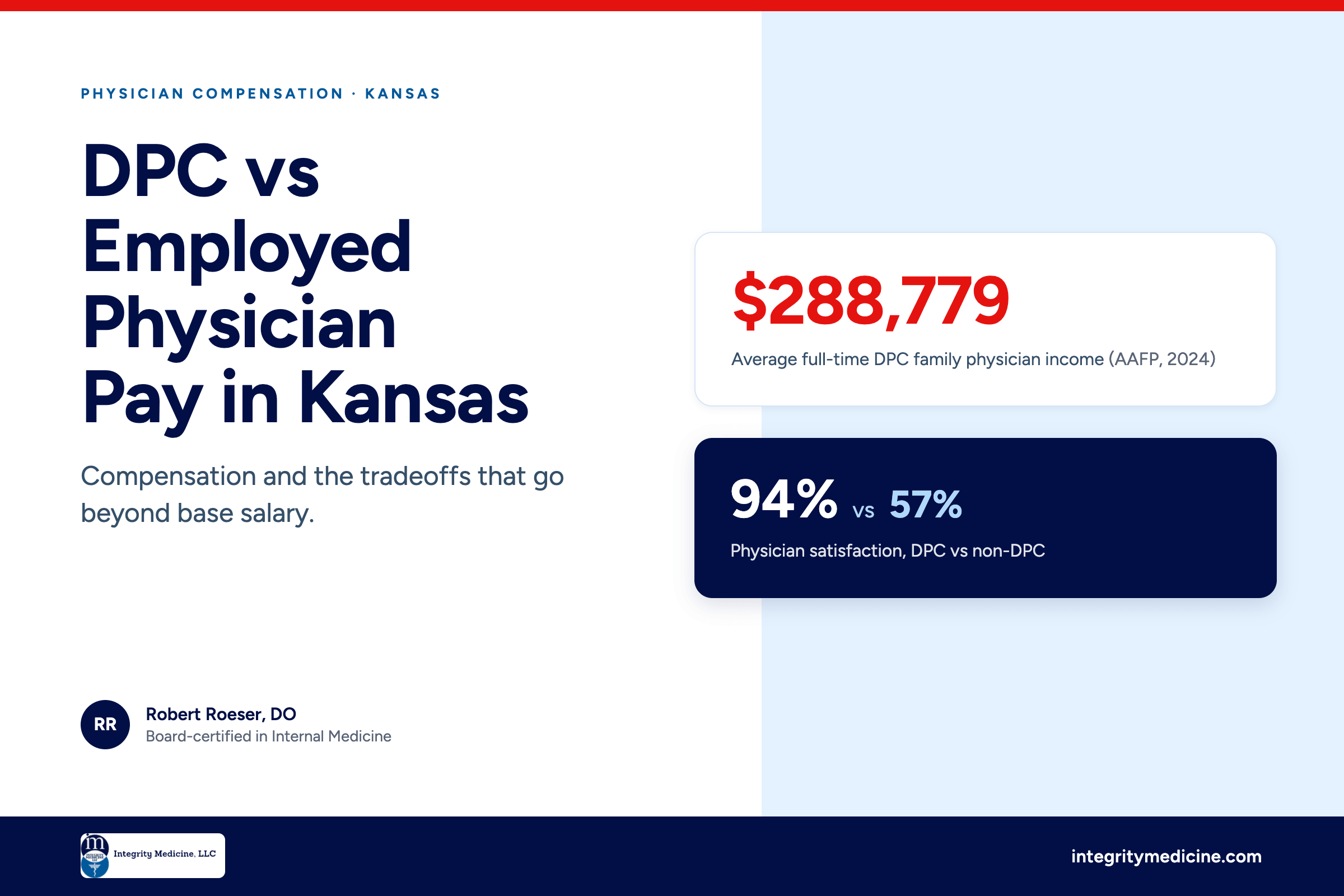
The AAFP Career Benchmark Dashboard reported an average full-time income of $288,779 for family physicians in Direct Primary Care settings in 2024. That figure is a national benchmark across employed Direct Primary Care and owner arrangements, and it is not an Integrity Medicine salary.
Integrity Medicine does not publish individual physician compensation. Pay and the rest of the tradeoff live in the companion piece on DPC versus employed physician pay in Kansas.
Two Kansas facts change how fast a Direct Primary Care panel can fill. Employer contracts and multi-generational family groups can add members in batches instead of one household at a time, and the 2026 DPC Alliance survey found employer partnerships among the faster paths for practices still building.
Integrity Medicine already runs that employer book. Details sit on the Kansas business owners page.
A physician who joins an existing multi-site practice also does not have to personally recruit a full panel before the model works. Older AAFP-based summaries put average time to a full panel near 20 to 21 months for practices starting from scratch, and joining Integrity Medicine in Newton or Andover skips that solo ramp.
The join a DPC or open one article covers those two paths.
Over 85% of Integrity Medicine patients still carry insurance for hospitals, specialists, and major procedures. The membership removes insurance from primary care, and Direct Primary Care does not require an uninsured panel to work.

Hospital continuity changes Direct Primary Care panel math in Kansas. National panel articles treat the model as an outpatient product, and that outpatient picture is incomplete at Integrity Medicine in Newton.
Integrity Medicine physicians keep active medical staff privileges at Newton Medical Center and continue to see our own hospitalized members. The Newton clinic sits at 715 Medical Center Drive, Suite 200, next to the hospital, and that adjacency is why clinic-plus-inpatient work stays realistic.
The full case is in Why We Still Round at Newton Medical Center. Physicians leaving a system who want to keep inpatient work should also read how to keep hospital work when you leave a health system.
Hospital days consume calendar space that a 2,500-patient employed clinic cannot spare. A smaller membership panel is what makes rounding compatible with same-day outpatient access, so if you drop hospital work out of Direct Primary Care the published right panel can creep upward, and if you keep it the panel has to protect clinic days and hospital days.
Distance also changes panel math at Integrity Medicine. Patients already drive from Harvey County, Butler County, Reno County, Marion County, and farther, and some of those visits resolve by email or a called-in prescription before anyone gets in the car.
Distance is a smaller constraint than the employed call tree those patients left. The Integrity Medicine panel still has to leave room for the people who do walk in.
Teaching medical students is another constraint on panel size. Mentoring fits when the book is not built on 15-minute slots, and it disappears when every hour has to produce a billable code.
Availability, communication, and excellence are the test Integrity Medicine uses. A panel that breaks any of those standards is too large, even if a spreadsheet says there is room for 50 more members.

At Integrity Medicine, full is a working limit on a Direct Primary Care panel. In the 2026 DPC Alliance data, full already meant different things to different physicians: some were full under 200, and most mature full panels sat between 400 and 700.
The 2024 AAFP data brief puts numbers on why a working limit matters for the doctor. 94% of Direct Primary Care physicians reported satisfaction with their practice, compared with 57% outside the model, and 49% reported no burnout at all, versus 14% of physicians not in Direct Primary Care.
Chasing 600 because a conference slide said 600 is how Direct Primary Care recreates the volume problem the model was built to leave. Integrity Medicine treats a panel as full when the promises below still hold.
Same-day access and next-day access still work at the practice, default visits still start at 30 minutes and can run longer, and physicians still book their own patients. Email still returns within 24 hours, and emergencies still reach a person, not a call tree.
Newton physicians at Integrity Medicine can still see their own patients at Newton Medical Center. Students can still sit in, and families can still split across doctors when that is the better fit.
Integrity Medicine is a multi-physician team. Internal Medicine and Family Medicine sit in the same practice, Newton and Andover share the model, and that structure is the practical answer for a Kansas physician who wants Direct Primary Care economics without building the entire book alone.
You can read more about our team. The day-to-day shift from employed practice, including who owns the appointment book, is covered in Direct Primary Care vs traditional practice for doctors.
If you want to see whether the practice's load and hospital work fit, contact us and say you are interested in physician opportunities. Compensation, panel design, and site fit belong in a conversation with Integrity Medicine.
Published national averages sit near 400 patients per Direct Primary Care physician in the AAFP 2024 study, and mature practices that call themselves full often report 400 to 700. There is no single panel cap; traditional primary care commonly carries 2,000 to 2,500, and individual panels move with part-time status, hospital work, pricing, and whether the physician is still filling.
AAFP's answer is that the average Direct Primary Care panel is about 400 and that viability depends on target salary, real estate, staffing, and membership price. A lean practice with employer contracts can sustain earlier than a solo office that is still renting space and recruiting household by household, and Integrity Medicine does not publish a break-even panel for new physicians.
Many Direct Primary Care physicians see mid-single digits to low teens in the office on a typical clinic day, plus electronic and phone encounters. The 2024 AAFP study averaged 41 encounters per week, mixing office visits and e-visits, which is a different day than 20 to 25 stacked 15-minute slots.
A 400 to 600 patient panel is enough when revenue comes from membership rather than fee-for-service billing, and national adult fees commonly fall between $50 and $100 a month. Integrity Medicine's published individual and employer rates sit in that band, and enough is the panel that funds the practice without breaking access, visit length, or hospital continuity.
Older AAFP-based summaries put average time to a full Direct Primary Care panel near 20 to 21 months for practices starting from scratch, and the 2026 DPC Alliance survey found 68.4% of respondents still filling. Employer groups and joining an existing multi-site practice shorten that ramp; solo launch from zero does not.
Some Kansas Direct Primary Care doctors still see hospital patients. Integrity Medicine physicians maintain medical staff privileges at Newton Medical Center and continue to care for their own admitted members, and the Newton clinic is adjacent to the hospital, so that work stays sustainable only when the outpatient panel is not built like an employed 2,500-patient list.
The useful question is what patient load still lets a Kansas physician practice medicine the way they claim they want to practice it. I converted Integrity Medicine in 2017 so hospital continuity, personal booking, 30-minute visits, and teaching could define the work instead of insurance rules defining it, and the panel has to serve that 2017 decision.
If the motives for leaving employed practice still need a fuller case, start with why Kansas physicians are choosing Direct Primary Care. If you are a Kansas physician testing the fit, use the contact page and say you are interested in physician opportunities in Newton or Andover.
Integrity Medicine can walk through load, hospital work, the existing patient base, and whether joining the practice is the right next step.