Newton: 316.283.6655
Andover: 316.202.9990
.jpg)
Newton: 316.283.6655
Andover: 316.202.9990
By Robert Roeser, DO, board-certified Internal Medicine physician
As a board-certified Internal Medicine physician, I converted Integrity Medicine to a pure Direct Primary Care model in 2017 after years of watching prior authorizations, denials for radiology or specialist referrals, step edits on medications, and 91-day lab timing rules delay care. Membership replaced fee-for-service billing for primary care at Integrity Medicine.
The switch to Direct Primary Care rewires the daily workflow, the purpose of documentation, who controls the calendar, and whether hospital work stays practical.
This article walks through the concrete differences a physician experiences when moving from traditional practice to Direct Primary Care, drawn from our practice in Newton and Andover, Kansas.
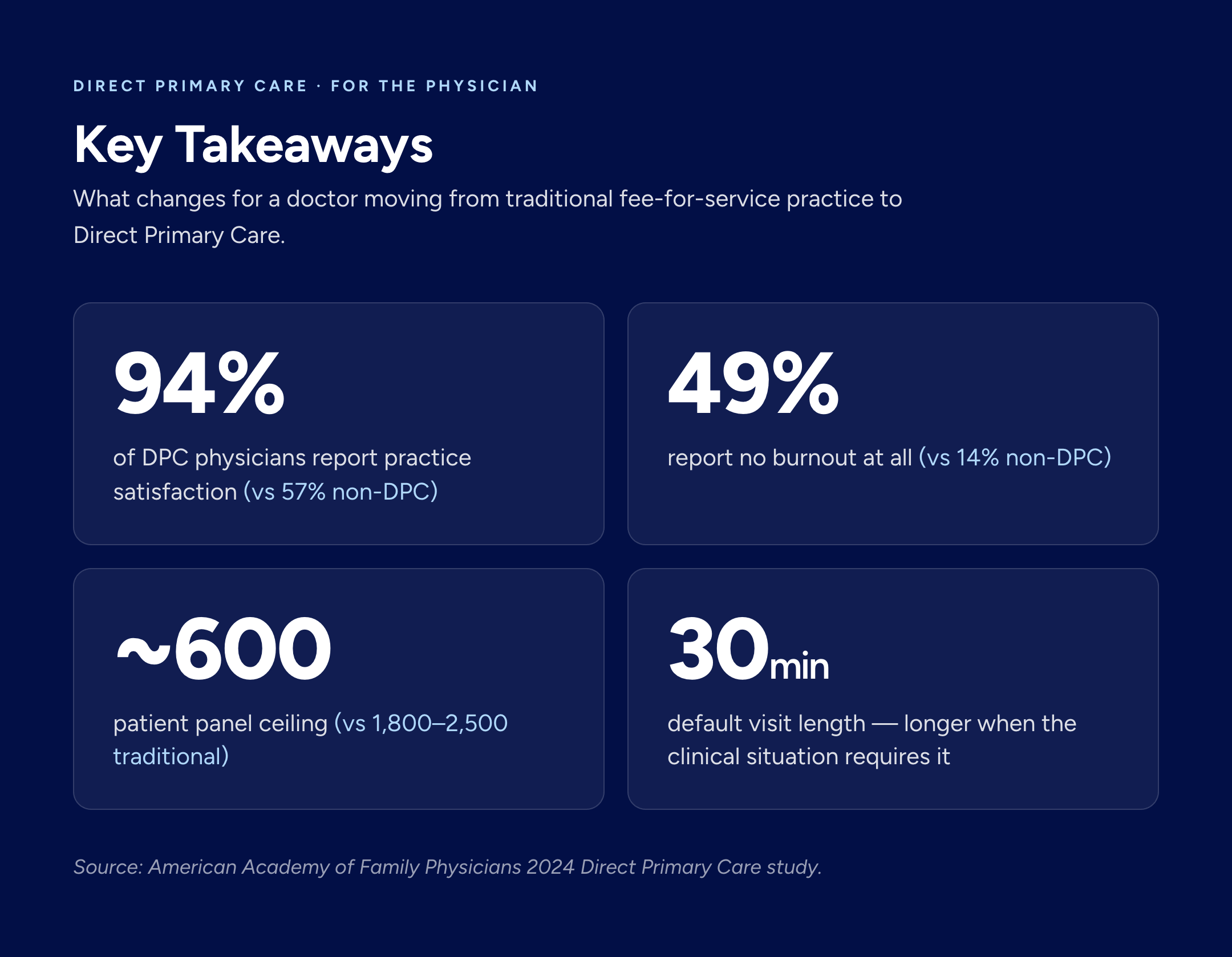
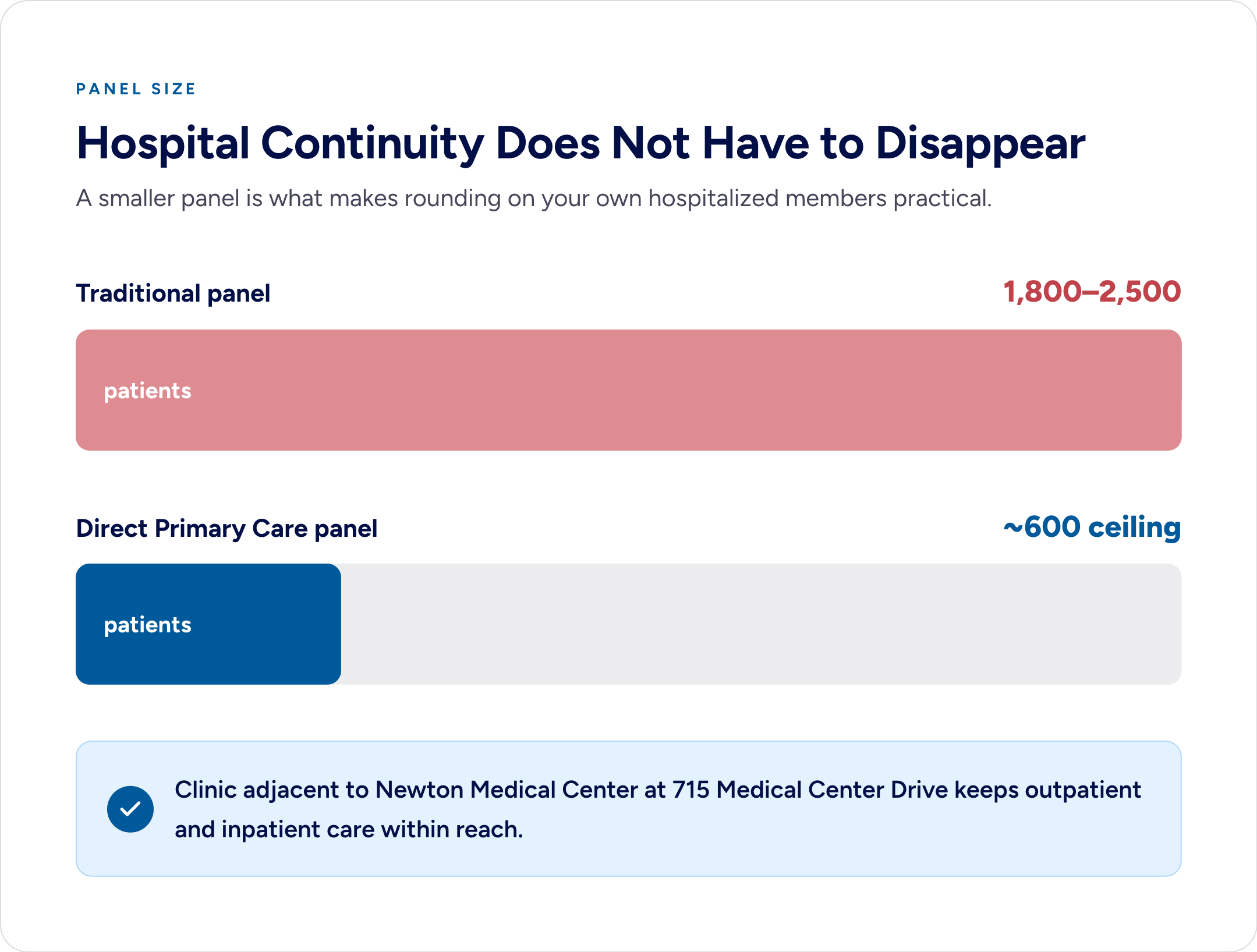
Industry panel-size ranges commonly cited for traditional practices run 1,800–2,500 patients. Direct Primary Care panels are typically far smaller. Exact numbers vary by practice. We keep our ceiling around 600 patients. For a deeper look at the total-rewards picture that includes compensation, see our comparison of DPC vs employed physician pay in Kansas.
If the day-to-day friction of traditional practice is already familiar, contact us to discuss how the Direct Primary Care model works for physicians.
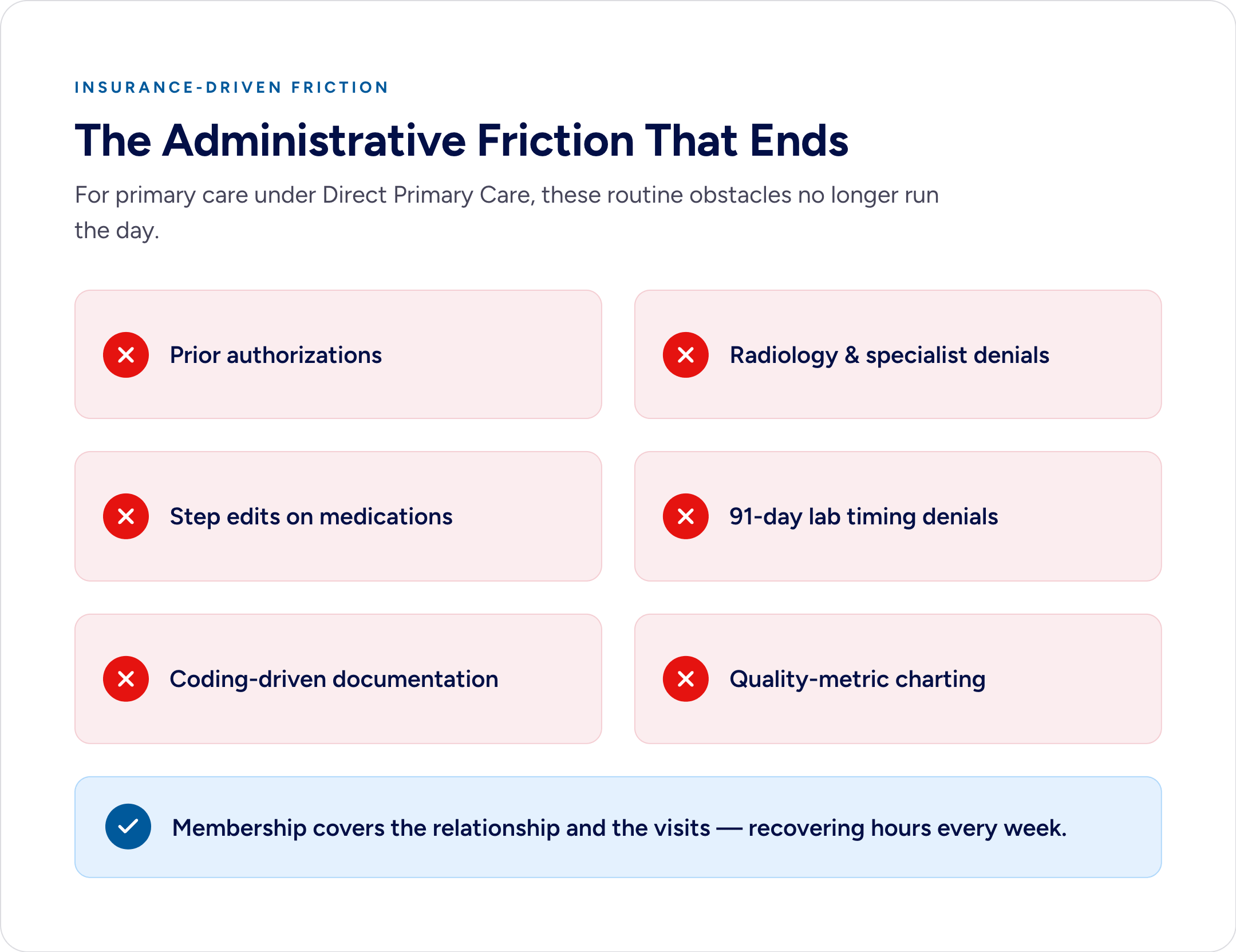
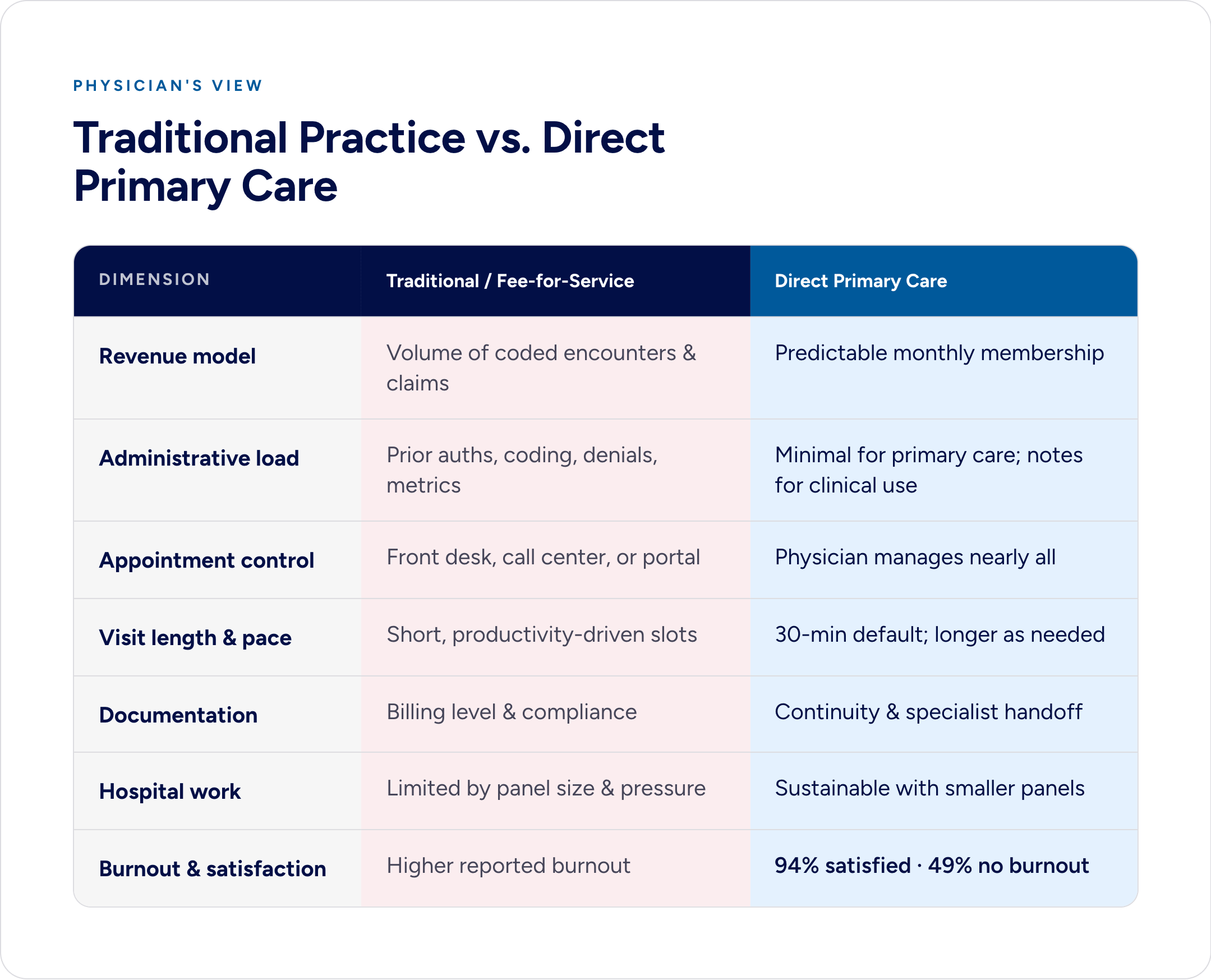
Traditional practice requires constant interaction with insurance rules. Radiology or specialist referrals trigger denials. Medications hit step edits. Labs ordered one day early under a 91-day rule get denied. Notes grow long because complexity codes drive payment.
In Direct Primary Care those primary-care frictions disappear. Membership covers the relationship and the visits. Prior authorizations and claims for routine primary care no longer consume the day.
Many insurance plans use timing rules that deny medically appropriate labs if they fall inside a 91-day window. The same logic applies to preventive screenings. Patients who need closer monitoring simply pay the cash price instead of waiting. You can see our transparent pricing for labs and membership.
We still coordinate imaging, specialists, and hospital care. Patients use their insurance for those pieces. More than 85% of our patients have insurance or a medical cost sharing product. The difference is that primary care itself is no longer filtered through the same administrative layer.
Documentation shifts as well. Notes are written for me and for the specialist who will eventually see the patient. They are not written to satisfy a coding algorithm or a quality metric that has little to do with the person in the room. That single change recovers hours every week.
We see this in conversion stories of many Kansas physicians who have examined the model. You can read more about the specific barriers that drove our 2017 switch in Why Kansas Physicians Are Choosing Direct Primary Care.
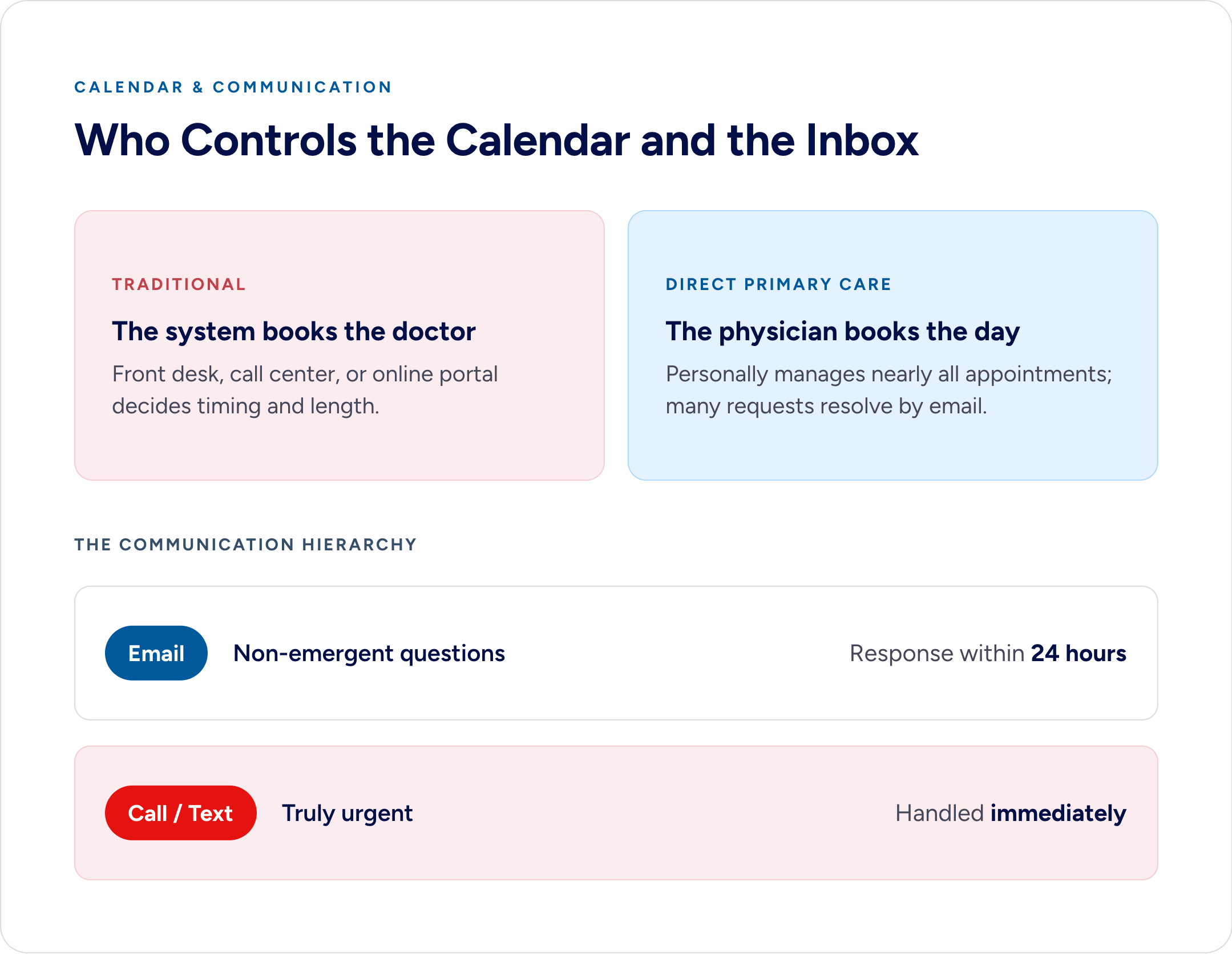
In traditional settings the schedule often belongs to the system. Patients book through a portal or front desk. The doctor is booked by someone else.
At Integrity Medicine I personally make nearly all of my appointments. The other physicians do the same. None of us did that in our prior practices. A patient emails a request. Often the question resolves by email without a visit. When a visit is needed, the timing and length fit the clinical need (that I determine) rather than a template.
We maintain a clear communication hierarchy. Non-emergent questions go to email and receive a response within 24 hours. True emergencies use call or text. This structure protects both patient care and the doctor’s ability to focus during visits. It avoids the text-anytime overload that turns some Direct Primary Care practices into full-time message triage.
Automated booking systems create the opposite problem. Patients do not always know what they need. A physician who personally reviews the request can often solve the issue without an appointment or can schedule the right kind of visit the first time. That control is one of the most practical day-to-day differences. If you want to explore how this works in practice, contact us about physician opportunities.
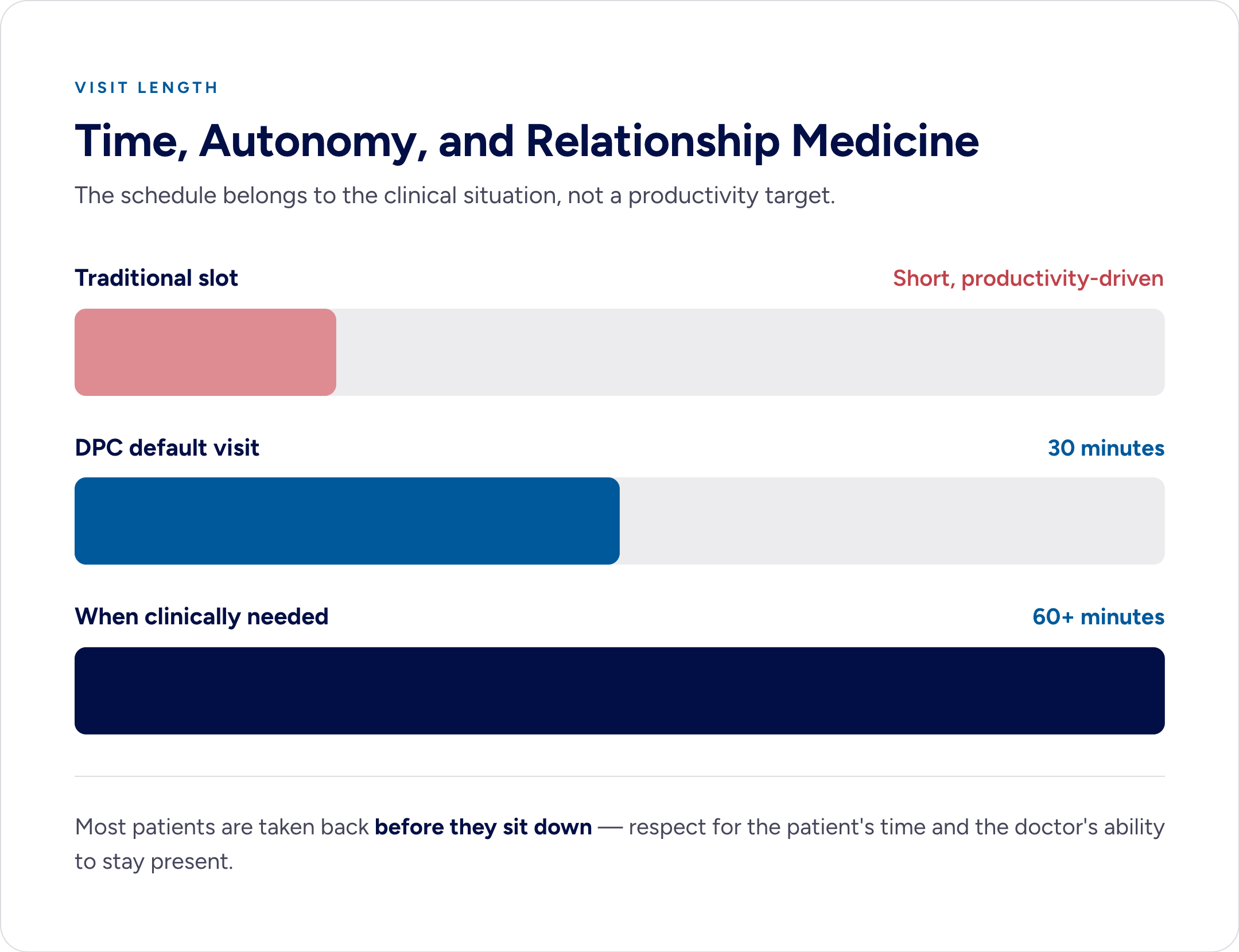
At Integrity Medicine, default visits run 30 minutes. When a stressed businessman thinks he needs an exam but actually needs a sounding board, the appointment can run an hour or longer. That kind of conversation is therapeutic and would not fit a traditional productivity model.
Clinical decisions stay with the physician. Visit length, follow-up timing, and treatment choices are no longer dictated by coding levels or prior-authorization algorithms. Notes are written for me and for the specialist who will eventually see the patient, not for an insurance algorithm.
The culture also changes the waiting room. Most patients check in and are taken back before they sit down. Our staff regularly run competitions to see how many patients can be seen without sitting down in the waiting room. The goal is not speed for its own sake. It is respect for the patient’s time and the doctor’s ability to stay present.
Relationship medicine returns because the volume pressure is gone. You can address multiple concerns in one visit. You can explain the mechanism behind a problem instead of matching a disease label to a drug category. This approach supports thorough chronic disease management without the usual barriers. Patients notice the difference. So do the physicians.
This is the practical side of restored autonomy. The schedule belongs to the clinical situation rather than a productivity target. The same design that supports same-day access also protects the physician’s ability to stay present. For more on why physicians make this shift, see Why Kansas Physicians Are Choosing Direct Primary Care.
Many physicians assume leaving a health system means giving up inpatient work. That assumption does not hold in every practice.
At Integrity Medicine we maintain active medical staff privileges at Newton Medical Center. The clinic sits adjacent at 715 Medical Center Drive Suite 200. Smaller panels make rounding on our own hospitalized members practical. The three Newton physicians see their own patients in the hospital. In our experience this level of continuity is uncommon among local practices.
The same smaller panel that enables longer outpatient visits also makes hospital work sustainable. You are not trying to manage a 2,000-patient panel while also covering inpatient care.
For a fuller discussion of how privileges and employment differ, see our related pieces on hospital continuity in Direct Primary Care and how to keep hospital work when you leave a health system.
Because the Newton clinic sits next to the hospital, moving between outpatient and inpatient care does not require long travel or complicated logistics. The design that keeps us available for acute needs in clinic also keeps us available when a member is admitted. Our multi-site presence also includes the Andover Direct Primary Care location.
This combination preserves full-spectrum practice for physicians who still find meaning in hospital medicine. It also creates natural opportunities to mentor medical students in real clinical settings.
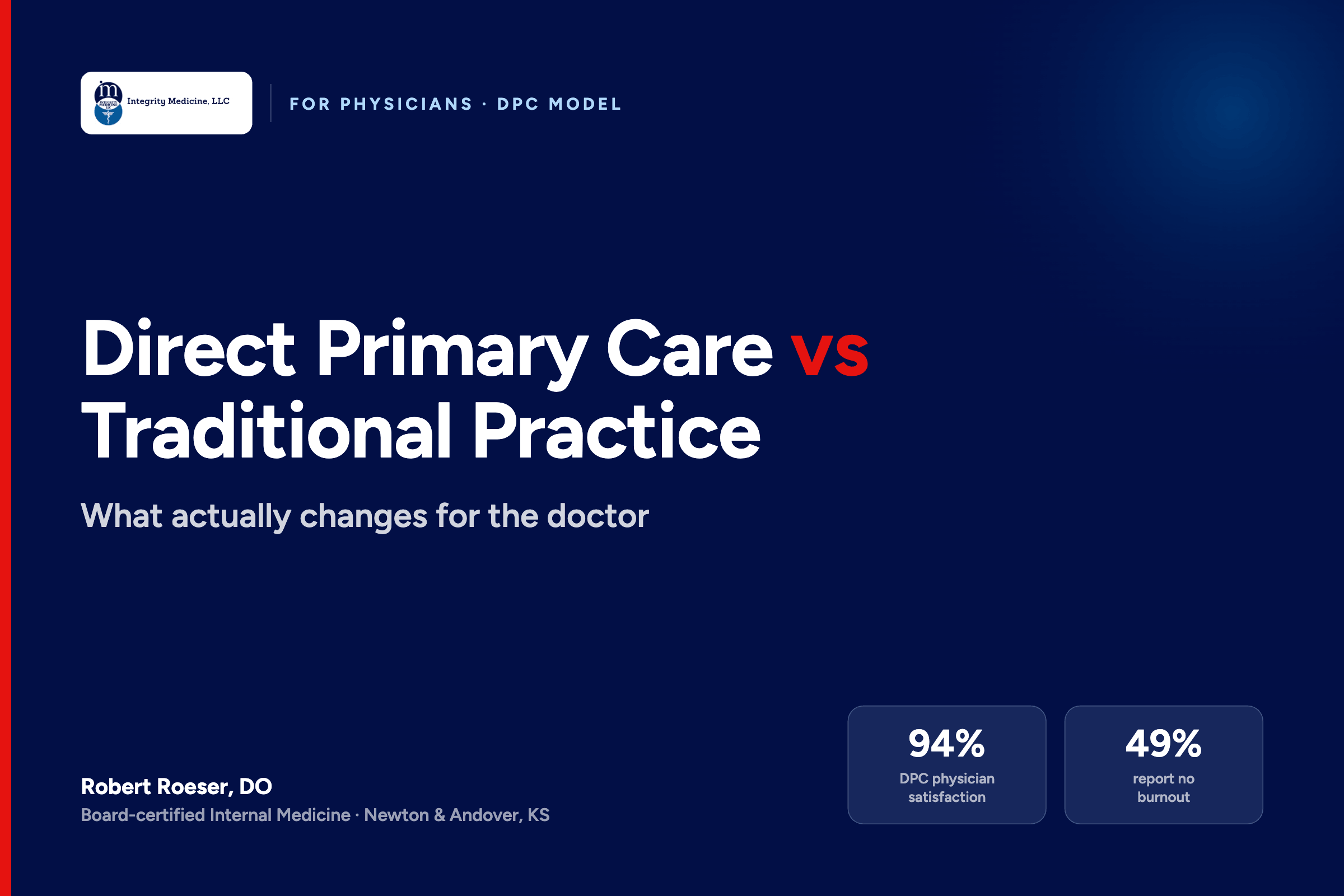
The American Academy of Family Physicians 2024 Direct Primary Care study provides useful context. 94% of physicians practicing in a Direct Primary Care model reported satisfaction with their overall practice, compared with 57% of physicians not in Direct Primary Care. 49% of Direct Primary Care physicians reported no burnout at all, versus 14% of non-Direct Primary Care physicians.
These figures do not claim that every Direct Primary Care practice is free of stress. They do show a consistent difference in how physicians experience each model. Reduced administrative load and restored clinical autonomy are the mechanisms most often cited. Additional context on compensation and practice metrics is available through the AAFP Career Benchmark Dashboard and the main AAFP Direct Primary Care resource.
The data matches what we see day to day at Integrity Medicine. When the administrative load drops, the work that remains feels closer to the medicine we trained to practice.
You can review the full 2024 AAFP Direct Primary Care data brief for the detailed findings.
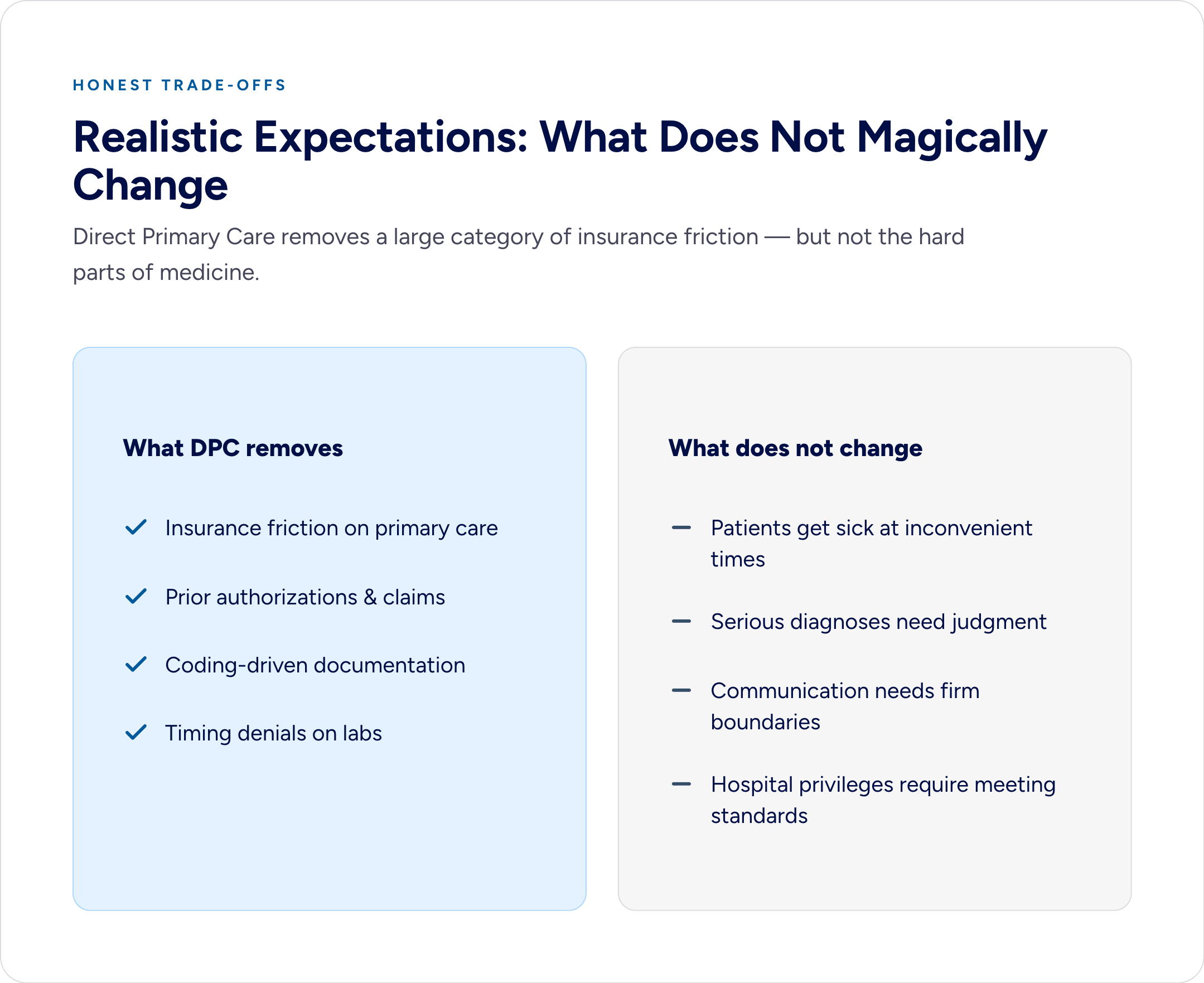
Direct Primary Care at Integrity Medicine removes a large category of insurance friction from primary care. It does not remove the hard days of medicine. Patients still get sick at inconvenient times. Serious diagnoses still require judgment and follow-through. Building or joining a practice still requires work.
At Integrity Medicine, communication must stay structured. An open text line without boundaries can recreate the very overload the model is meant to solve. Hospital privileges at Newton Medical Center still require meeting medical-staff standards.
Membership revenue is predictable once the panel is stable, but the early phase of any transition carries real financial and operational risk. The model works best for physicians who want to practice broad-scope primary care and are willing to own the relationship side of the practice.
This is simply a different set of trade-offs that restore control over the parts of the work that matter most.
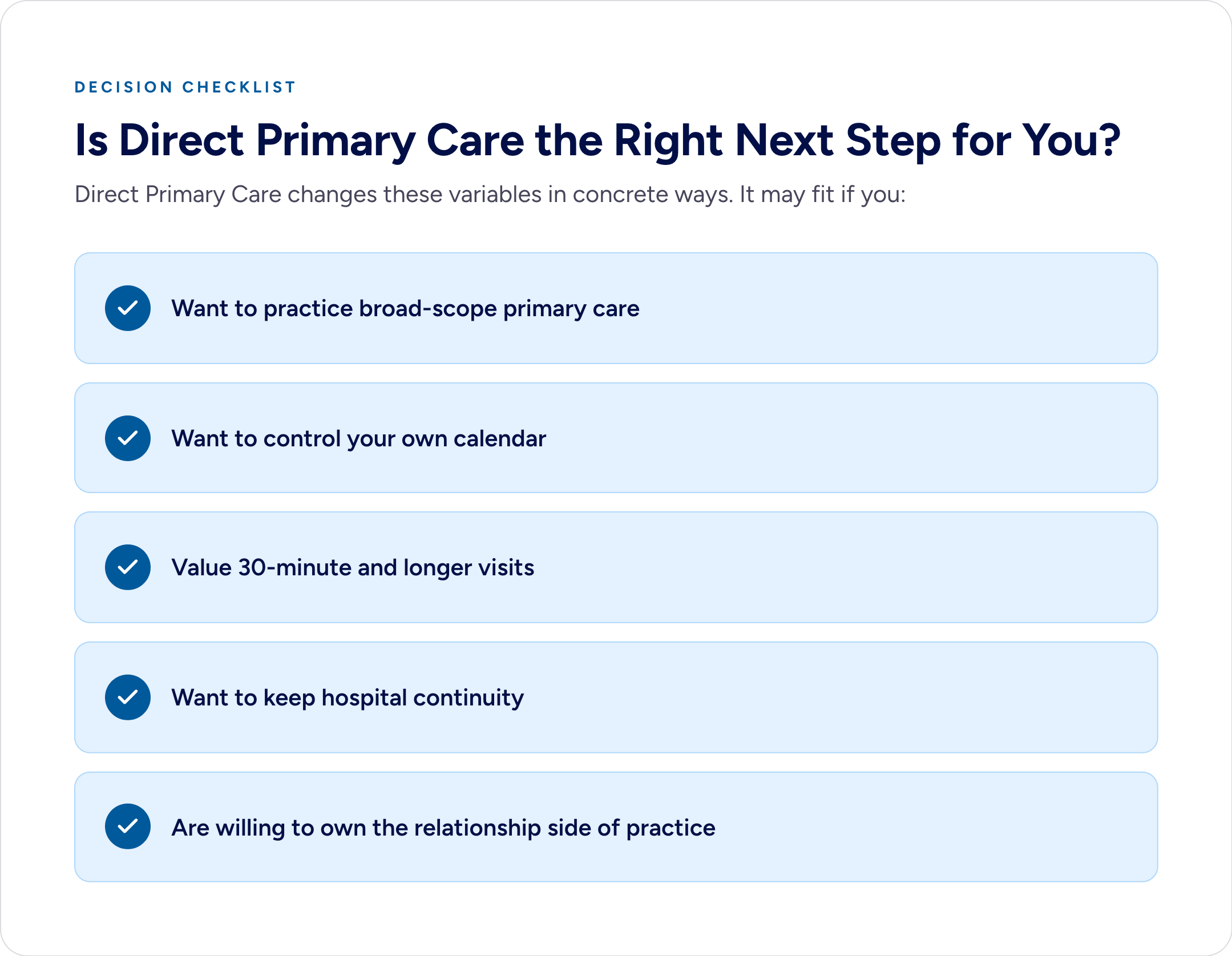
If the daily feel of traditional practice has become a problem (short slots, coding pressure, prior-authorization delays, loss of control over the schedule), Direct Primary Care changes those variables in concrete ways.
At Integrity Medicine we practice pure Direct Primary Care across Newton and Andover while retaining hospital continuity at Newton Medical Center. We also mentor and precept medical students. The multi-site structure and established patient base lower some of the risk that comes with starting a solo practice from scratch. You can learn more about the practice on our About page and my bio.
If you are exploring physician opportunities or simply want to understand the model from the inside, reach out. A conversation is the best way to see whether it's a good fit.
Contact us about physician opportunities
No. At Integrity Medicine, primary care visits and membership operate outside insurance billing. Imaging, specialists, hospital care, and many medications still involve the patient’s insurance. More than 85% of our patients carry insurance for those services.
Yes. Medical staff privileges are distinct from employment. At Integrity Medicine the physicians maintain privileges at Newton Medical Center and continue to care for their hospitalized members. Smaller panels and clinic proximity make this practical. See our full discussion of hospital continuity in Direct Primary Care.
Prior authorizations, claims, coding complexity, and timing denials for routine primary care largely disappear. Documentation shifts from billing-driven to clinical. Residual coordination for external services remains, but the volume and friction are substantially lower.
Control of the calendar and the purpose of the visit. The physician decides appointment timing and length. Notes serve continuity rather than coding. Conversations that require an hour become possible again.
No. Integrity Medicine operates as a multi-physician practice with locations in Newton and Andover. The model supports team-based pure Direct Primary Care while preserving individual clinical autonomy and hospital continuity. You can learn more about our Newton Direct Primary Care location, the Andover Direct Primary Care location, and the broader practice on the About page.