Newton: 316.283.6655
Andover: 316.202.9990
.jpg)
Newton: 316.283.6655
Andover: 316.202.9990
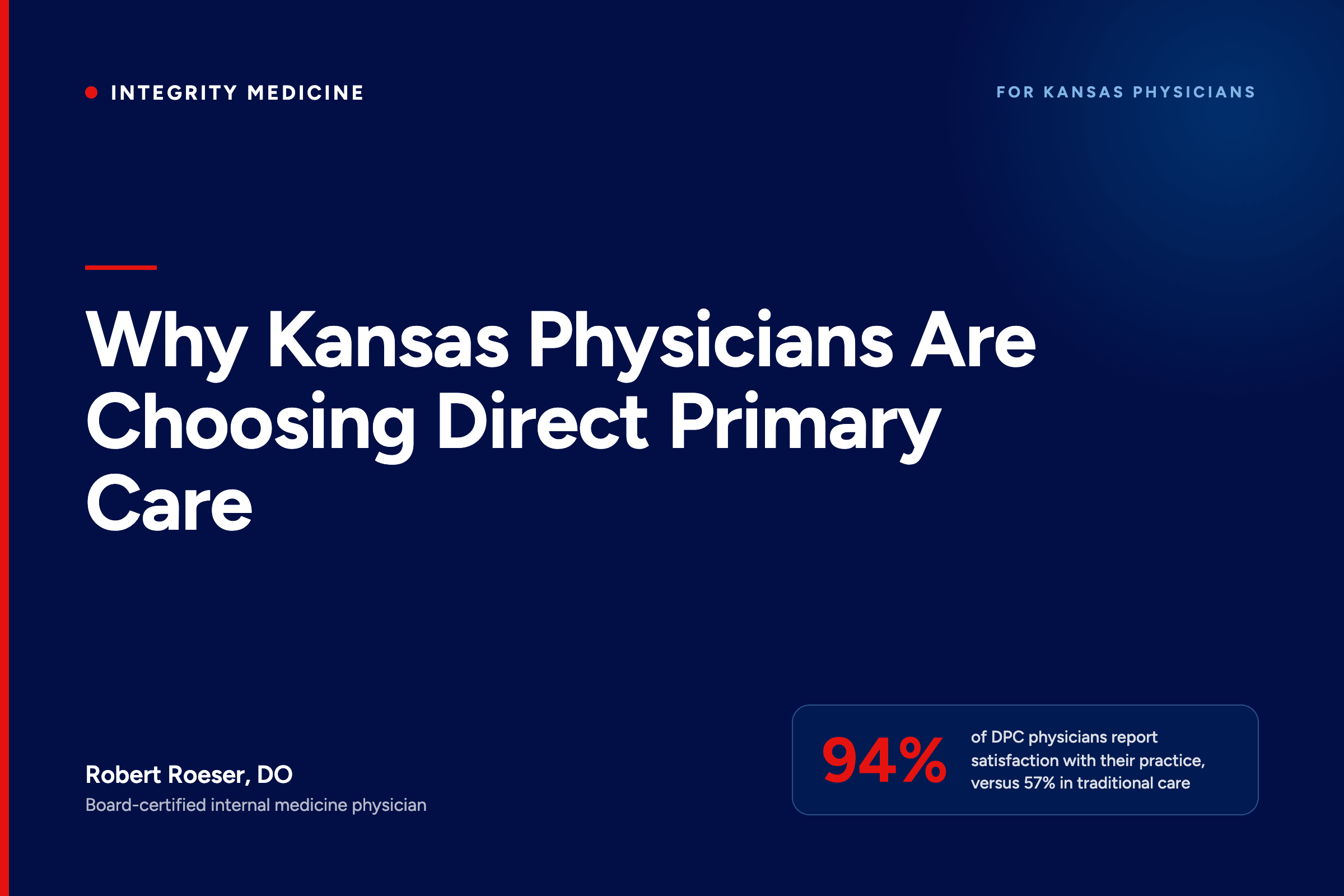
More primary care physicians in Kansas are looking hard at Direct Primary Care. The reasons stay consistent: clinical autonomy, far less time spent on insurance paperwork, and the chance to practice relationship-centered medicine again.
I made that shift in 2017 after years of watching government and insurance mandates delay the care patients needed. The switch came from watching denials for radiology and specialist referrals, prior authorizations, step edits for prescription medications, and waiting periods for labs interrupt care that should have been straightforward.
This article walks through the specific friction that prompted the change at Integrity Medicine, the autonomy and reduced administrative burden that followed, the data on physician satisfaction and burnout, the practical benefits for doctors, and the local advantages available in South-Central Kansas. If you are a physician considering the same path, it also shows how to explore opportunities here.
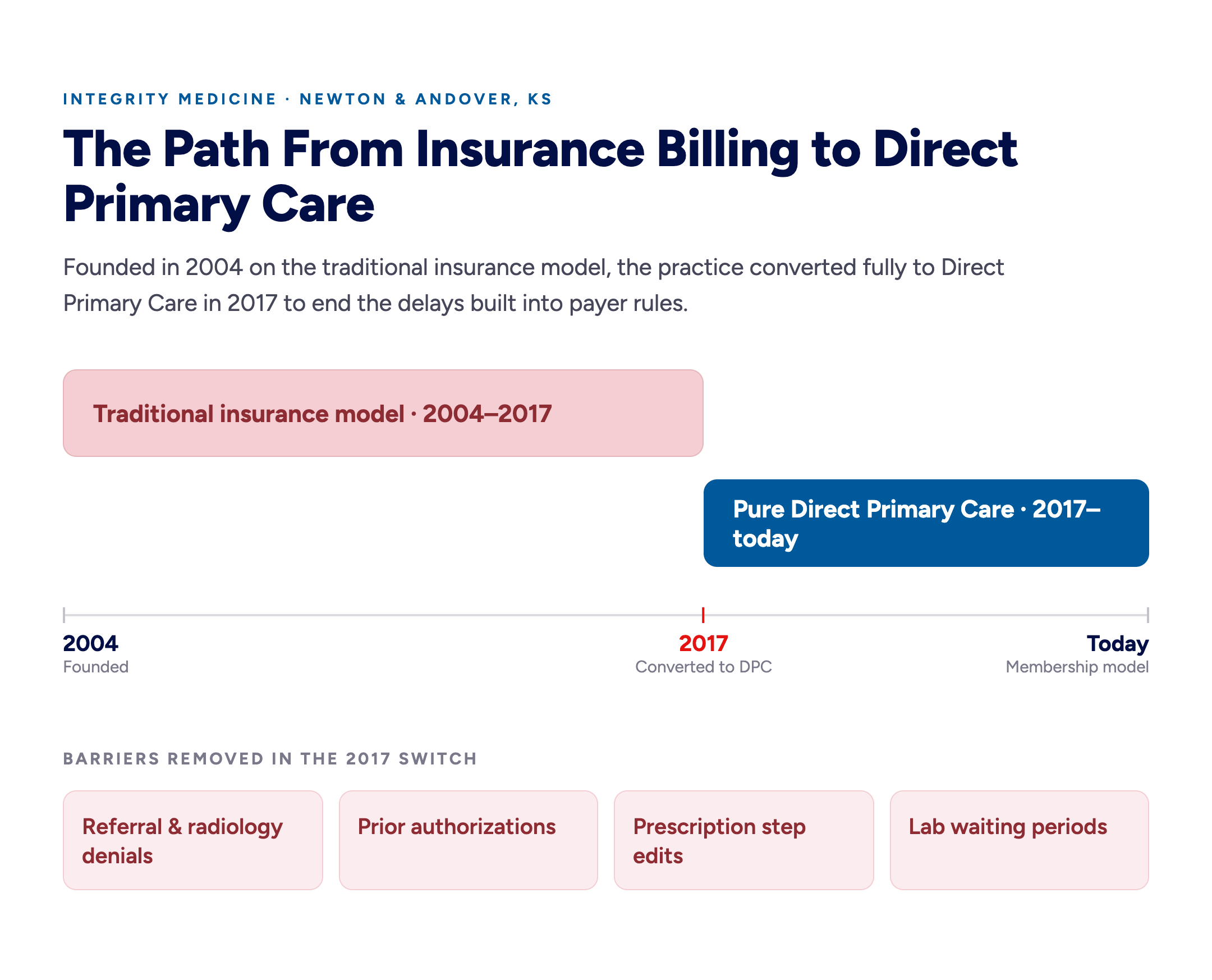
I founded Integrity Medicine in 2004 because I wanted to practice medicine with integrity rather than as an employee of impersonal corporate systems. For more than a decade Integrity Medicine operated under the traditional insurance model.
By 2017 the protocols and regulations had become a daily barrier at Integrity Medicine. Denials for radiology and specialist referrals, prior authorizations, step edits for prescription medications, and waiting periods for labs routinely delayed or blocked care that patients should have received without interference. Those same requirements turned physicians into intermediaries for insurance companies instead of diagnosticians focused on the person in front of them.
The delays were built into the insurance system. Every authorization and step edit added friction between the physician and the patient who needed help.
In 2017 Integrity Medicine converted fully to a pure Direct Primary Care model so those barriers could end. Membership replaced fee-for-service billing for primary care. The denials, prior authorizations, and lab waits that had defined daily practice became a thing of the past.
Patients at Integrity Medicine still use insurance or cost-sharing plans for hospitals, major procedures, and specialists. Over 85% of our patients carry some form of coverage. The membership simply removes the middleman from the primary care they use most.
That 2017 conversion restored the ability for physicians at Integrity Medicine to diagnose, treat, and coach patients without first checking a payer rulebook. It is the same reason many other Kansas physicians are now examining the Direct Primary Care model. You can read more about our founding story and team.
If the friction of traditional practice is already familiar, contact us to discuss how the Direct Primary Care model works for physicians.
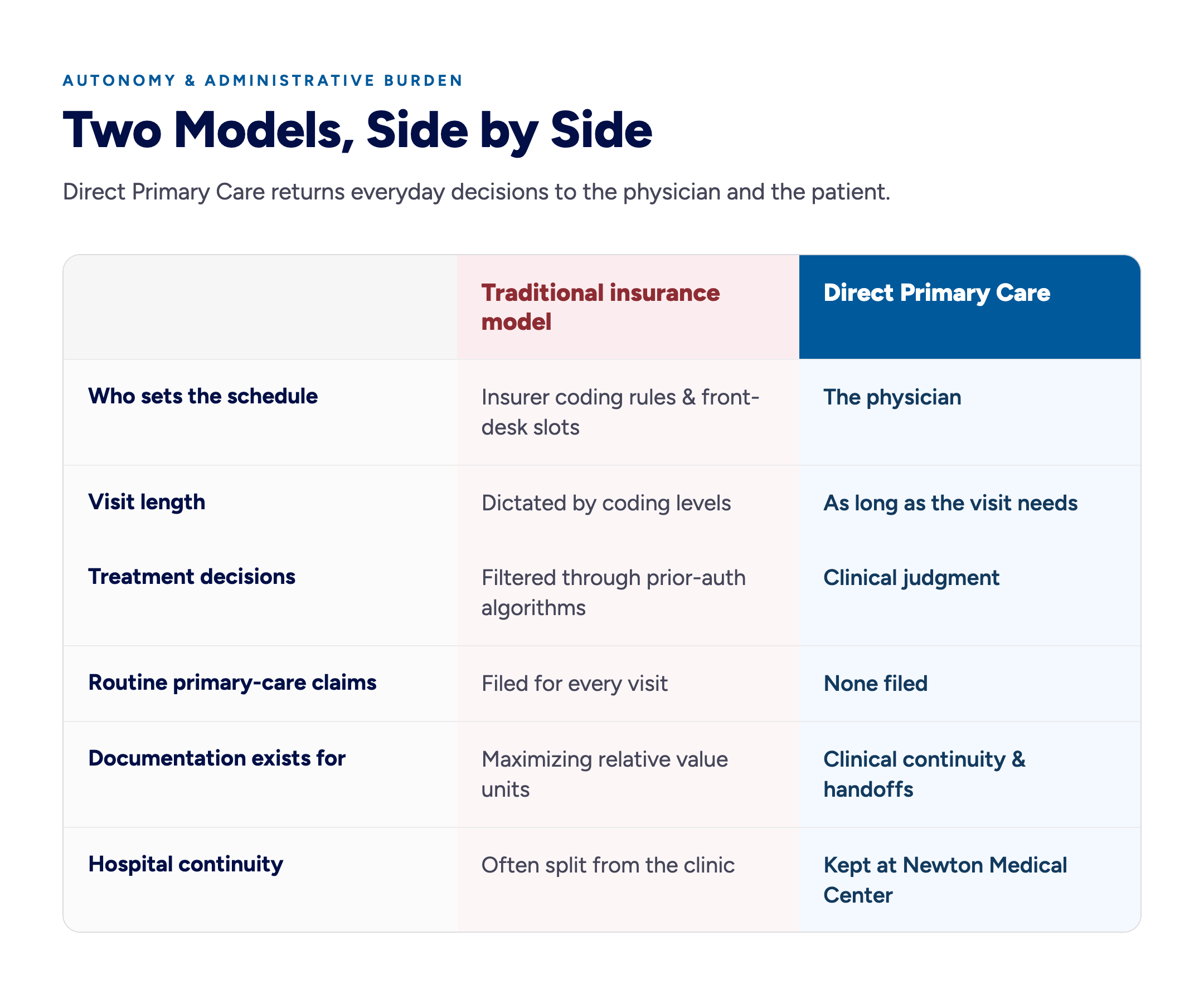
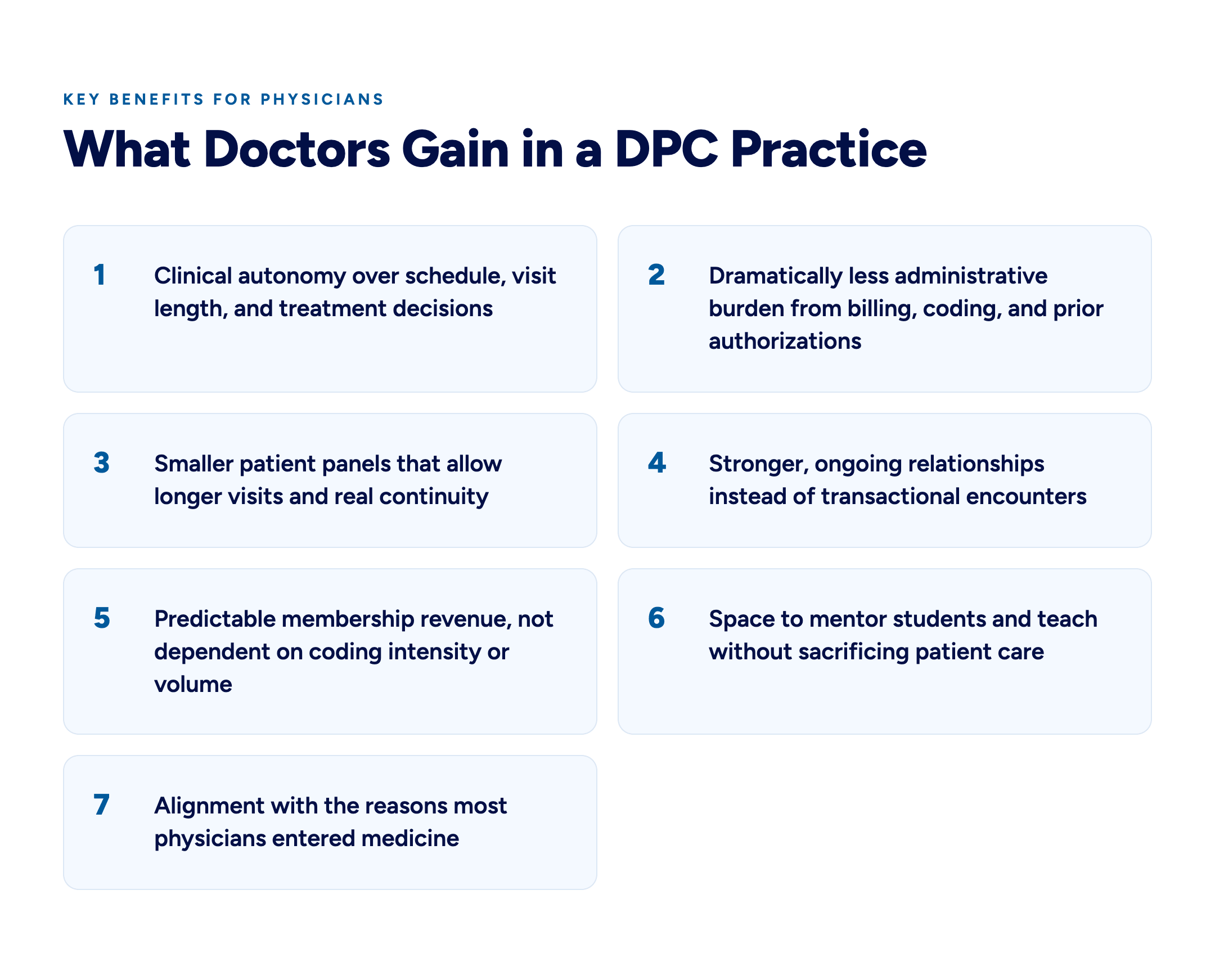
Direct Primary Care at Integrity Medicine returns clinical decision-making to the physician. Visit length, follow-up timing, and treatment choices are no longer dictated by coding levels or prior-authorization algorithms.
Administrative burden drops sharply at Integrity Medicine because the practice no longer files insurance claims for routine primary care services. Documentation exists for clinical continuity and specialist handoffs, not for maximizing relative value units. That change frees hours each week that used to disappear into forms, appeals, and inbox management.
The result is room for relationship-centered care. Visits last long enough to address multiple concerns, explain mechanisms, and coach patients through complicated conditions. I book most of my own appointments. Physicians at Integrity Medicine continue to see their own patients in the hospital at Newton Medical Center. Those continuities matter for both the doctor and the patient.
In the traditional insurance system I rarely controlled my own schedule. That single change removes layers of front-desk friction and keeps relationships direct.
Mentoring fits naturally into the Direct Primary Care structure at Integrity Medicine. I serve as a preceptor for medical students and participate in medical missions. The model leaves space for teaching the next generation of physicians without the volume pressure that makes precepting nearly impossible in high-panel traditional practices.
I love the interaction with patients and the opportunity to coach them through complicated medical issues. At Integrity Medicine we diagnose and treat patients who have these conditions. We treat the patients, not the labels. That philosophy is at the core of how we practice at Integrity Medicine.
This Direct Primary Care approach also supports same-day or next-day access when patients need it and ongoing chronic disease management without the usual barriers.
Physician burnout remains high across primary care. Administrative load, short visit slots, and the constant friction of third-party rules are among the most frequently cited drivers.
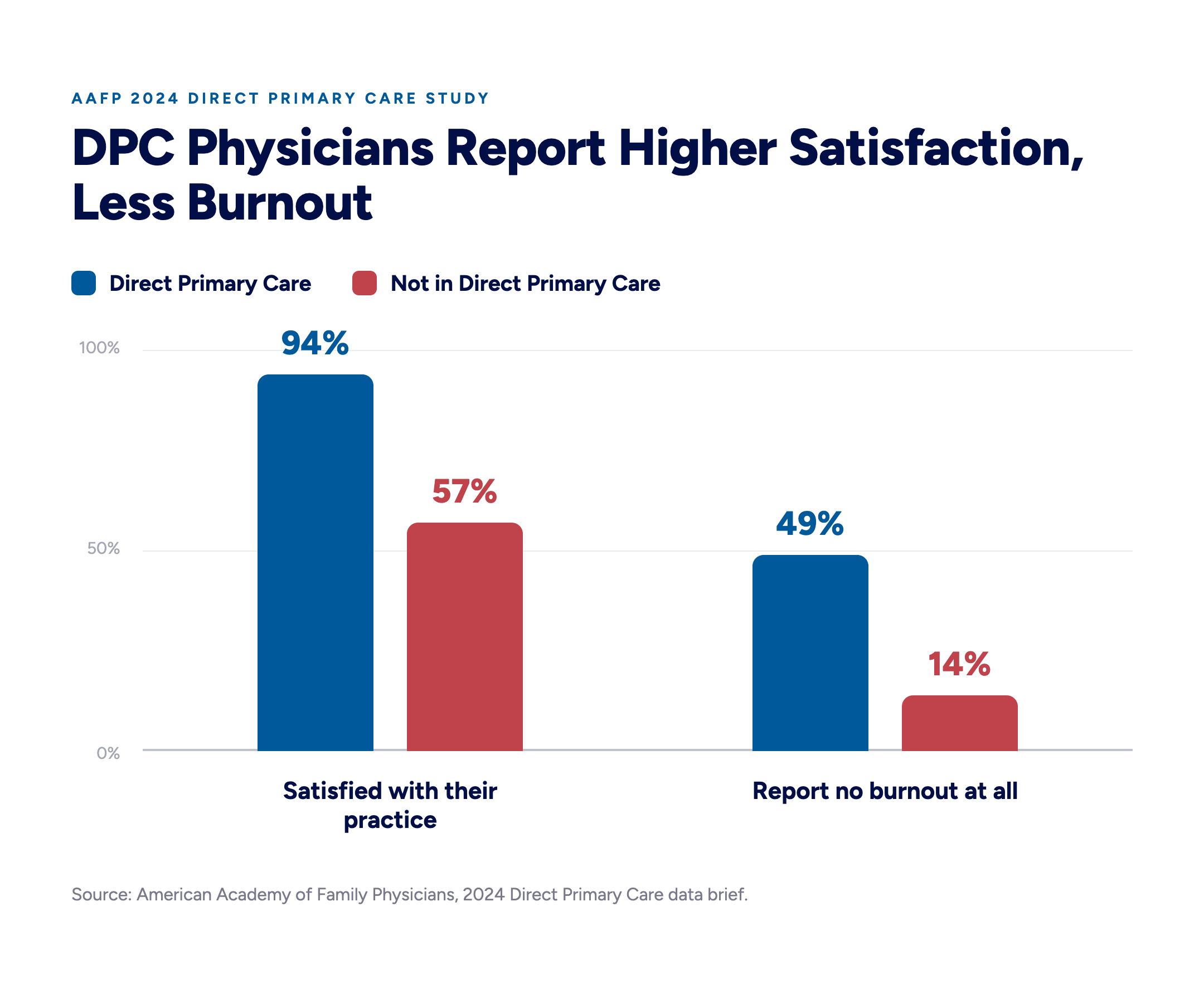
Data from the American Academy of Family Physicians 2024 Direct Primary Care study shows a clear contrast. 94% of physicians practicing in a Direct Primary Care model reported satisfaction with their overall practice, compared with 57% of physicians not in Direct Primary Care.
49% of Direct Primary Care physicians reported no burnout at all, versus 14% of non-Direct Primary Care physicians. Among those who did report burnout, the frequency was also lower in the Direct Primary Care group.
These figures from the American Academy of Family Physicians 2024 Direct Primary Care study do not claim that every Direct Primary Care practice is burnout-free. They show that the structural removal of insurance billing and prior-authorization volume correlates with substantially higher satisfaction and lower rates of burnout for the physicians who have made the switch.
In the experience of physicians at Integrity Medicine, the restored ability to spend time with patients and to practice medicine according to clinical judgment is the practical mechanism behind those figures.
The data matches what physicians at Integrity Medicine see day to day. When the administrative load drops, the work that remains feels closer to the medicine we trained to practice.
You can review the full 2024 AAFP Direct Primary Care data brief for the detailed findings.
Physicians who move to the Direct Primary Care model consistently describe several practical gains that explain the benefits of Direct Primary Care for physicians.
The membership structure at Integrity Medicine also creates a stable patient base. Because over 85% of patients at Integrity Medicine keep insurance for larger needs, the panel is not limited to the uninsured or underinsured. Families, employers, and individuals with high-deductible plans all use the Direct Primary Care model for the primary care they need most often. You can see the current transparent membership pricing that supports this predictability.
This combination of autonomy and relationship-centered care is what draws many Kansas physicians to explore the Direct Primary Care model. It is also why the benefits of Direct Primary Care for physicians keep coming up in conversations with colleagues who are tired of the traditional insurance system.
The reduced administrative burden shows up in daily work. When prior authorizations and step edits disappear from the daily workflow at a Direct Primary Care practice such as Integrity Medicine, the time that used to go into appeals returns to clinical work and teaching. That shift is one of the most practical reasons physicians switch. If you are ready to explore whether the Direct Primary Care model fits, contact us to discuss physician opportunities.
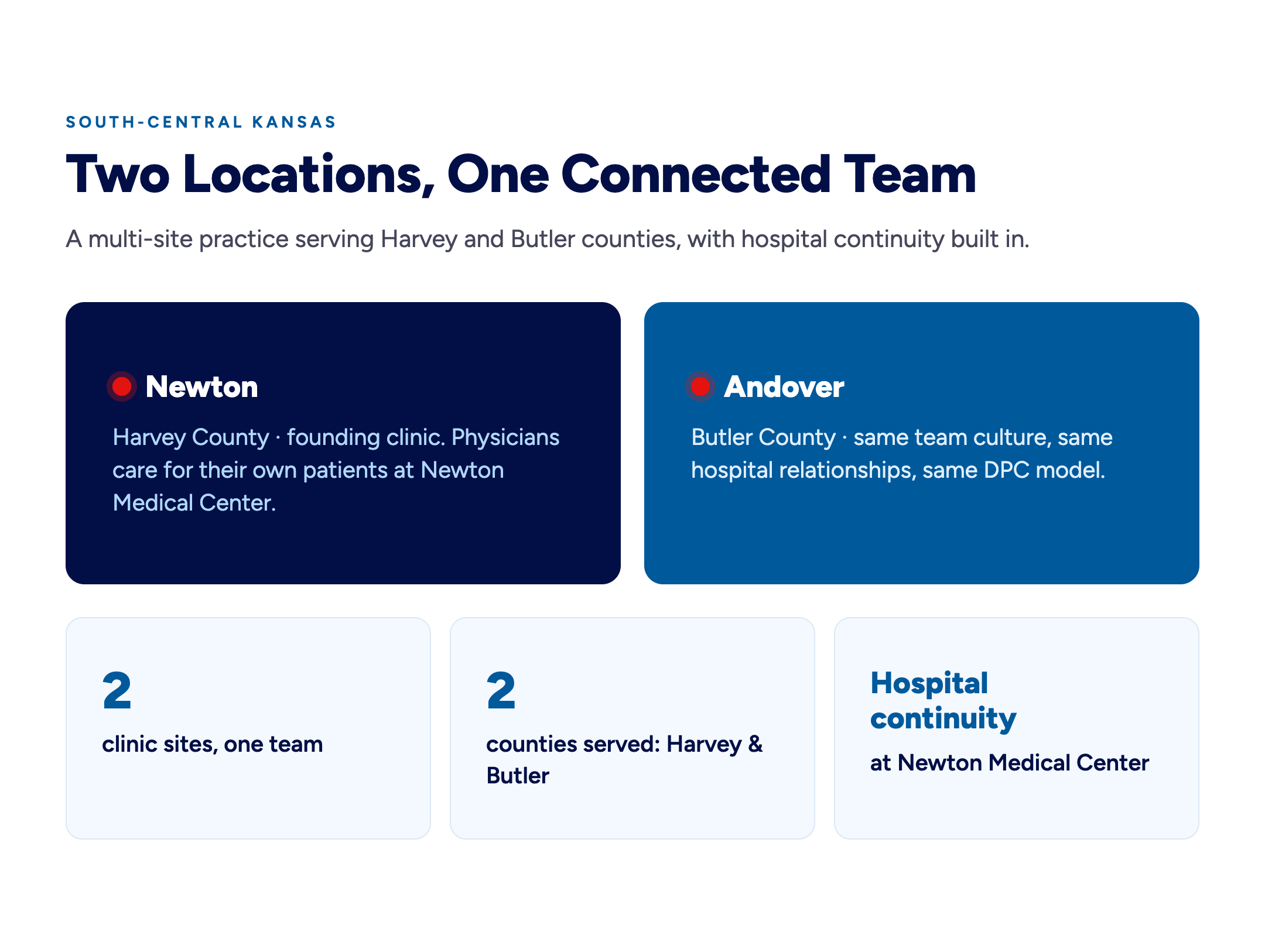
Location and structure matter when evaluating a Direct Primary Care practice. Integrity Medicine operates two sites: Newton and Andover. That multi-site presence at Integrity Medicine serves Harvey County, Butler County, and surrounding communities without forcing a single-location constraint.
Hospital continuity is built in at Integrity Medicine. Physicians at Integrity Medicine are members of the medical staff at Newton Medical Center and continue to care for their own patients when they are admitted. That connection is uncommon in many pure outpatient Direct Primary Care models and preserves the full-spectrum experience many Internal Medicine and Family Medicine physicians value.
For a physician who still wants to care for patients in the hospital, this matters. The clinic and the inpatient work stay connected rather than split between separate systems.
The patient base at Integrity Medicine is established and stable. Mentoring medical students is already part of the culture. The practice has grown through patient referrals and word of mouth rather than high-volume advertising, which reinforces a culture focused on availability, communication, and excellence.
Integrity Medicine has even hired physicians based on recommendations from our own patients. That process tells you something about the relationships that form when panels stay manageable and communication stays open. The team at Integrity Medicine includes physicians such as Dr. Leah Inman, who brings additional Internal Medicine depth to the practice.
These local factors at Integrity Medicine give Kansas physicians a concrete path that does not require building a panel from zero or operating in isolation. You can see how the Direct Primary Care model works day to day on our Newton Direct Primary Care and Andover Direct Primary Care pages. For families evaluating options in the region, we also outline the practical criteria in our guides to the best Direct Primary Care in Harvey County and the best Direct Primary Care in Butler County.
Interest in Direct Primary Care continues to grow among primary care physicians looking for a sustainable way to practice. Some open independent practices. Others prefer to join an established multi-site group that already has systems, a patient base, and hospital relationships in place.
Integrity Medicine is one such option in South-Central Kansas. Physicians who join Integrity Medicine work inside a pure Direct Primary Care model with clinical autonomy, reduced administrative load from the elimination of insurance billing for routine care, existing locations in Newton and Andover, an established culture, and the ability to continue hospital work at Newton Medical Center.
The multi-site setup at Integrity Medicine means a physician can practice in Newton or Andover while still participating in the same team culture and hospital relationships. That structure lowers the risk that comes with starting a solo practice from scratch. See our Andover location for more on the Butler County side.
If you are a physician exploring this path, the next step is a direct conversation. Reach out through our contact page and let us know you are interested in physician opportunities at Integrity Medicine. We can discuss how the Direct Primary Care model works day to day, the local advantages of the Newton and Andover sites, and whether the fit is right for both sides.
Kansas physicians are choosing Direct Primary Care because it restores clinical autonomy, removes the administrative friction of insurance denials, prior authorizations, step edits, and lab waits that drives burnout, and makes relationship-centered care possible again. The 2017 conversion at Integrity Medicine was driven by those specific insurance barriers that delayed care. The same barriers still exist in traditional practices.
According to the American Academy of Family Physicians 2024 Direct Primary Care study, 94% of Direct Primary Care physicians report satisfaction with their practice versus 57% of non-Direct Primary Care physicians, and 49% report no burnout versus 14%. The practical benefits for physicians—autonomy, reduced administrative burden, smaller panels, stronger relationships, and mentoring space—combined with the local advantages of multi-site presence in Newton and Andover plus hospital continuity at Newton Medical Center, all point in the same direction.
If you are ready to explore whether the Direct Primary Care model is the right next step for your career, start the conversation. Contact us to discuss physician opportunities in Direct Primary Care here in Kansas at Integrity Medicine.