Newton: 316.283.6655
Andover: 316.202.9990
.jpg)
Newton: 316.283.6655
Andover: 316.202.9990
Most families in Harvey County who start looking for better primary care already know the usual frustrations. Appointments booked weeks out. Rushed visits. Bills that arrive months later. Difficulty reaching the doctor between visits. Direct Primary Care changes that equation. The question is how to tell which practice actually delivers on the promise for Newton, Hesston, Halstead, and the surrounding communities.
This page lays out the practical criteria that matter most when evaluating Direct Primary Care in Harvey County. It shows what those criteria look like in daily operation at one Newton clinic, with specific examples of access speed, pricing, continuity, and local reach. You will leave knowing exactly what to measure and what questions to ask.
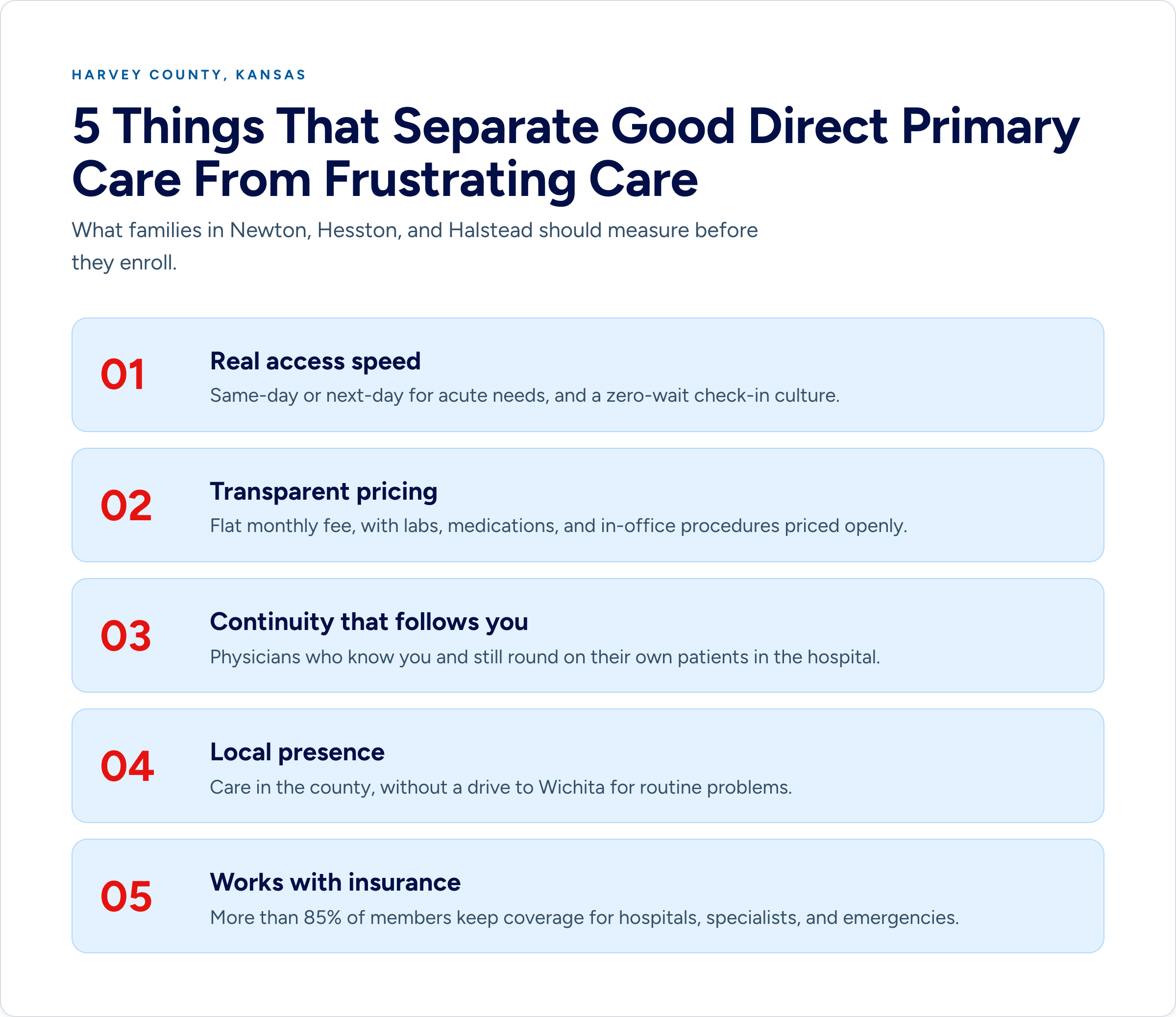
When patients in our area compare options, five factors consistently separate practices that work from those that frustrate:
Direct Primary Care is a membership model. Patients pay a flat monthly fee and receive unlimited primary care visits, direct communication with their physician, same-day or next-day appointments for acute needs, and cash pricing on labs and imaging that is often a fraction of insurance rates. No per-visit copays. No insurance billing for primary care.
The best practices in this model treat those features as non-negotiable rather than marketing claims. The rest of this page shows how each criterion plays out in real life at our Direct Primary Care clinic in Newton.
Most patients at our Newton clinic check in and never sit down. A staff member is already walking them back. We have run internal competitions to see how many patients we can see without a single person waiting in a chair. Default appointment length is thirty minutes. Visits run longer when the problem requires it.
I personally schedule nearly all of my appointments, and so do the other doctors here. Patients email or call with a concern. Often the issue resolves by message or a prescription called in or filled at the office without a visit. When an exam is needed, the slot opens the same day or the next.
One Friday afternoon a patient walked into the Newton clinic at 4:58 holding a hand full of blood. The assigned physician had already left for the day. I brought him back, cleaned the wound, numbed it, and closed the laceration. He left at 5:35. The visit was included in membership.
Another morning a patient texted about a wrist problem while I was still in early devotion. He needed to leave by 1 p.m. for a Royals game. I had our team send an X-ray order to Newton Medical Center within minutes. We reviewed the film the same day and he made the game. No office visit was required.
We want to be urgent care for our people. That is how the clinic runs. Friday afternoon lacerations close in thirty to forty-five minutes.
Teachers and nurses with impossible schedules get phone management and medications left in an exterior lockbox so they can pick them up after a shift. Distance is rarely the real bottleneck. Patients an hour away often resolve issues faster by direct communication than by navigating a closer clinic’s call tree.
The practice is really fast. It is not instant medicine. Clear communication rules keep the line open for real needs while protecting focus on the patient in the room. For more on how this compares when acute care is needed, see our guide to Direct Primary Care vs urgent care.
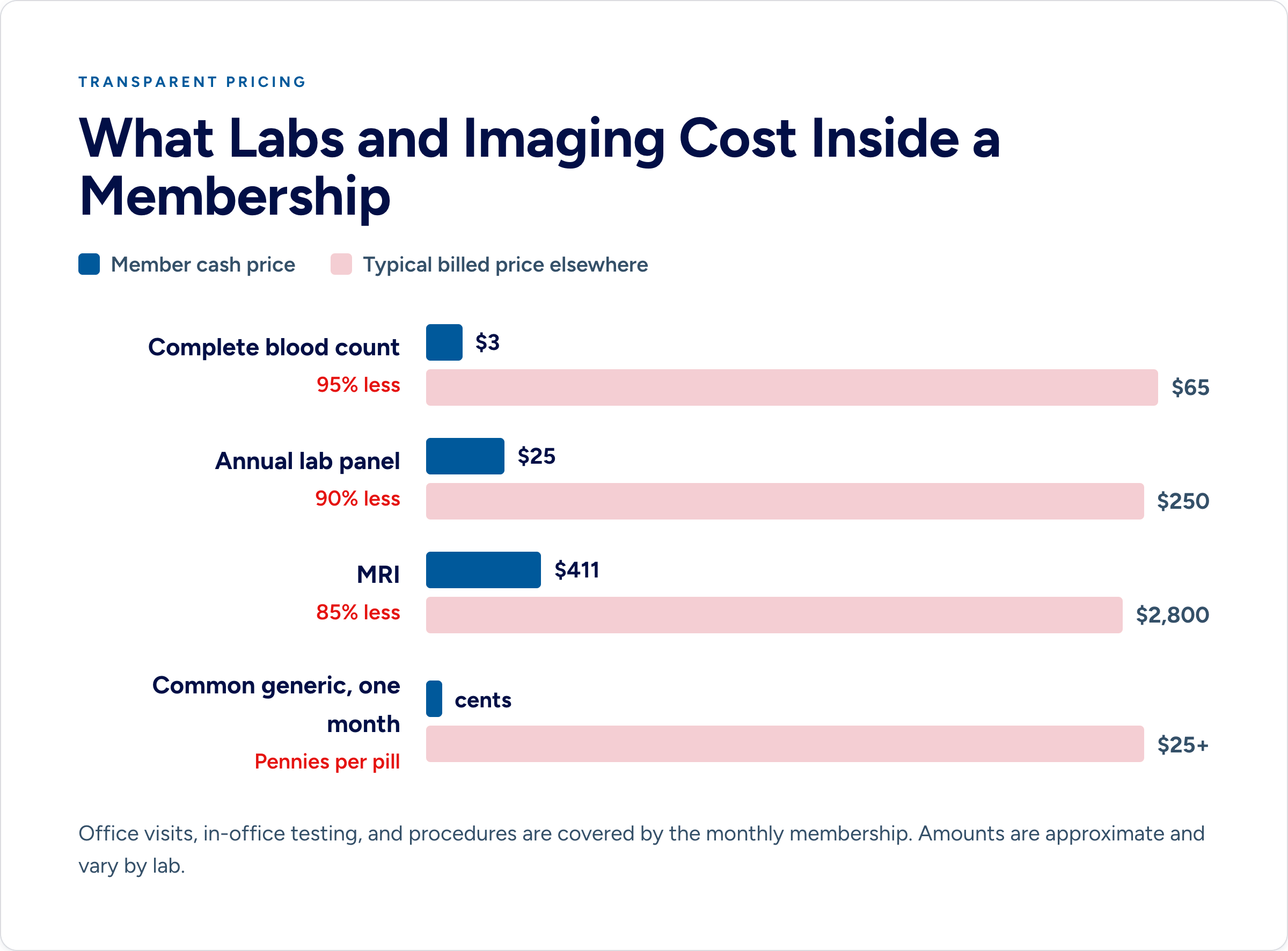
Membership covers the visits. There is no per-visit charge for the evaluation, the rapid test, or the conversation that prevents a second trip.
Specific cash prices patients encounter at Integrity Medicine:
You can review current membership pricing and the full list of included services on our pricing page.
Over eighty-five percent of our patients still carry insurance. They use it for radiology outside the clinic, specialist care, hospital stays, and true emergencies. They simply stop billing insurance for primary care visits. The result is fewer surprise bills and less friction when something acute appears.
People can walk in without a wallet or purse. Charges accumulate and auto-debit on the first of the month. Parents send teenagers alone knowing no money is required at the desk.
Many patients look only at the copay and conclude insurance covers care. The fuller math includes the monthly premium plus deductible. Direct Primary Care makes the primary care portion predictable so the insurance policy can do what it does best: protect against major expenses.
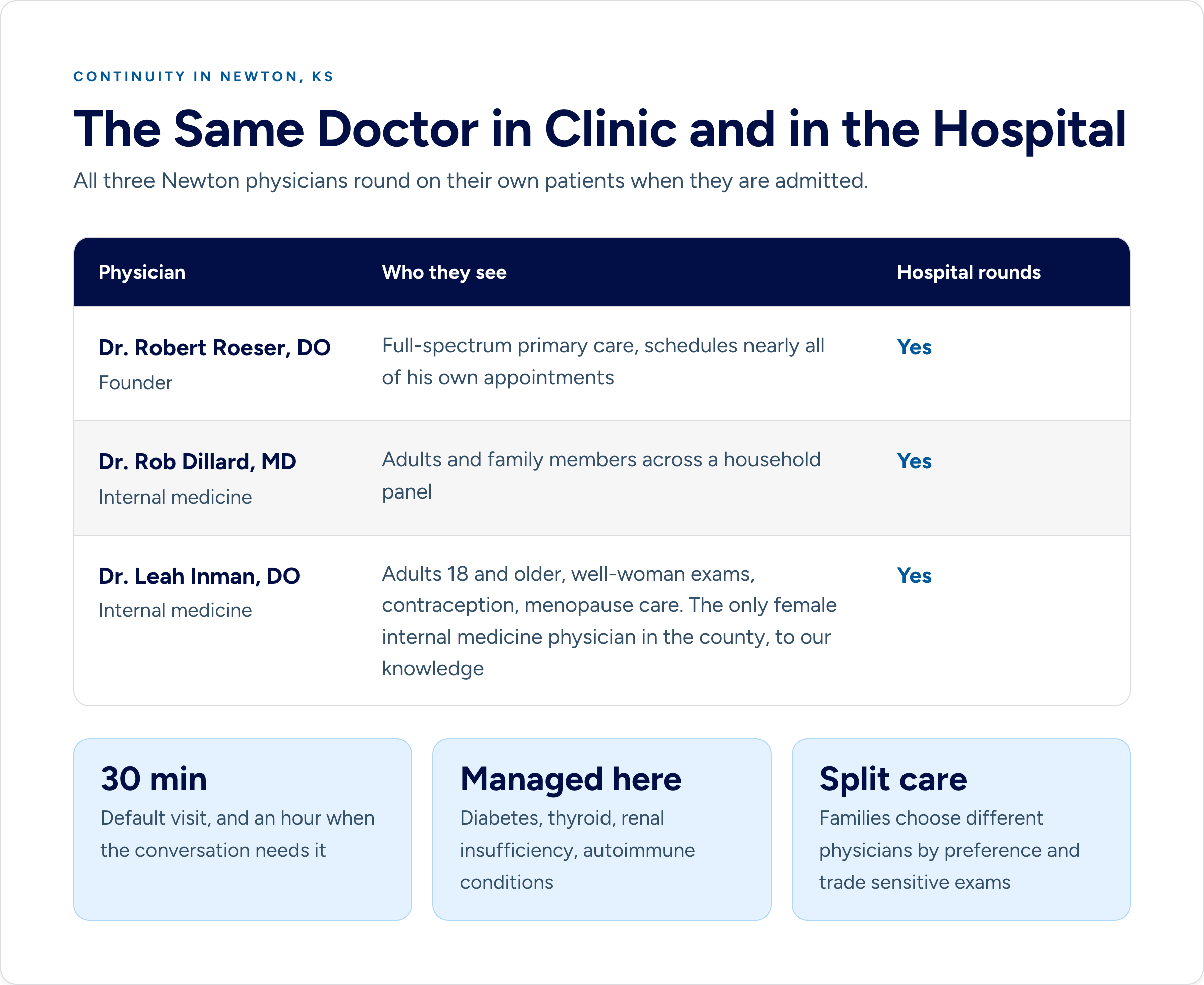
All three of us Newton physicians, myself (Dr. Robert Roeser, DO), Dr. Rob Dillard (MD), and Dr. Leah Inman (DO), round on our own patients in the hospital. In our experience, no other practice in town does this consistently. When a patient is admitted, the same doctor who knows the medication list, allergies, and baseline stays involved from the start.
Dr. Inman is the only female internal medicine physician in the county, to our knowledge. She sees adults eighteen and older and offers well-woman exams, contraception conversations, and menopause care. Families often split care across us: a mother and teenage daughter with Dr. Inman while the father and younger son see Dr. Dillard. We trade visits when a patient prefers a different gender for a sensitive exam.
Internal medicine doctors used to be called diagnosticians. The goal is to find the problem, complete the workup, and hand a specialist a patient whose evaluation is already finished. Newton lacks several specialists in-house. We manage many of those conditions locally: diabetes, thyroid, renal insufficiency, autoimmune issues. We do this rather than reflexively referring every complex problem out of town.
Appointments last long enough for the conversation. One recent visit with a stressed businessman was scheduled for an hour and ran seventy-five minutes. He did not need an exam. He needed a sounding board. That kind of unhurried relationship medicine is difficult under high-volume insurance panels.
Availability, communication, and excellence determine whether a practice can deliver. We aim to A.C.E. that test every day. Learn more about Dr. Leah Inman, Dr. Robert Roeser, and Dr. Rob Dillard. For ongoing conditions, see how we approach chronic disease management.
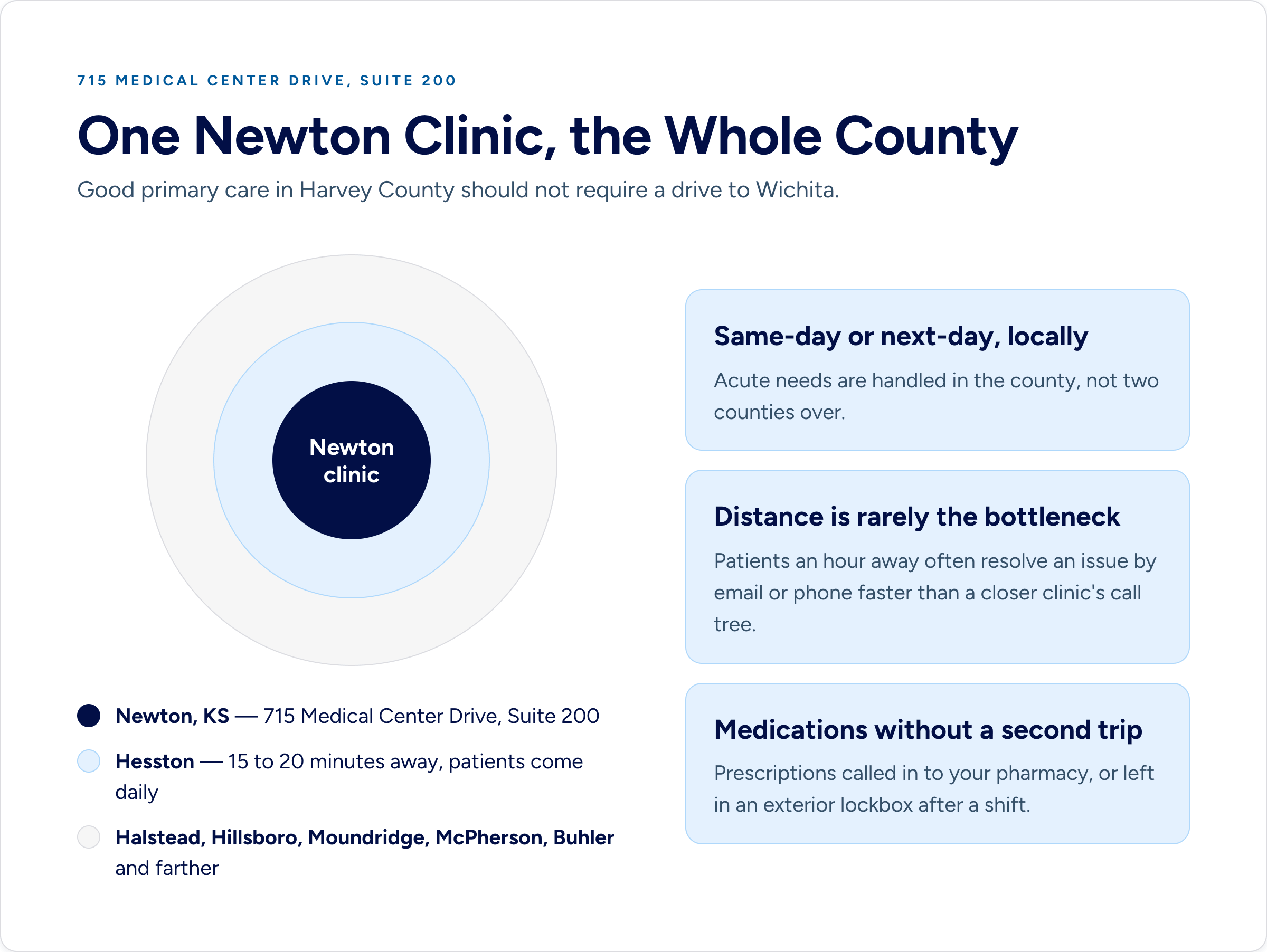
Our Newton Direct Primary Care clinic at 715 Medical Center Drive, Suite 200 sits in the middle of Harvey County. Patients come every day from Hesston, only fifteen to twenty minutes away. Regular patients also drive from Halstead, Hillsboro, Moundridge, McPherson, and farther. Families from Buhler and the surrounding communities form a meaningful part of our panel.
Good primary care in Newton, Hesston, or Halstead should not require a drive to Wichita. Same-day or next-day appointments and the doctor’s direct number stay local. For context on access challenges across the region, see our overview of primary care access in Butler and Harvey County.
Employer memberships run sixty dollars per employee per month regardless of age, with children at thirty dollars. Multi-generational families can use the same employer rate by treating themselves as a business group: shared account, auto-debit, and a minimum of five adults. Small construction firms, honey producers, churches, and mom-and-pop businesses with as few as five or six people already use the model.
Distance objections are common. The practical answer is that communication does not require a drive. Email resolution, phone triage, and pharmacy call-ins often finish the problem before the patient ever leaves the house.
Membership is simple. Choose the age-based plan, complete a short enrollment, and schedule a free meet-and-greet if desired. Once enrolled, patients email or call their physician directly for non-emergent needs and use text or phone for true urgency.
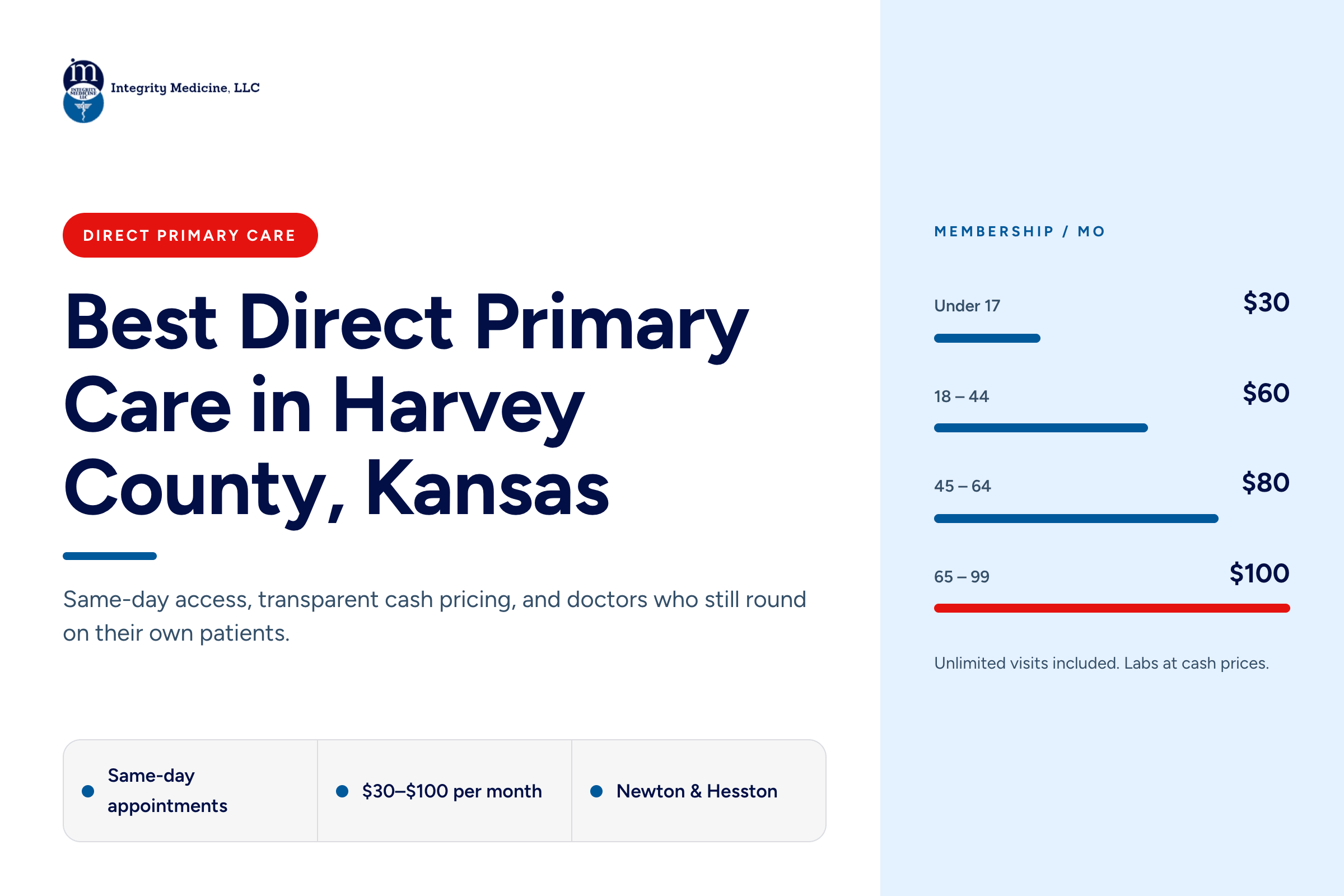
Membership starts at thirty dollars a month for dependent children under seventeen, sixty dollars for ages eighteen to forty-four, eighty dollars for forty-five to sixty-four, and one hundred dollars for sixty-five to ninety-nine. All in-office procedures, testing, and visits are included. Medications and labs are available at the cash rates listed earlier. Full details are on our pricing page.
The model works especially well for:
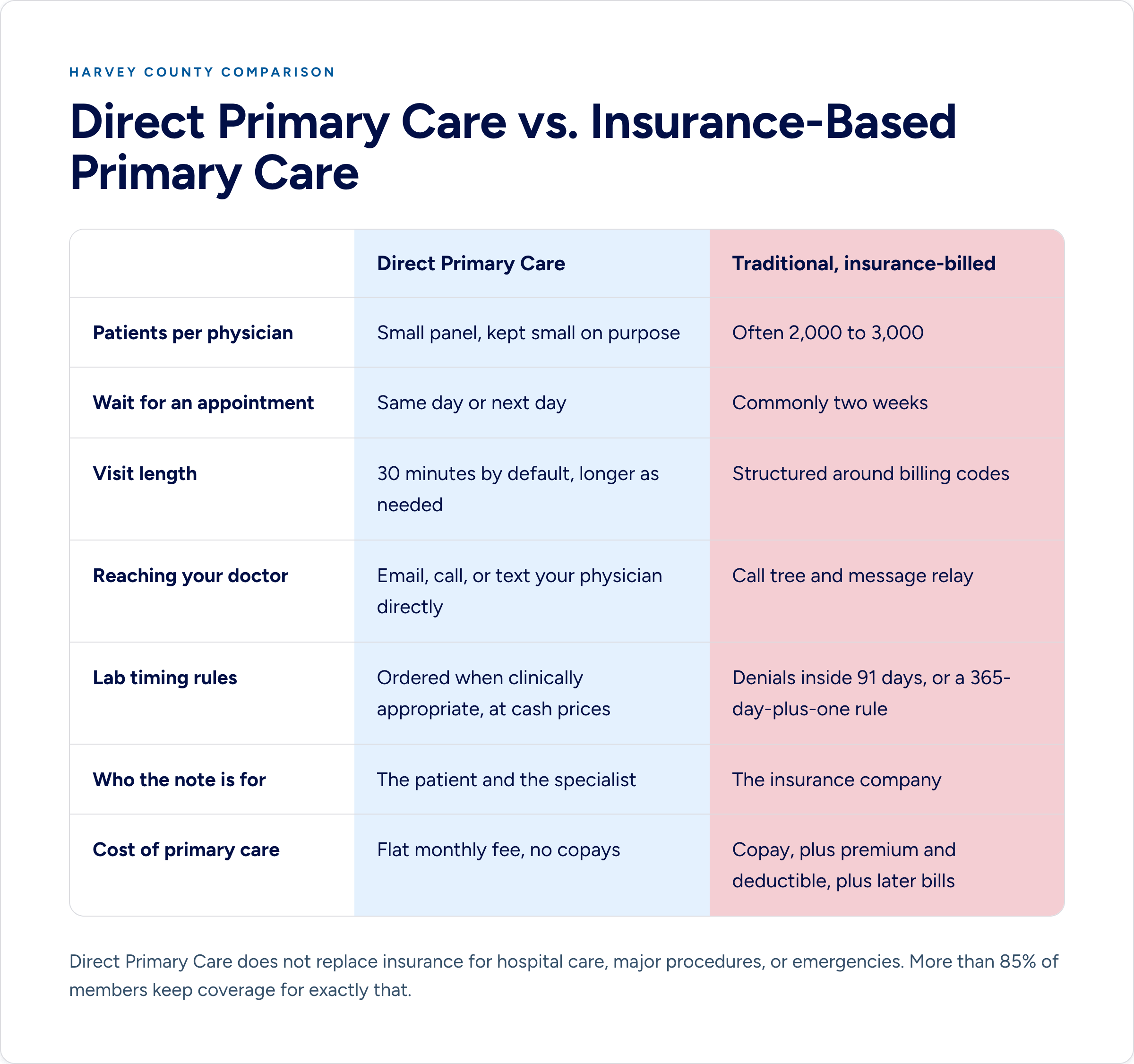
Direct Primary Care does not replace insurance for hospital care, major procedures, or true emergencies. It removes the friction from the eighty percent of care that happens in the primary care setting.
Traditional insurance-based primary care in the area often means panels of two thousand to three thousand patients per physician, two-week waits for appointments, and visits structured around billing codes. In our experience, many insurance plans use timing rules that create denials and surprise out-of-pocket costs even when the test is medically appropriate. Labs are frequently denied if ordered within ninety-one days of a prior one. Certain screenings face a three-hundred-sixty-five-day-plus-one rule.
Direct Primary Care keeps panels smaller so same-day access stays available. I determine urgency the way an emergency department does. Many issues resolve by email. Visits last long enough. Notes are written for the patient and the specialist, not for the insurance company.
For members, the practice functions as urgent care for non-emergency acute needs. Our existing comparison of Direct Primary Care versus urgent care shows the practical trade-offs in cost, continuity, and when each option still makes sense.
Membership at Integrity Medicine runs thirty dollars a month for dependent children under seventeen, sixty dollars for adults eighteen to forty-four, eighty dollars for ages forty-five to sixty-four, and one hundred dollars for ages sixty-five to ninety-nine. All office visits, procedures, and in-office testing are included. Labs and medications are available at transparent cash rates far below typical retail or insurance prices. See our pricing page for the complete list of what is included.
Yes for hospital stays, major procedures, specialist visits, and true emergencies. Over eighty-five percent of Integrity Medicine patients keep insurance for those purposes. The membership simply removes primary care from the insurance billing system so everyday visits and communication stay predictable.
Yes for members. Most acute issues are handled the same day or next day. Many resolve by phone or email without a visit. The clinic treats same-day access as standard rather than exceptional. See how same-day sick visits work for members.
Yes. Dr. Leah Inman is an internal medicine physician who sees adults and offers well-woman exams, contraception care, and menopause management. She is the only female internal medicine doctor in the county, to our knowledge. Families often split care across physicians based on preference.
The physicians personally schedule nearly all of their own appointments. Patients email or call with the concern. The doctor determines whether a visit is needed or whether the issue can be resolved remotely. This eliminates a large class of unnecessary visits that insurance-driven systems require for billing.
Yes. Employer plans are sixty dollars per employee per month. Multi-generational families can enroll under the same rate by forming a family group of at least five adults with shared billing. Construction companies, honey producers, churches, and smaller local businesses already use the model.
If the criteria above match what you want from primary care, the next step is a free meet-and-greet at the Newton clinic. Bring your questions. We will show you exactly how access, pricing, and continuity work for real patients in Harvey County.
Schedule the conversation. See the clinic. Decide whether the model fits your family.