Newton: 316.283.6655
Andover: 316.202.9990
.jpg)
Newton: 316.283.6655
Andover: 316.202.9990
Most people reach for urgent care the moment something feels off and their regular doctor is booked out two weeks. That reflex makes sense if the only alternative is a long wait and a rushed visit.
Direct Primary Care changes the math. Members at Integrity Medicine get same-day or next-day visits with their own physician, no per-visit fee, and a practice that treats those visits as routine rather than exceptional.
This page shows the real differences between Direct Primary Care and urgent care, when each option is the better fit, and how one clinic in Newton and Andover, Kansas actually delivers the access that most people assume only a walk-in clinic can provide.
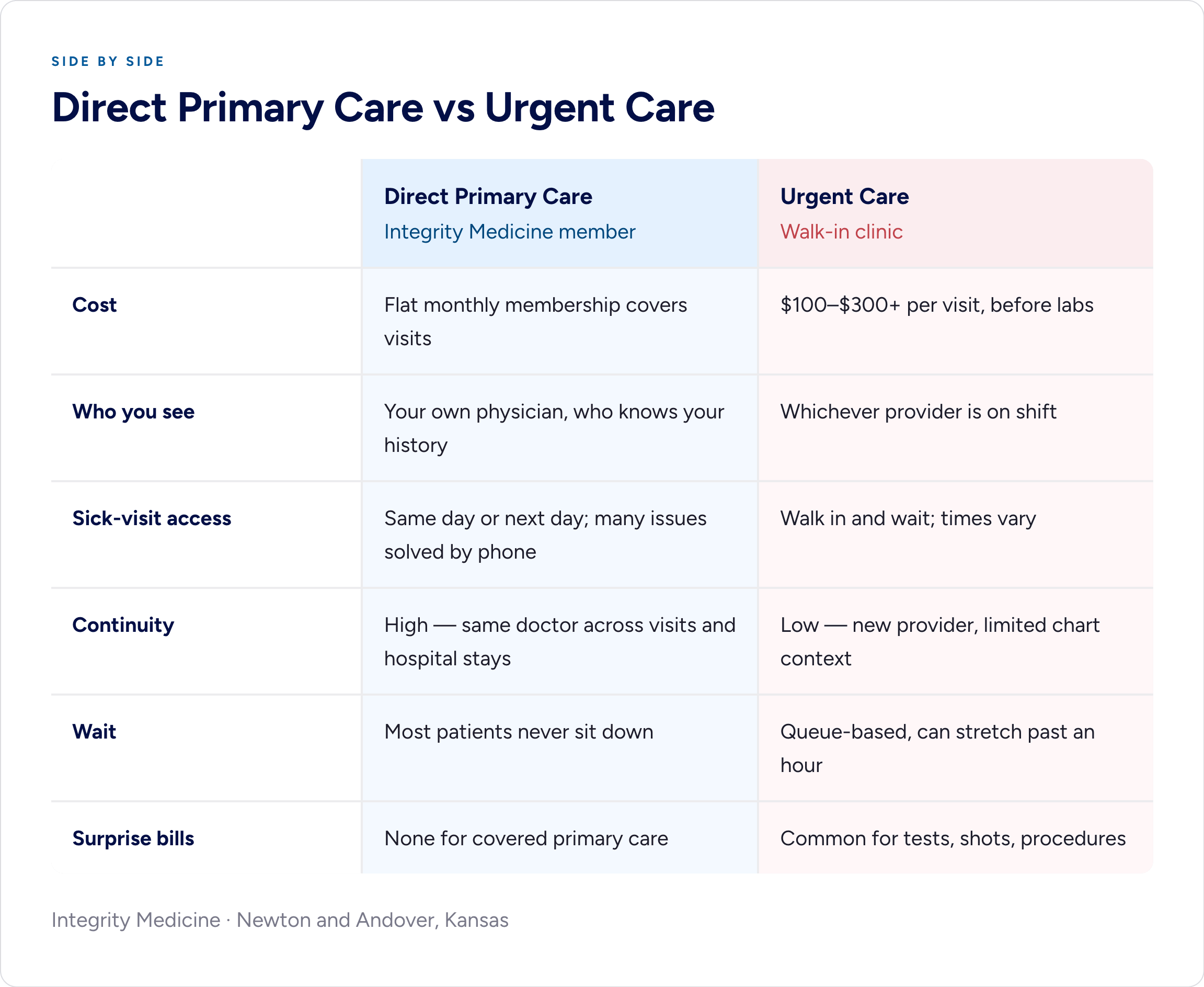
Direct Primary Care is a membership model. Patients pay a predictable monthly fee and receive unlimited primary care visits, direct communication with their doctor, and same-day or next-day access for acute issues.
Urgent care centers are walk-in clinics built for non-life-threatening problems that need attention now.
Urgent care exists for the gap between a closed primary care office and the emergency room. Typical reasons people walk in:
The model is episodic. You see whoever is working that shift. The provider treats the problem in front of them and sends you on your way. Follow-up, if needed, usually points back to a primary care doctor you may not have. Cash prices commonly land between $150 and $300 before add-ons. Insured patients still face copays and possible deductible charges. Many centers staff primarily with nurse practitioners and physician assistants.
That design works when you have no regular doctor or when the issue truly cannot wait until the next available primary care slot. It becomes expensive and fragmented when the same pattern repeats several times a year.
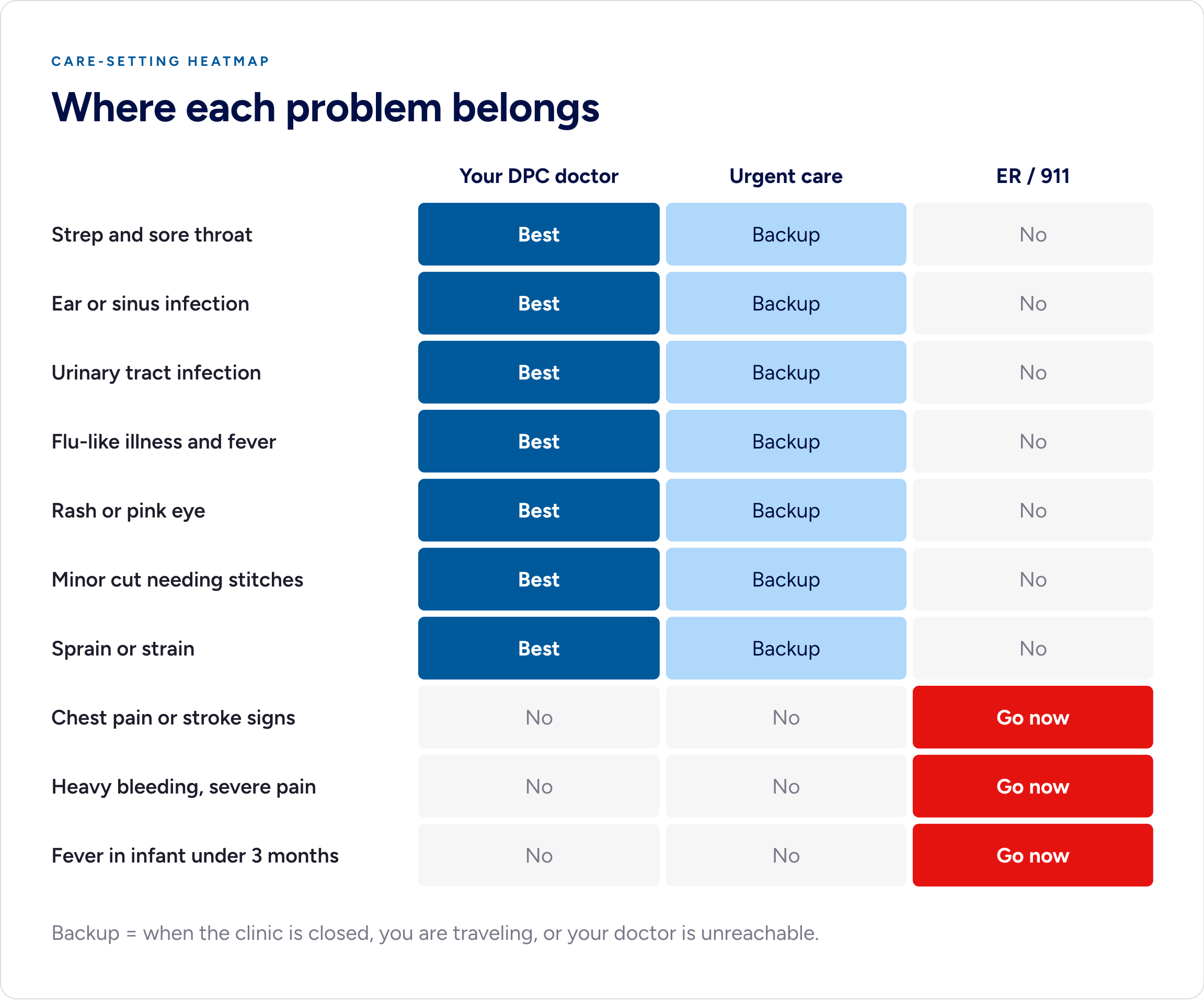
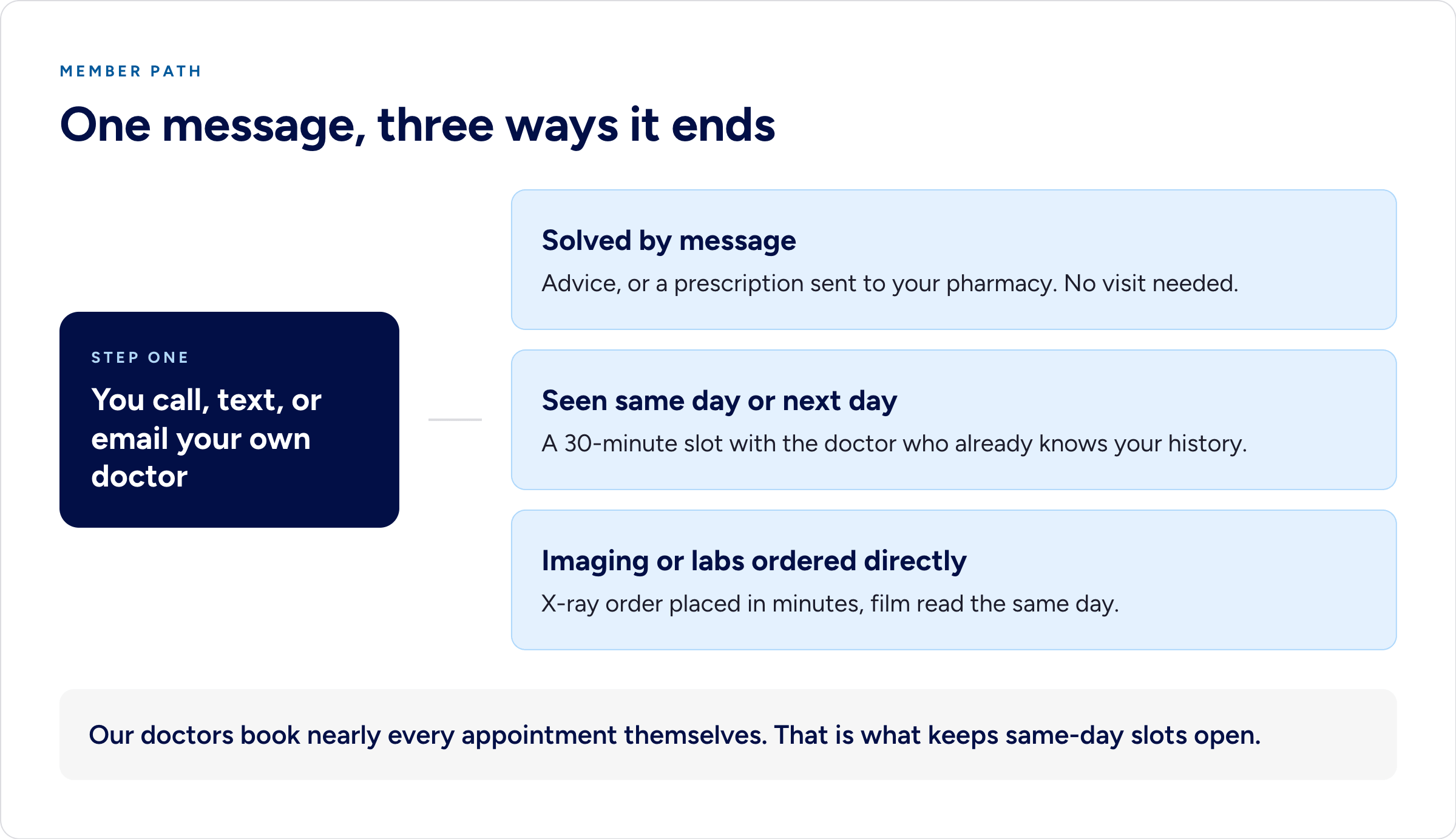
A Direct Primary Care practice keeps smaller panels so same-day and next-day appointments stay open for members. At Integrity Medicine the doctors themselves book nearly every appointment. A patient can email or call with a concern, rather than only having the option to walk-in. Often the issue resolves by message or a prescription called in or filled at the office without a visit. When an in-person exam is needed, the slot opens the same day or the next.
Common conditions members bring that would otherwise drive an urgent care visit:
Because the doctor already knows the medication list, allergies, and baseline, decisions move faster and safer. A blood-pressure reading that looks high is compared against the patient’s own history. An antibiotic choice accounts for prior reactions and current medicines. That context is missing in a walk-in setting.
Analyses of Direct Primary Care practices report that members use urgent care substantially less often than comparable patients in traditional insurance-based primary care. The reduction comes from real access and continuity, not from denying care.
We want to be urgent care for our people. That is not a marketing line. It is how the clinic runs.
Most patients check in and never sit down. A staff member meets them at the door and walks them straight back. We have run internal competitions to see how many patients we can see without a single person waiting in a chair.
Default appointment length is thirty minutes. Visits run longer when the problem requires it.
One Friday a patient walked in at 4:58 p.m. with a hand full of blood. The doctor assigned to him had already left for the day. The physician still on site brought him back, cleaned a dirty wound, numbed it, and closed the laceration. He left at 5:35. The visit was already covered by membership with no separate bill and no emergency-room charge.
Another morning a patient texted about a wrist problem while the doctor was still in early devotion. The patient needed to leave by 1 p.m. for a Royals game. An X-ray order went to Newton Medical Center within minutes. The film was reviewed the same day and the patient made the game. No office visit was required.
Friday afternoon lacerations have become routine. They close in thirty to forty-five minutes. The emergency-room alternative for the same repair often runs near two thousand dollars.
Teachers and nurses with impossible schedules get phone management and medications left in an exterior lockbox. They pick them up after a shift instead of taking a full day off. Distance is rarely the real bottleneck. Patients an hour away often resolve issues faster by direct communication than by navigating a closer clinic’s call tree and scheduling system.
Members reach their physician directly between visits. Email or phone the office for routine questions like refills or scheduling. Call or text for urgent concerns.
We are really fast, but we are not instant medicine. Clear rules keep the line open for real needs.
For more on how same-day care works at our Andover location, see our family medicine services. Patients from the Newton area receive the same access at our Newton clinic.
Membership covers the sick visit. There is no per-visit charge for the evaluation, the rapid strep test, or the conversation that prevents a second trip.
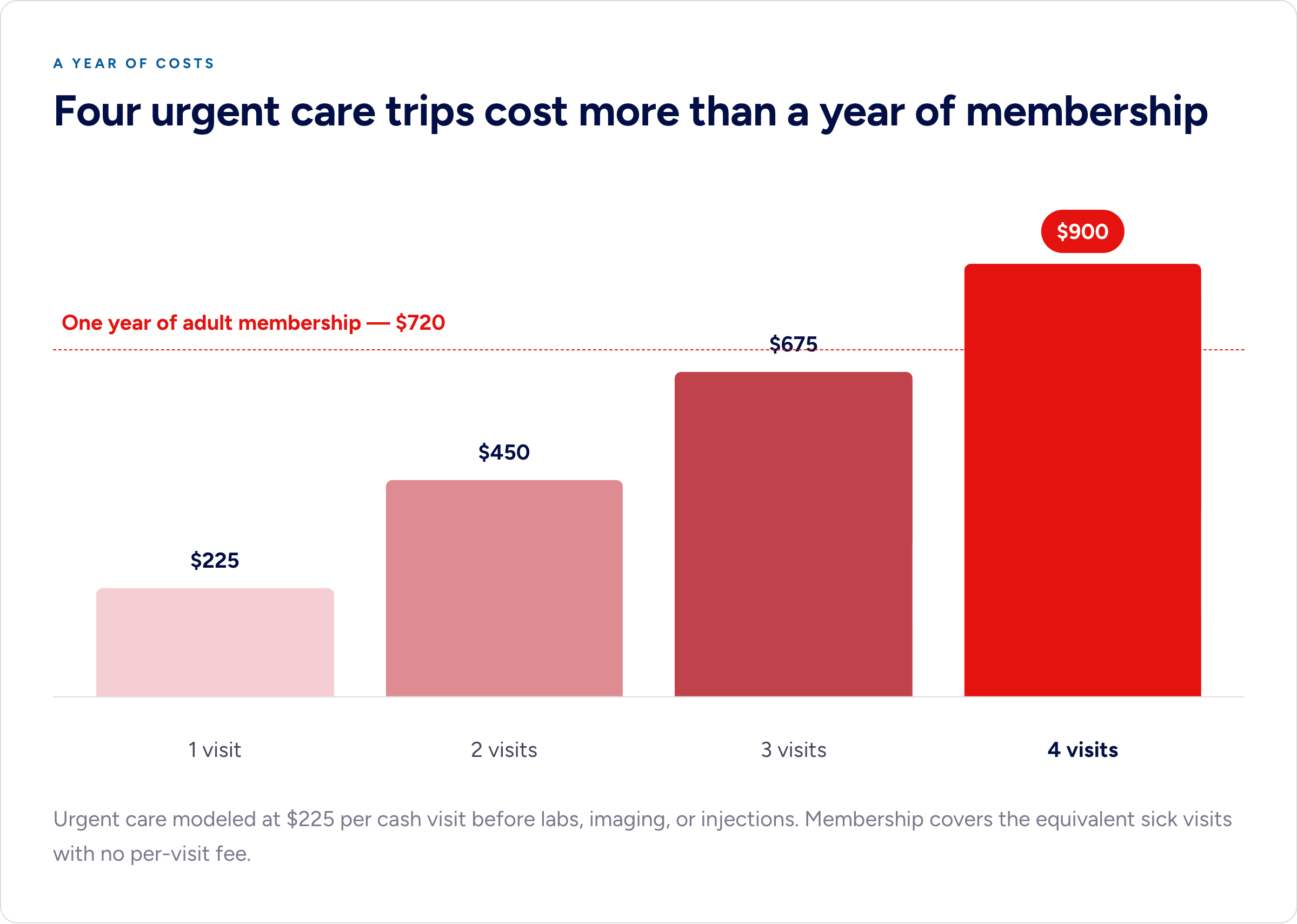
Compare that with typical urgent care economics. A basic cash visit often starts at $150 to $300. Add a rapid test, an injection, or a simple X-ray and the total climbs past $400. Four such visits in a year can exceed the annual cost of a Direct Primary Care membership for an adult.
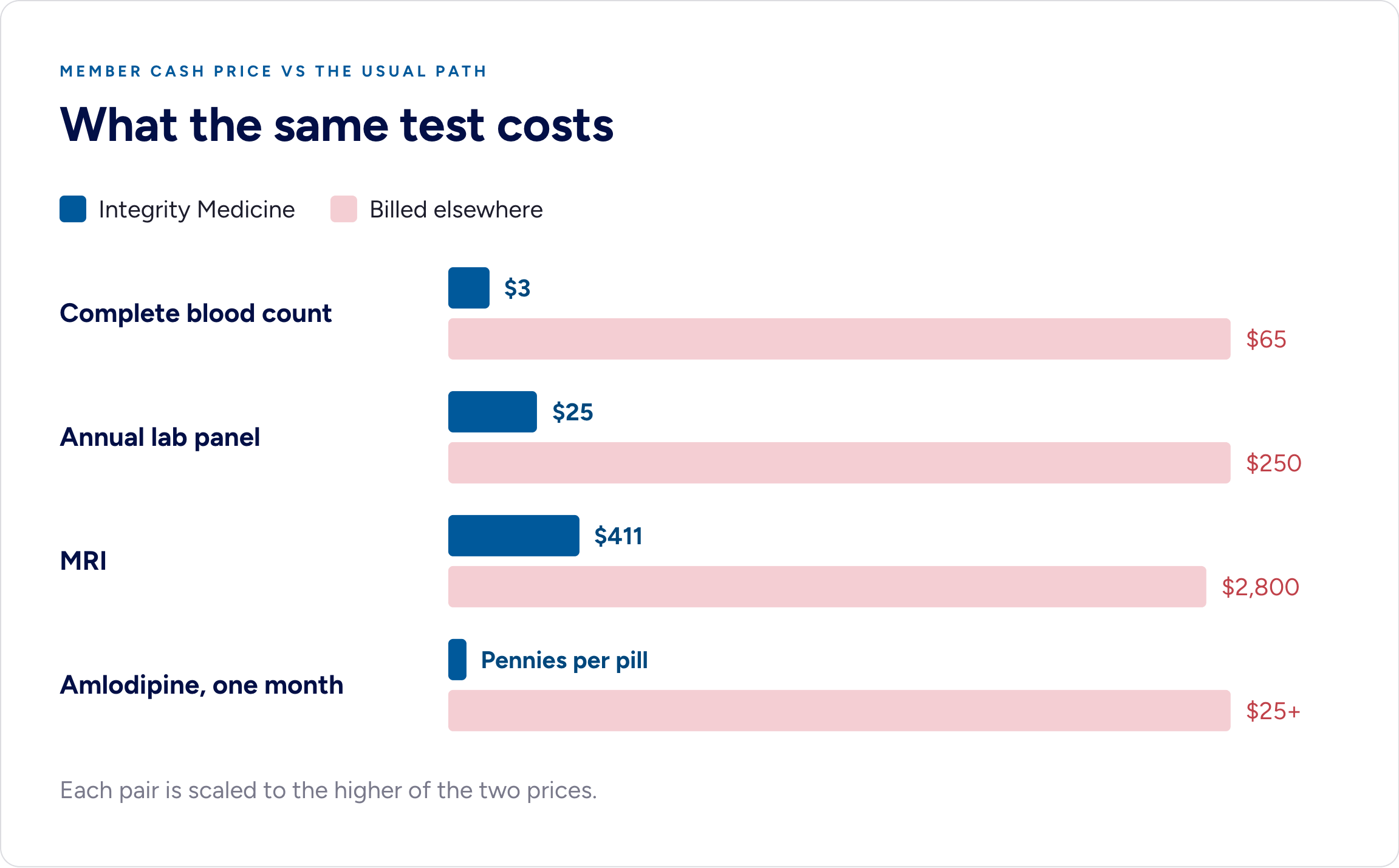
Specific cash prices at Integrity Medicine for services patients commonly seek at urgent care or through insurance:
Over eighty-five percent of Integrity Medicine patients still carry insurance. They use it for radiology outside the clinic, specialist care, hospital stays, and true emergencies. They simply stop billing insurance for primary care visits. The result is fewer surprise bills and less friction when something acute appears.
People can walk in without a wallet or purse. Charges accumulate and auto-debit on the first of the month. Parents send teenagers alone knowing no money is required at the desk.
Current Direct Primary Care membership pricing is straightforward. There is no enrollment fee and no long-term contract.
Direct Primary Care does not replace every urgent need. Use urgent care when:
Go to the emergency room or call 911 for:
Membership does not cover the emergency room. Your insurance does. Your Integrity Medicine doctor stays involved for follow-up and coordination once the acute episode is managed.
We move quickly when it matters. Clear communication rules keep the line open for real needs while protecting the doctor’s ability to focus on the patient in the room.
Choose Direct Primary Care if you want a doctor who knows you, same-day or next-day access for most acute problems, transparent monthly pricing, and the ability to handle the majority of issues that currently send you to urgent care. The model works especially well for families, people with high-deductible plans, small businesses, and anyone tired of the cycle of long waits followed by short visits.
Learn more about what Direct Primary Care includes at our Newton and Andover locations.
Choose urgent care if you have no primary care relationship, the problem is straightforward and self-contained, or you need care outside the hours your Direct Primary Care clinic can reach you.
Many families keep both. Direct Primary Care becomes the default medical home. Urgent care remains a backup for travel or true after-hours gaps. The volume of urgent care visits drops once the membership is in place.
Availability, communication, and excellence determine whether a practice can actually deliver that reduction. Those three standards are the test.
Our Andover family medicine services cover the everyday illnesses and minor injuries that drive most urgent care trips, along with ongoing care for the whole family.
Direct Primary Care is a membership model that gives patients unlimited visits with their own physician, same-day or next-day access, and direct communication for a flat monthly fee. Urgent care is a walk-in clinic that treats non-life-threatening acute problems on a per-visit basis with limited continuity. The biggest practical difference is that DPC members see a doctor who already knows their history and face no extra charge for the visit.
Yes for the majority of common acute issues. Members bring strep, UTIs, ear infections, sinus problems, minor cuts, and flu-like illness to their own doctor the same day or next day. Analyses of Direct Primary Care practices report that members use urgent care substantially less often. True emergencies and certain after-hours needs still require the ER or a walk-in clinic.
A typical cash urgent care visit runs $150 to $300 before labs or imaging and can exceed $400 with add-ons. A Direct Primary Care membership covers the equivalent sick visit with no per-visit fee. Four urgent care trips in a year often cost more than an entire year of adult membership.
Go to urgent care if the clinic is closed, your doctor is unreachable, you are traveling, or you need an on-site service the clinic cannot provide that day. For everything else that is non-emergency, start with your Direct Primary Care physician first. Many issues resolve by phone or email without a trip.
Yes for hospital care, major procedures, specialist visits, and true emergencies. Over 85 percent of Integrity Medicine patients keep insurance for those purposes. The membership simply removes primary care from the insurance billing system so visits, communication, and basic procedures stay predictable and affordable.
Strep and sore throat, ear infections, urinary tract infections, sinus infections, flu-like illness, rashes, minor lacerations, sprains, and medication issues tied to ongoing care. The doctor can also order rapid testing, perform simple procedures, and coordinate imaging when needed. Context from the ongoing relationship improves the quality of those decisions.
Waking up sick should not mean a long wait or a surprise bill. If you want a practice that treats same-day access as standard rather than exceptional, schedule a free meet-and-greet at the Newton or Andover clinic. Bring your questions. We will show you exactly how the access works for real patients.