Newton: 316.283.6655
Andover: 316.202.9990
.jpg)
Newton: 316.283.6655
Andover: 316.202.9990
Most primary care physicians no longer follow their patients into the hospital. Hospitalists now handle the majority of inpatient care across the country. Many Direct Primary Care practices follow the same pattern and hand hospitalized members to the hospitalist team.
At Integrity Medicine we made a different choice. I am a board-certified Internal Medicine physician and a member of the medical staff at Newton Medical Center. I practice in the clinic and in the inpatient setting. When one of our members is admitted, our physicians continue to care for them there.
That continuity matters for the patient who already knows their doctor and for the physician who still wants to practice full-spectrum medicine.
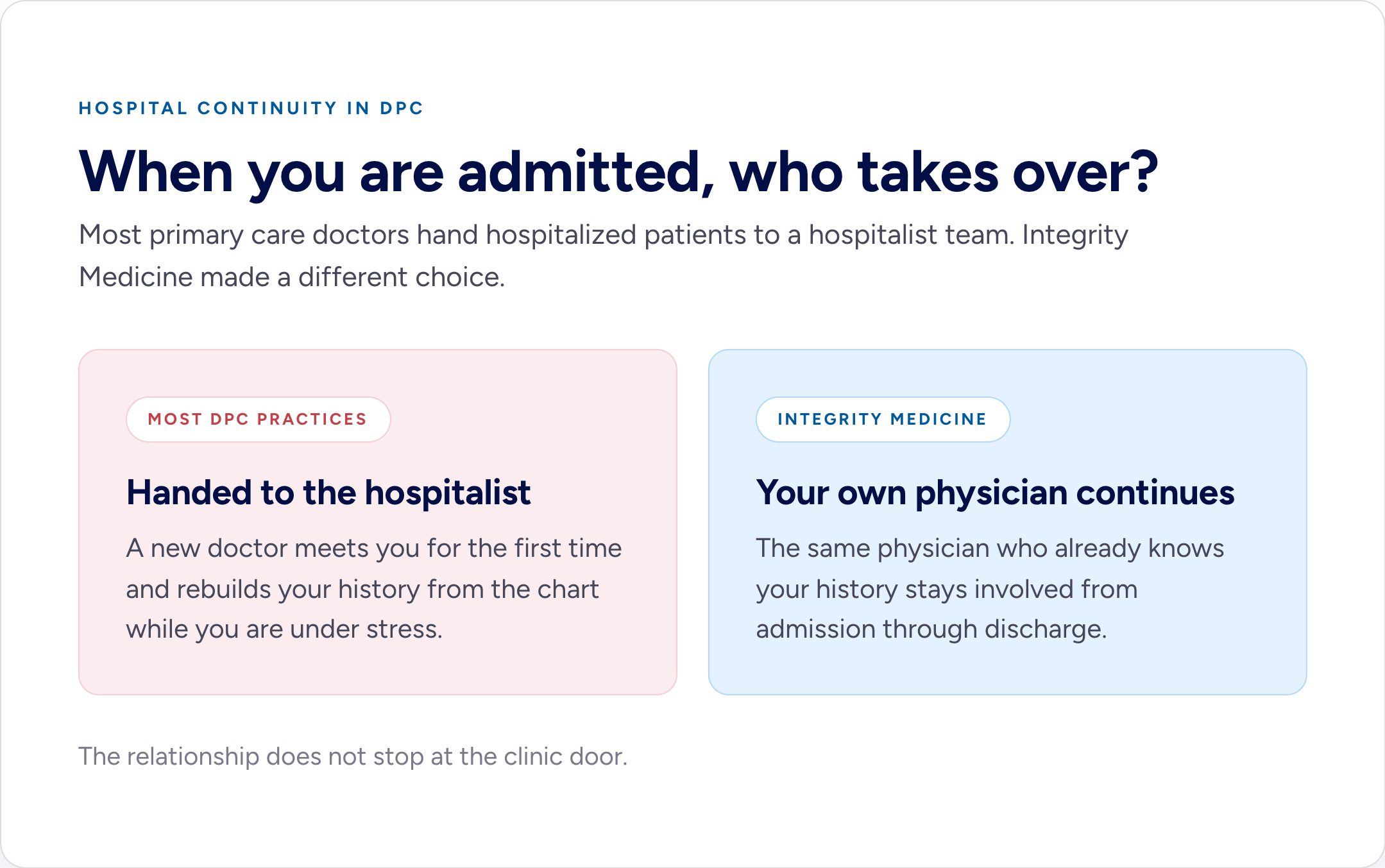
Hospital continuity in Direct Primary Care means the same physician who already knows your history remains involved when you are admitted to the hospital. The model does not require it. At Integrity Medicine we chose to keep it because the relationship does not stop at the clinic door.
This article explains what hospital continuity looks like inside a pure Direct Primary Care model, how the outpatient schedule accommodates inpatient work, why the combination benefits both patients and physicians, and what it means for people in Newton, Hesston, Halstead, and the surrounding Harvey County communities. If you want to explore whether this approach fits your family, start with a free meet-and-greet.
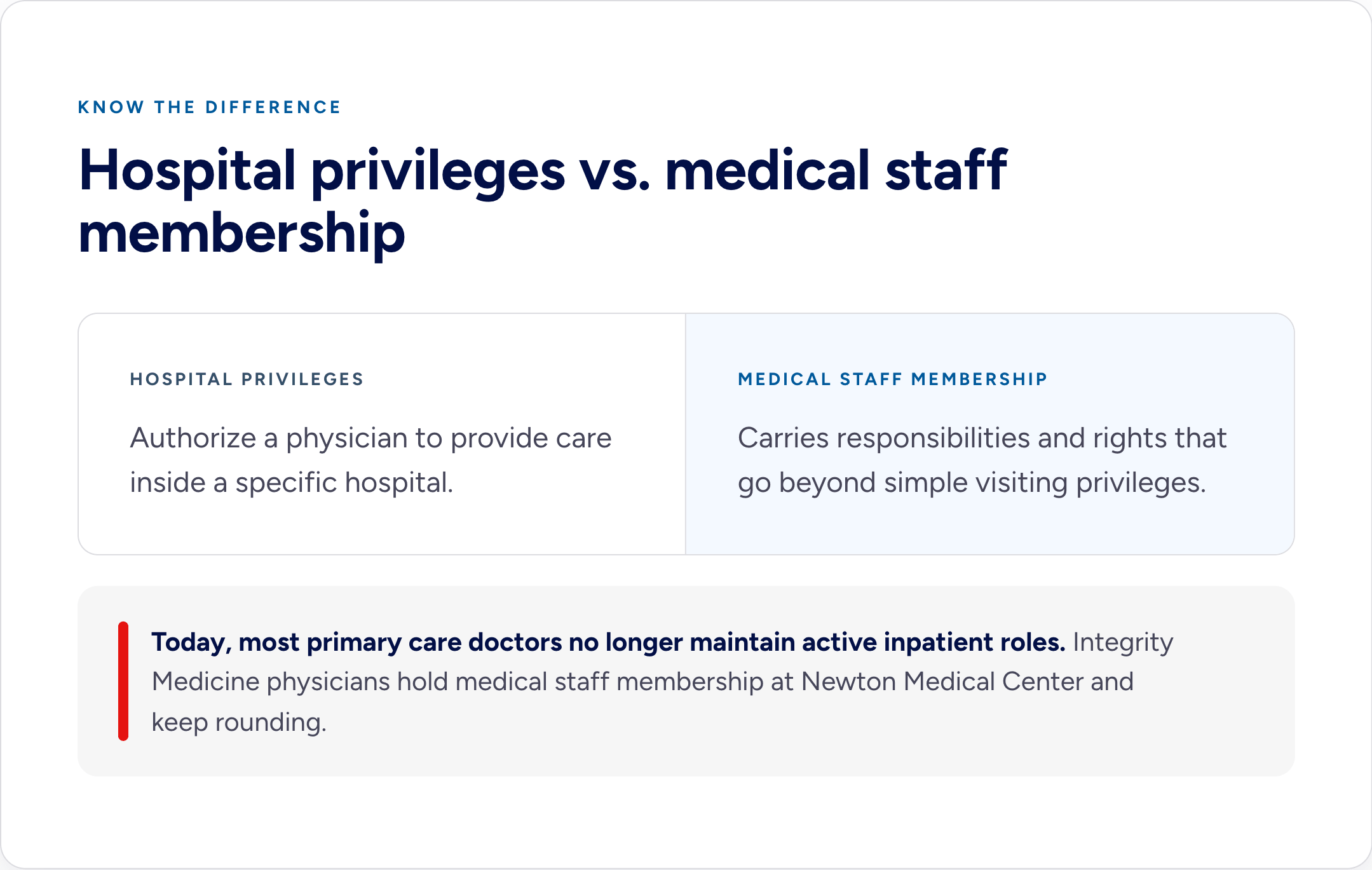
Hospital privileges authorize a physician to provide care inside a specific hospital. Medical staff membership carries responsibilities and rights that go beyond simple visiting privileges.
In modern practice most primary care doctors no longer maintain active inpatient roles. The rise of hospitalists made the traditional model of morning rounds followed by a full outpatient schedule difficult to sustain. For physicians interested in the formal process, the American Academy of Family Physicians outlines the steps to hospital credentialing and privileges.
At Integrity Medicine, Direct Primary Care changes the math. Our smaller patient panels and the complete removal of insurance billing for primary care free the hours that used to disappear into prior authorizations and coding documentation. That recovered time makes it possible for our physicians—who are members of the medical staff at Newton Medical Center—to continue inpatient work without sacrificing same-day access for outpatients.
Many pure Direct Primary Care practices still choose the outpatient-only path and coordinate with hospitalists instead. Both approaches are legitimate. The choice depends on the physician’s training, the local hospital environment, and the practice’s priorities.
I am a board-certified Internal Medicine physician and a member of the medical staff at Newton Medical Center. I practice in the clinic and in the inpatient setting. Our clinic at Integrity Medicine sits at 715 Medical Center Drive, Suite 200, immediately adjacent to the hospital. That physical proximity simplifies coordination.
When a member of Integrity Medicine is admitted to Newton Medical Center, our physicians continue to see them there. Continuity of care while in the hospital is part of the culture we built.
Dr. Inman has named it as one of the defining elements of how we practice. Dr. Dillard brought extensive emergency medicine experience to our clinic. Several of our physicians carry hospital backgrounds that make inpatient work a natural extension of outpatient care rather than an interruption.
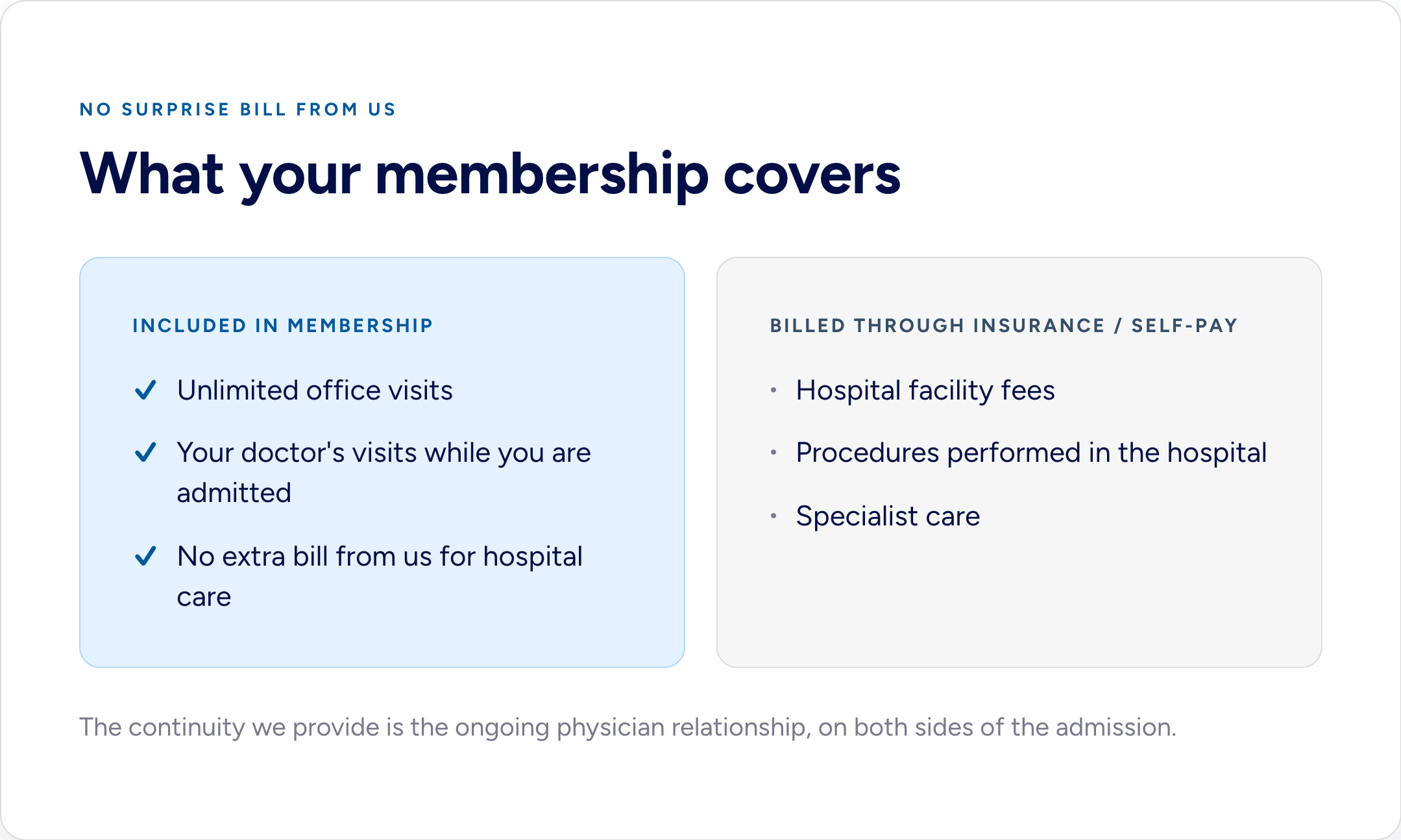
Membership covers primary care. Hospital facility charges, specialist fees, and procedures performed in the hospital are handled through the patient’s insurance or self-pay arrangements the same way they would be under any other primary care model. The continuity we provide is the physician relationship itself.
You can learn more about our Newton Direct Primary Care location and how the model works day to day.
The practical question most physicians ask is simple: how do physicians at a Direct Primary Care practice round in the hospital and still offer same-day or next-day appointments in the clinic?
At Integrity Medicine the answer starts with smaller panels. Direct Primary Care practices intentionally limit panel size so visits can last long enough to address multiple concerns and so the physician can remain available by text, email, or phone. That same lower volume creates the schedule flexibility required for inpatient work.
Personal appointment booking helps. I still make nearly all of my own appointments. When a patient needs to be seen the same day or when a hospitalized member needs attention, the schedule can flex without layered call centers or rigid templates.
In our experience at Integrity Medicine the zero-wait culture in the clinic is protected by the same design that makes hospital involvement sustainable. Most patients check in and walk straight back. Staff run internal competitions to keep chairs empty in the waiting room. The same flexible schedule that supports same-day sick visits also leaves room for hospital work.
For more on how this access works in practice, see our guide to Direct Primary Care vs urgent care.
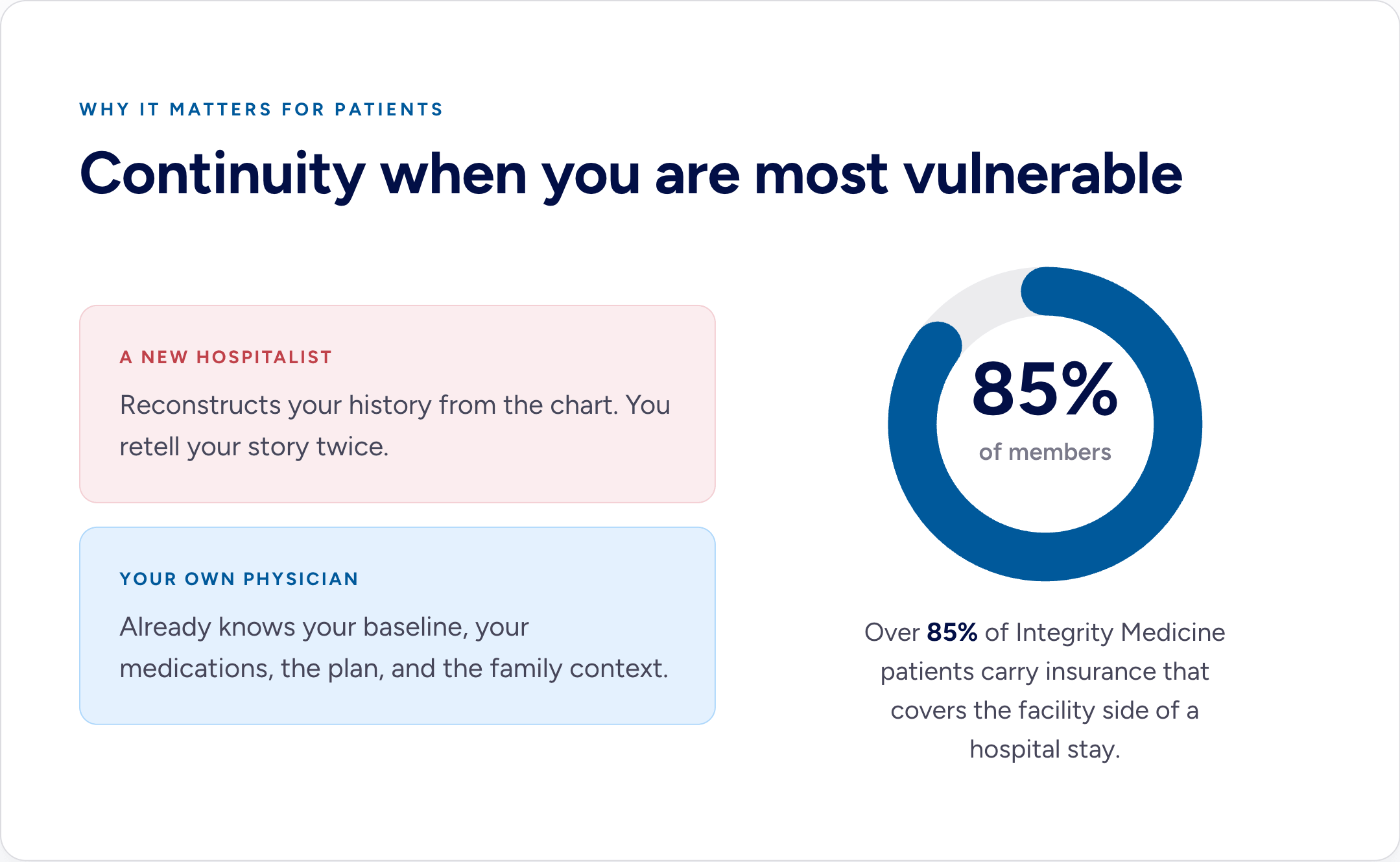
When a patient is admitted, the hospitalist who meets them for the first time must reconstruct history from the chart and from the patient under stress. The physician who already knows the long-term plan, the medication responses, the patient’s baseline, the family context, and the prior decisions starts from a different place.
Continuity reduces fragmentation at the moment patients are most vulnerable. Transitions at discharge become smoother because the same physician who managed the hospital stay will also manage the outpatient recovery. Patients do not have to retell their story to a new team and then again to their regular doctor a week later.
For members of Integrity Medicine this continuity happens at no additional membership cost. The relationship that already exists in the clinic simply continues inside the hospital when it is needed.
Over 85 percent of Integrity Medicine patients carry insurance that covers the facility side of hospitalization. The Direct Primary Care membership keeps the primary care relationship intact on both sides of the admission. This same continuity supports our approach to chronic disease management and ongoing care for complex conditions. Patients managing long-term conditions often benefit most from a physician who already understands their full picture.
Many physicians entered medicine because they wanted to care for the whole patient across settings. Pure outpatient practice is valuable and often necessary. It is not the only sustainable path.
At Integrity Medicine, keeping medical staff membership and inpatient involvement preserves professional satisfaction for those of us who still find meaning in hospital medicine. It also creates natural opportunities to mentor medical students in real clinical settings rather than in simulated ones.
Precepting becomes more complete when students can see both the outpatient relationship and the inpatient decisions that follow from it. I serve as a preceptor for medical students and participate in medical missions. The Direct Primary Care model leaves space for teaching the next generation without the volume pressure that makes precepting nearly impossible in high-panel traditional practices.
The administrative burden that drives burnout in traditional primary care is largely absent from a pure Direct Primary Care practice such as Integrity Medicine. Removing insurance claims for primary care services frees the hours that used to be spent on prior authorizations and coding. Those hours can support hospital work without the exhaustion that once made rounding unsustainable.
Autonomy, relationship continuity, and the chance to practice across settings are among the reasons some Kansas physicians are looking closely at Direct Primary Care opportunities that still include hospital involvement. For a deeper look at why physicians make this shift, see Why Kansas Physicians Are Choosing Direct Primary Care.
Newton Medical Center serves Harvey County and the surrounding communities. For patients who live in Newton, Hesston, Halstead, North Newton, or nearby towns, having primary care physicians on the medical staff of the local hospital is not theoretical. It is practical.
Integrity Medicine operates its Newton clinic specifically to serve this community. The same physicians who provide unlimited office visits, same-day access, and direct communication also maintain the hospital relationship. That combination is uncommon in pure Direct Primary Care and rarer still when the clinic sits next door to the hospital. Our best Direct Primary Care in Harvey County guide walks through the criteria we believe matter most for local families, including continuity with physicians who still round in the hospital.
For physicians considering a move to Direct Primary Care in South-Central Kansas, the model offers a concrete path. You can practice with the autonomy and reduced administrative load of Direct Primary Care while retaining the ability to care for your own patients when they are admitted at Newton Medical Center. Multi-site presence in Newton and Andover adds further flexibility. The practice has grown through patient referrals and word of mouth rather than high-volume advertising. That reinforces a culture focused on availability, communication, and excellence. Learn more about the team and our approach on the About page.
.webp)
Some do. Many pure DPC practices operate entirely outpatient and coordinate with hospitalists. Others, including Integrity Medicine, maintain medical staff membership and continue to care for their hospitalized members. The choice depends on the physician’s training, the local hospital, and the practice’s priorities.
When a member of Integrity Medicine is admitted to Newton Medical Center, our physicians continue to see them there. Continuity of care while in the hospital is part of how we practice.
No. Direct Primary Care membership covers primary care services. Hospital facility fees, procedures performed in the hospital, and specialist care are billed through the patient’s insurance or self-pay arrangements the same way they would be under any other primary care model. That being said, there is never an additional bill for hospital care from us. It is included in your membership. The continuity we provide is the ongoing physician relationship. See our pricing page for membership details.
Smaller patient panels and personal appointment booking create the flexibility required. The Newton clinic of Integrity Medicine sits next to the hospital, which further reduces logistics. The design that protects same-day outpatient access also makes inpatient involvement sustainable.
Hospital continuity is centered on Newton Medical Center, where our physicians hold medical staff membership. Patients who primarily use the Andover clinic still benefit from the same physician relationship and care coordination if hospitalization at Newton Medical Center occurs.
Hospital continuity is not automatic in Direct Primary Care. Nearly all practices deliberately choose a pure outpatient model and work effectively with hospitalists. At Integrity Medicine we chose to keep medical staff membership at Newton Medical Center and to continue caring for our own patients when they are admitted.
The doctor who already knows the patient is often the best person to help when the patient is sickest. Smaller panels and the removal of insurance bureaucracy make the combination of outpatient Direct Primary Care and inpatient work possible without sacrificing access or professional sustainability.
If you are a patient in Newton or the surrounding communities who values that continuity, start with a free meet-and-greet. If you are a physician considering Direct Primary Care and still want the option of hospital work, reach out through the same contact page and let us know you are interested in opportunities. We can discuss how the model works day to day and whether the fit is right.