Newton: 316.283.6655
Andover: 316.202.9990
.jpg)
Newton: 316.283.6655
Andover: 316.202.9990
By Robert Roeser, DO, board-certified in Internal Medicine
Many primary care physicians evaluating a move to Direct Primary Care start with the same question. What does the pay actually look like compared with an employed hospital or system role?
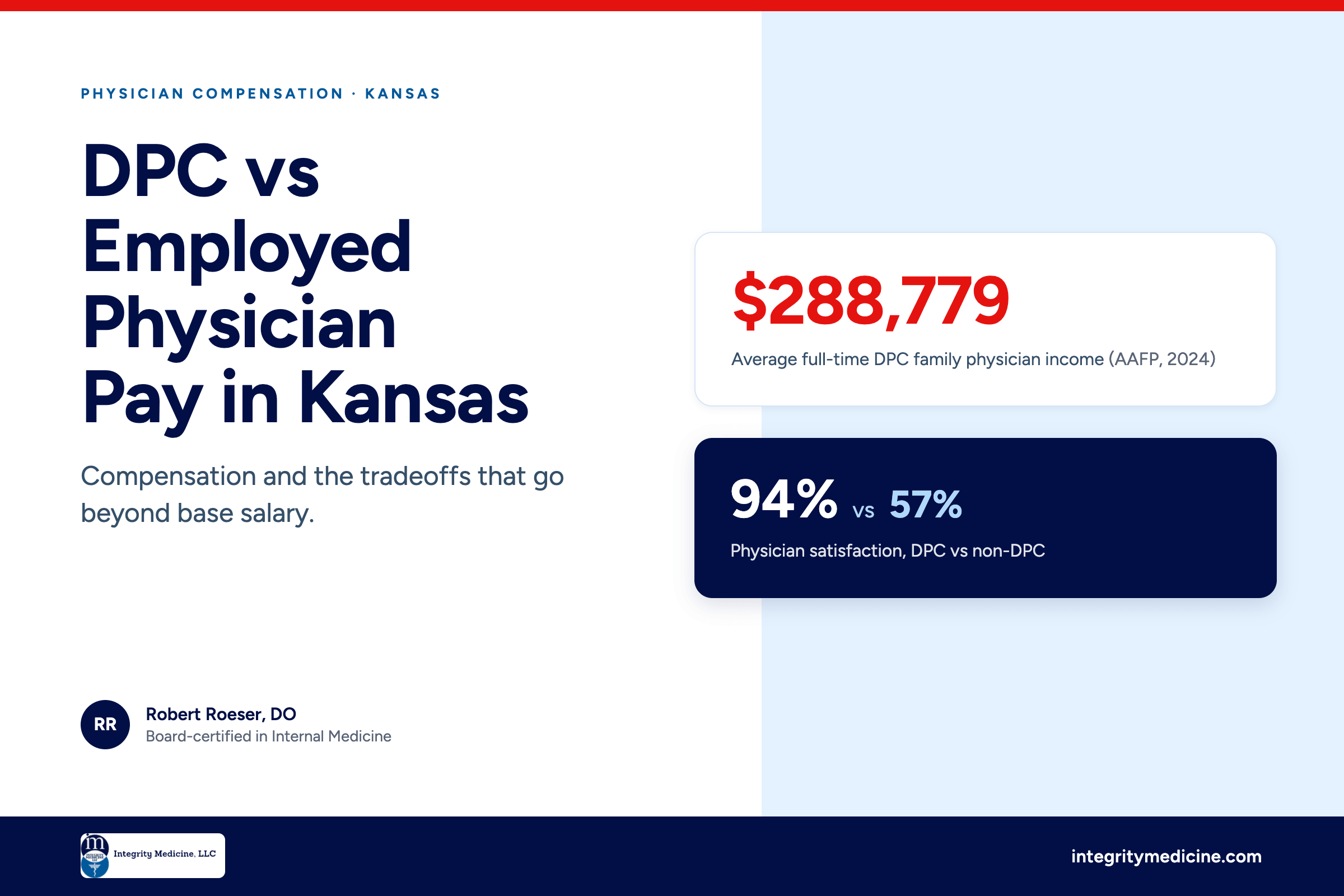
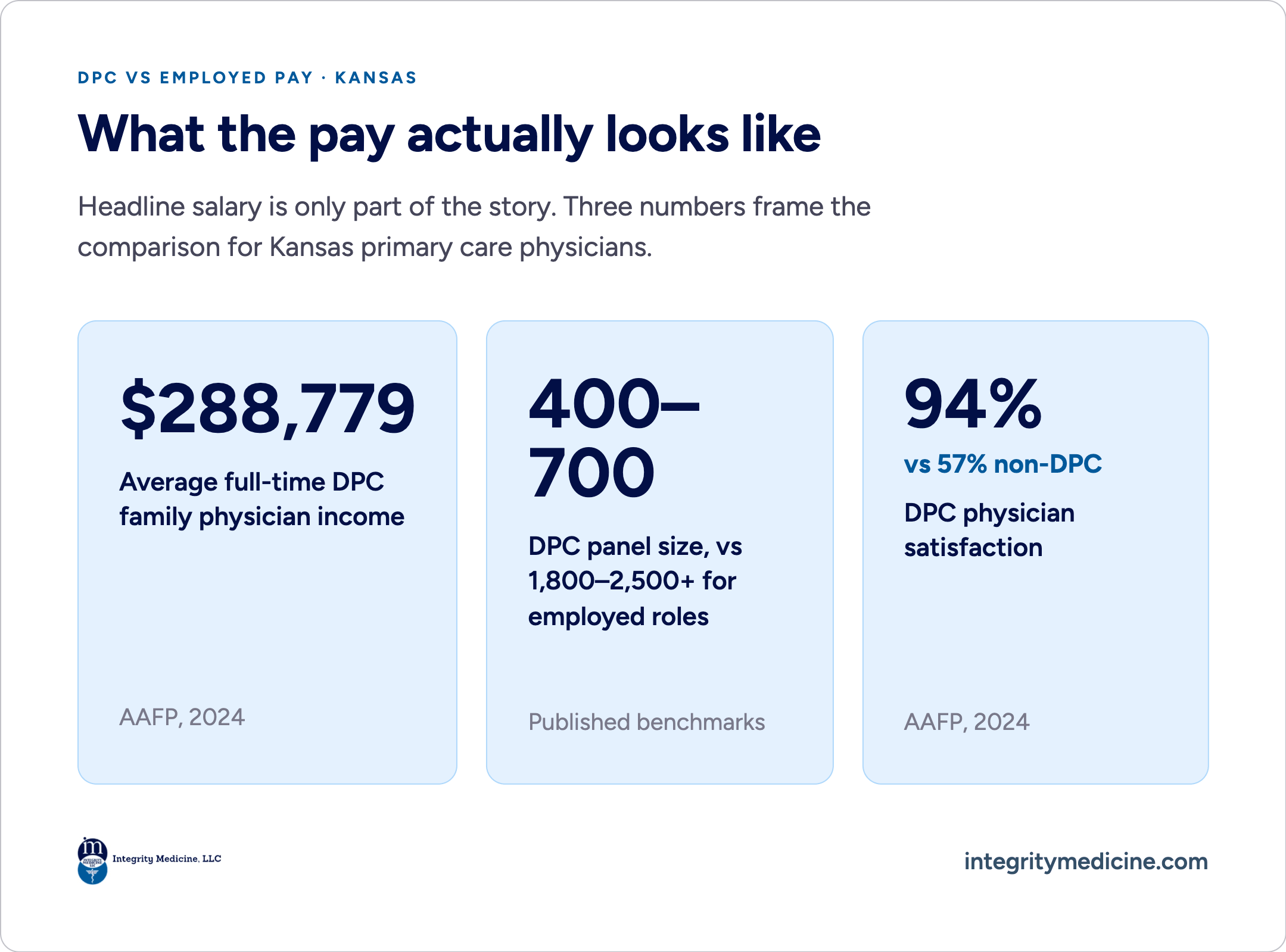
At Integrity Medicine we answer that question with both published data and lived experience. The American Academy of Family Physicians reports an average full-time income of $288,779 for family physicians in Direct Primary Care settings in 2024. Headline salary numbers still only tell part of the story.
The real comparison includes panel size, administrative time, clinical autonomy, burnout risk, benefits responsibility, and whether the model still allows hospital work. This article walks through the published compensation data, how the membership revenue model works, the non-financial factors that affect day-to-day reality, and the local picture for physicians in Kansas.
If you are a physician already weighing options, you can reach out through our contact page to discuss how the model works in practice.

Employed primary care compensation usually combines a base salary with productivity incentives tied to relative value units or visit volume. Benefits such as health insurance, retirement matching, and paid time off often come with the package.
Published ranges for Kansas primary care physicians from job-posting aggregators fall roughly in the low-to-mid $200,000s for many Family Medicine and Internal Medicine roles. Higher figures appear in certain settings or with productivity bonuses.
National Medscape and MGMA data for primary care often place median total compensation in a similar or slightly higher band depending on the year and whether the role includes supervisory or procedural work.
But there are tradeoffs. Large patient panels are common because revenue depends on volume and coding.
Administrative time spent on documentation, prior authorizations, and billing follow-up is significant. Clinical decisions can be constrained by payer rules. Many physicians report that the hours required to hit productivity targets erode the time available for complex patients or teaching.
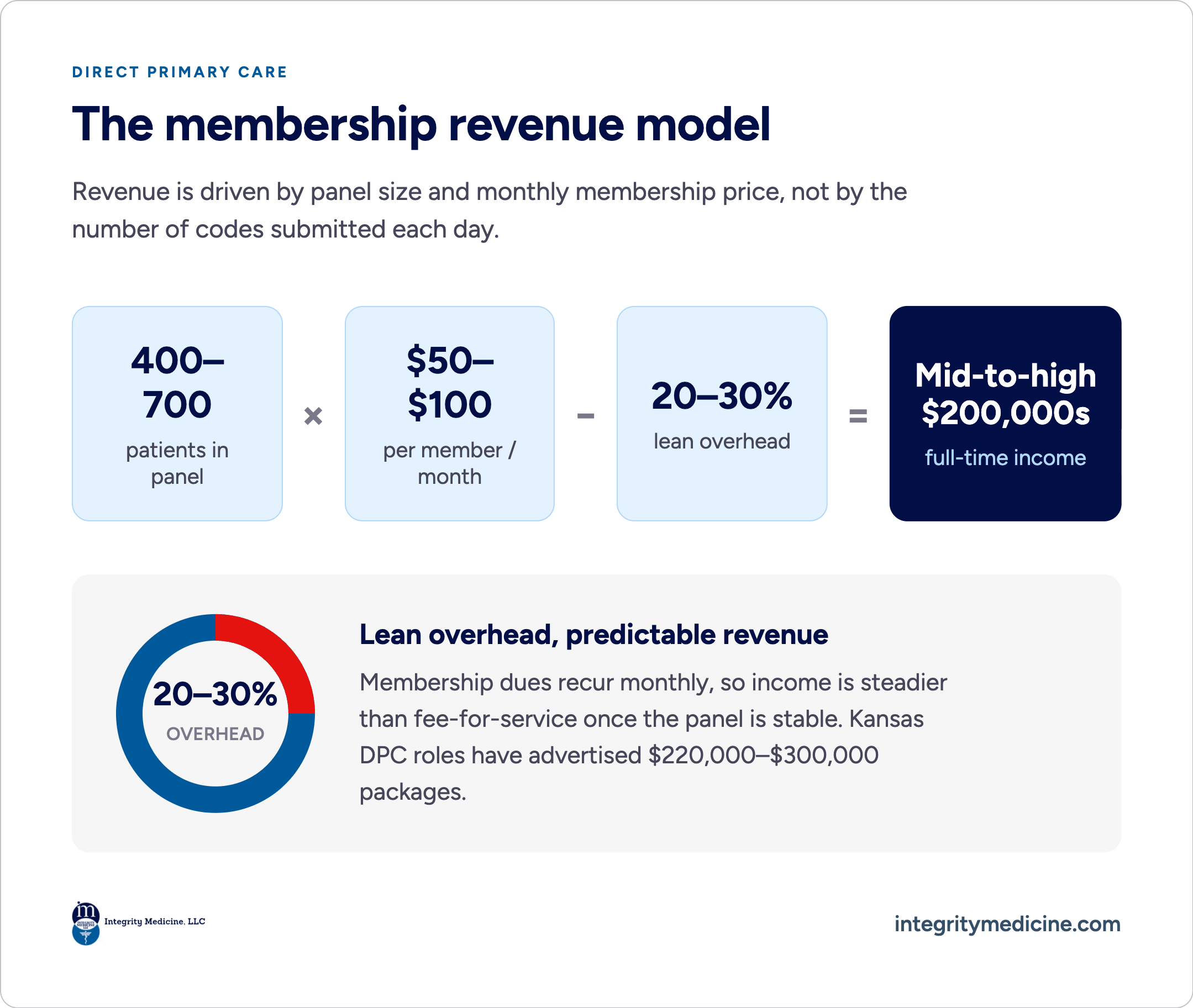
Direct Primary Care replaces fee-for-service billing for primary care with a membership model. Patients or employers pay a flat monthly fee. That fee covers unlimited primary care visits, direct access, and many in-office services. Revenue is therefore driven by panel size and membership price rather than by the number of codes submitted each day.
According to the American Academy of Family Physicians Career Benchmark Dashboard, family physicians practicing in Direct Primary Care settings earned an average full-time income of $288,779 in 2024. That figure includes a mix of base salary, bonus or incentive pay, and practice revenue share across both employed Direct Primary Care and owner arrangements.
Industry analyses of the model frequently illustrate the math with panel-size examples. A panel of several hundred patients at typical membership rates of $50–$100 per month, after lean overhead in the 20–30 percent range, can support full-time primary care income in the mid-to-high $200,000s for many practices.
Kansas job postings for Direct Primary Care roles have advertised packages in the $220,000–$300,000 range with productivity or partnership components.
The model offers two paths. Physicians can own or co-own a practice and carry full business responsibility. They can also work as employed physicians inside an established Direct Primary Care group, receiving a salary or salary-plus-bonus structure while still operating under membership economics and reduced insurance-billing load.
Integrity Medicine is structured as a pure Direct Primary Care practice with multiple physicians. We do not publish individual compensation figures. You can review the current membership pricing that underpins the patient side of this model.
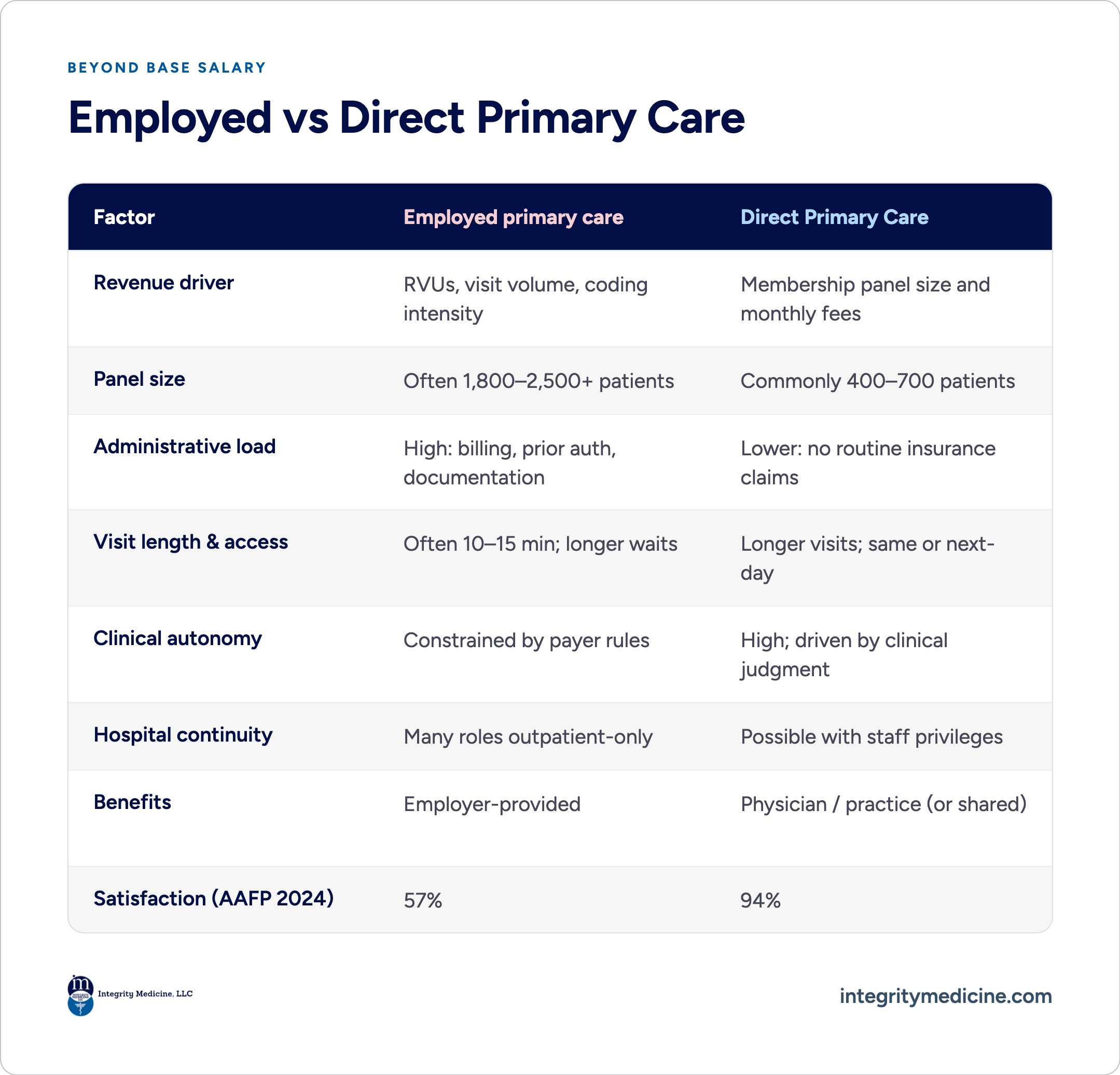
A useful comparison looks at several columns at once.
Individual results vary by location, specialty, panel maturity, and practice design. The consistent pattern across published data and physician reports is that Direct Primary Care trades higher volume and third-party friction for smaller panels, more predictable recurring revenue, and greater control over the clinical day.
AAFP 2024 data showing 94% satisfaction among Direct Primary Care physicians versus 57% among non-DPC physicians illustrates why many find the non-financial columns decisive.
For a deeper look at why many physicians find the non-financial columns decisive, see our related piece on why Kansas physicians are choosing Direct Primary Care.
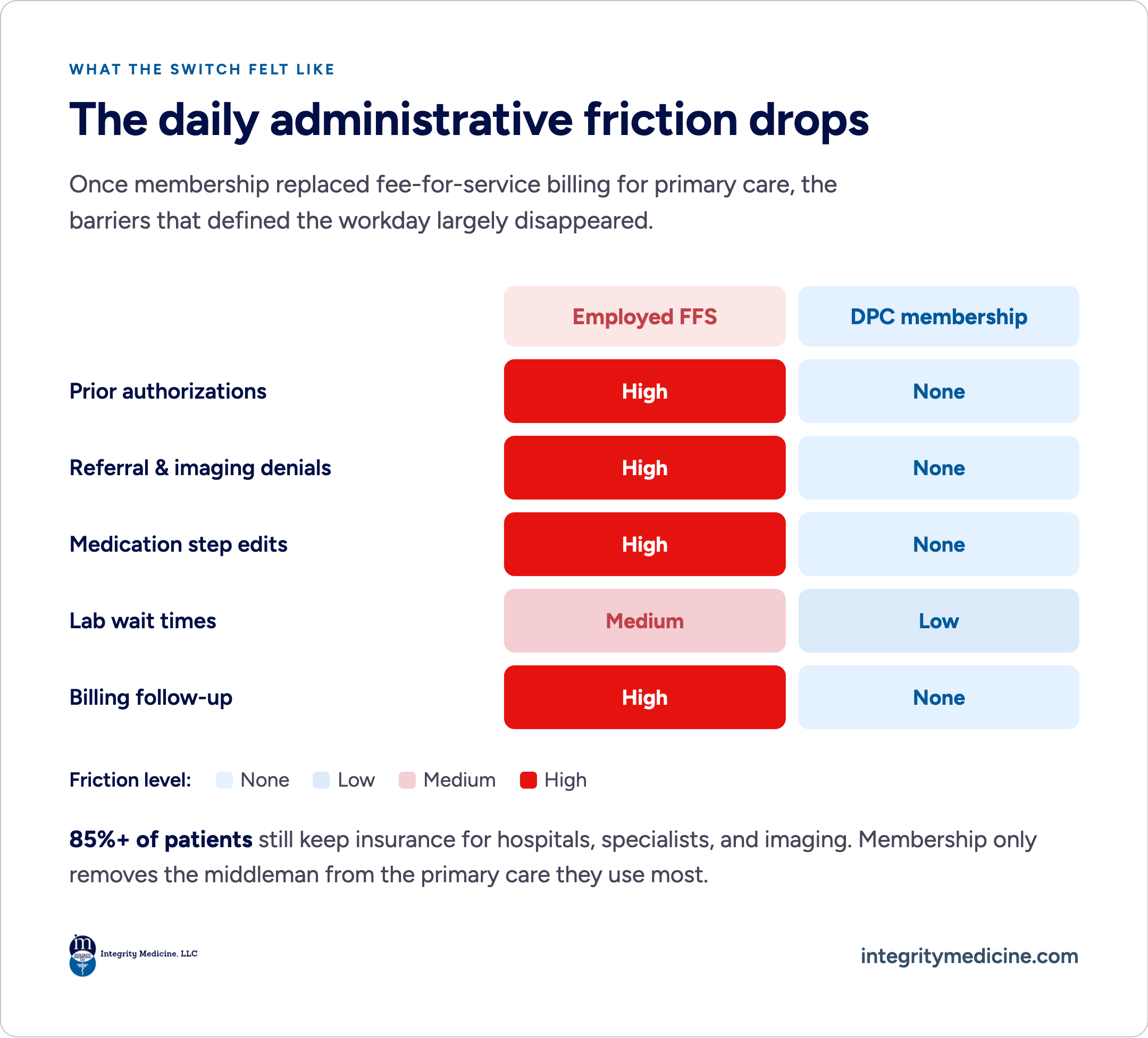
I converted our Integrity Medicine practice fully to Direct Primary Care in 2017 after more than a decade under the traditional insurance model. The specific friction was daily and concrete.
Denials for radiology or specialist referrals. Prior authorizations. Step edits on medications. Waiting periods for labs that delayed care patients needed.
Those barriers consumed time and energy that belonged to diagnosis and treatment. Once membership replaced fee-for-service billing for primary care, the administrative layer that had defined the workday largely disappeared.
I still make nearly all of my own appointments. Our physicians at Integrity Medicine continue to see their own patients when they are admitted at Newton Medical Center. That continuity is uncommon in many pure outpatient models and preserves the full-spectrum work many of us value.
The patient base remains stable. Over 85 percent of our patients carry insurance or other coverage for hospital care, specialists, and major procedures. The membership simply removes the middleman from the primary care they use most often.
Mentoring medical students fits naturally because the schedule is not driven by volume targets that leave no room for teaching. This same flexibility supports our approach to chronic disease management. Those day-to-day changes are the practical reason many physicians report higher satisfaction even when headline compensation is comparable.
You can read more about how hospital continuity works inside our Direct Primary Care practice and why Kansas physicians are choosing Direct Primary Care.
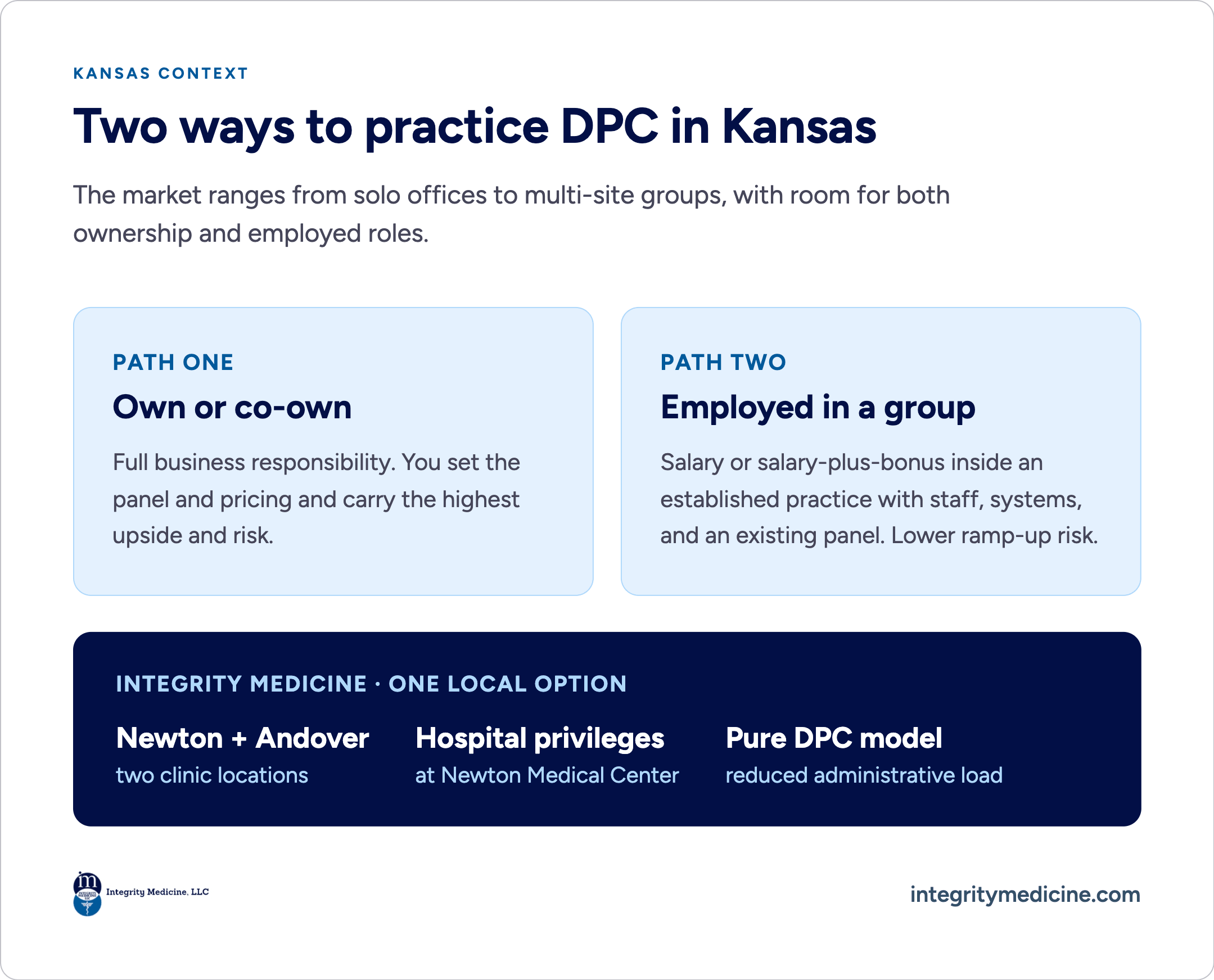
Kansas has a growing Direct Primary Care presence. Practices range from solo offices to multi-site groups. Some roles are pure ownership. Others offer employed positions inside established practices with systems, staff, and an existing panel already in place. Our approach at Integrity Medicine is detailed further in our guide to the best Direct Primary Care in Harvey County.
Integrity Medicine operates sites in Newton and Andover and maintains active medical staff privileges at Newton Medical Center. That combination of multi-site outpatient access and hospital continuity is one concrete local option for physicians who want the model without starting from zero. The reduced administrative load of the membership model (no routine insurance claims, prior authorizations, or coding intensity for primary care) makes the hospital work sustainable alongside same-day outpatient access.
The culture at Integrity Medicine emphasizes availability and clear communication over volume metrics. Physicians who join work inside a pure Direct Primary Care model with that reduced administrative load, while benefiting from existing locations and the ability to continue hospital work at Newton Medical Center.
You can see how the model works day to day on our Newton Direct Primary Care and Andover Direct Primary Care pages. For more on the practice itself, visit our About page.
If you are a physician considering the switch, the practical next step is a direct conversation about how the model works day to day, the local advantages, and whether it's a good fit. Reach out through our contact page and note that you are interested in physician opportunities. We can walk through the structure, the patient base, hospital work, and the non-financial returns that matter alongside compensation.
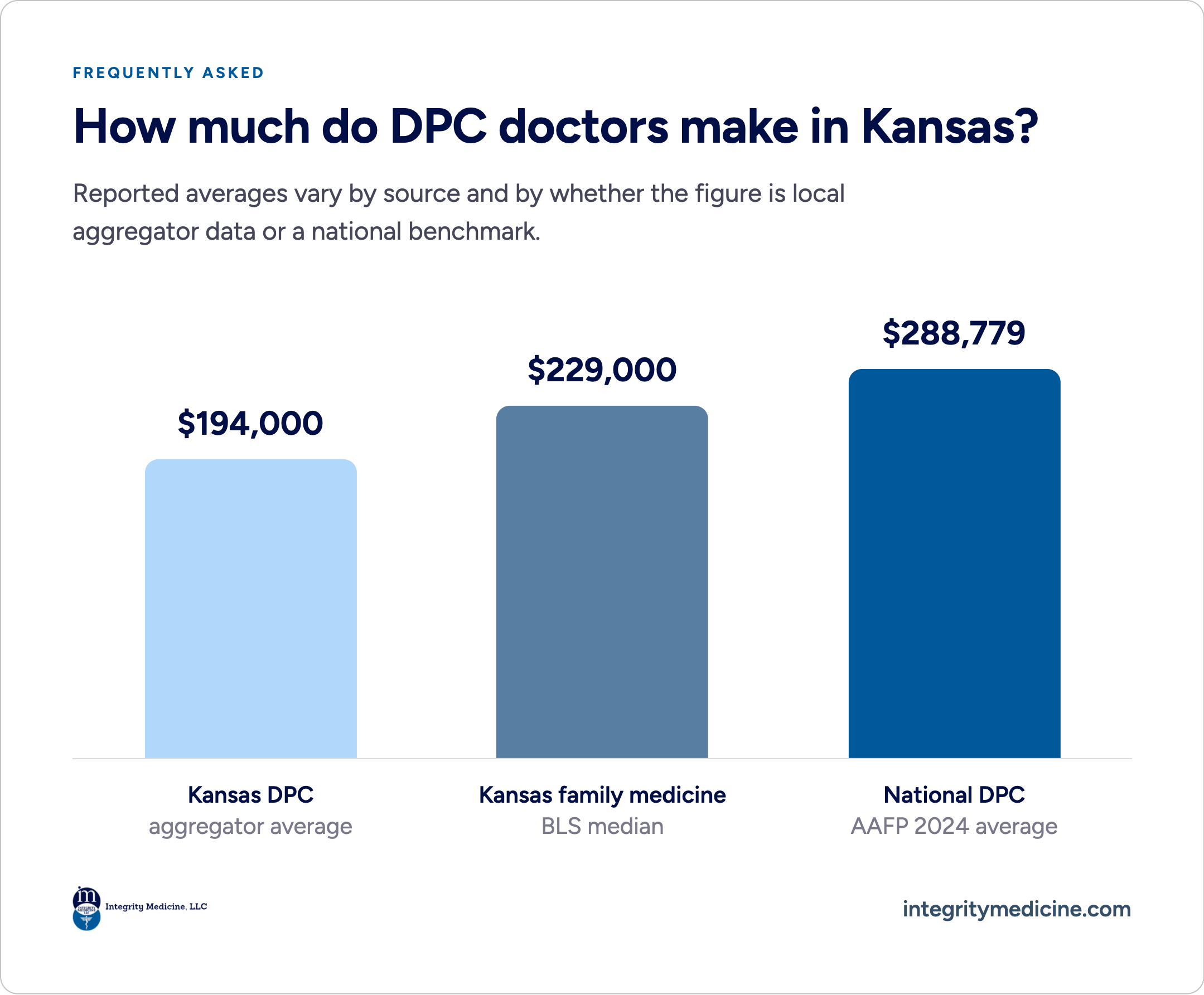
Published aggregator data for Direct Primary Care physician roles in Kansas centers near $194,000 on average, with ranges commonly reported between roughly $170,000 and $220,000 and higher figures for top earners or partnership tracks. The American Academy of Family Physicians 2024 Career Benchmark shows a national average full-time income of $288,779 for family physicians in Direct Primary Care settings.
Individual results depend heavily on panel size, membership rates, overhead, and whether the role is ownership or employed within a Direct Primary Care practice.
For primary care physicians (family medicine and general internal medicine), recent data from the Bureau of Labor Statistics and job aggregators place typical full-time figures in the low-to-mid $200,000s. BLS data for family medicine physicians in Kansas shows a median of approximately $229,000. Aggregator sites that track job postings report averages near $200,000–$245,000 depending on the source and year.
Specialists earn substantially more on average, which pulls overall “physician” medians higher when all specialties are combined.
It can be competitive once a panel is established, especially after accounting for lower overhead and reduced administrative time. Early years while a panel is building often produce lower income than a mature employed role. Many physicians report that the combination of comparable or better effective compensation plus substantially lower burnout and higher autonomy makes the overall package preferable even when base numbers are similar.
Employed roles inside an established Direct Primary Care group can still include benefits. Pure ownership shifts responsibility for health insurance, retirement contributions, malpractice, and disability coverage to the physician or the practice. Those costs need to be factored into any net comparison.
Yes, when the practice maintains active medical staff privileges and the local hospital allows it. At Integrity Medicine our physicians continue to care for their own patients at Newton Medical Center. That continuity is a meaningful part of the professional satisfaction for many Internal Medicine and Family Medicine physicians and is not automatic in every Direct Primary Care setting. For more detail see our piece on hospital continuity as a Direct Primary Care physician.
Membership revenue is more predictable month to month than pure fee-for-service once the panel is stable. The main uncertainty occurs during the ramp-up period of a new practice. Joining an established group reduces that ramp-up risk.
Direct Primary Care physician compensation in Kansas is competitive with many employed primary care roles. Published aggregator data places Kansas Direct Primary Care physician averages near $194,000, while the American Academy of Family Physicians reports a national full-time average of $288,779 for family physicians in Direct Primary Care settings in 2024.
The larger practical difference for most physicians sits in the reduction of administrative friction (no routine insurance claims, prior authorizations, or coding intensity for primary care), the restoration of clinical autonomy, smaller panels that allow longer visits, and the ability to continue hospital work when the practice maintains medical staff privileges.
Integrity Medicine, a pure Direct Primary Care practice with locations in Newton and Andover, does not publish individual physician compensation figures. Physicians who join work inside a membership model that supports both competitive income and full-spectrum practice, including care of their own hospitalized patients at Newton Medical Center.
If you are a Kansas physician evaluating whether this model fits your career goals, contact us to discuss physician opportunities in Direct Primary Care.