Newton: 316.283.6655
Andover: 316.202.9990
.jpg)
Newton: 316.283.6655
Andover: 316.202.9990
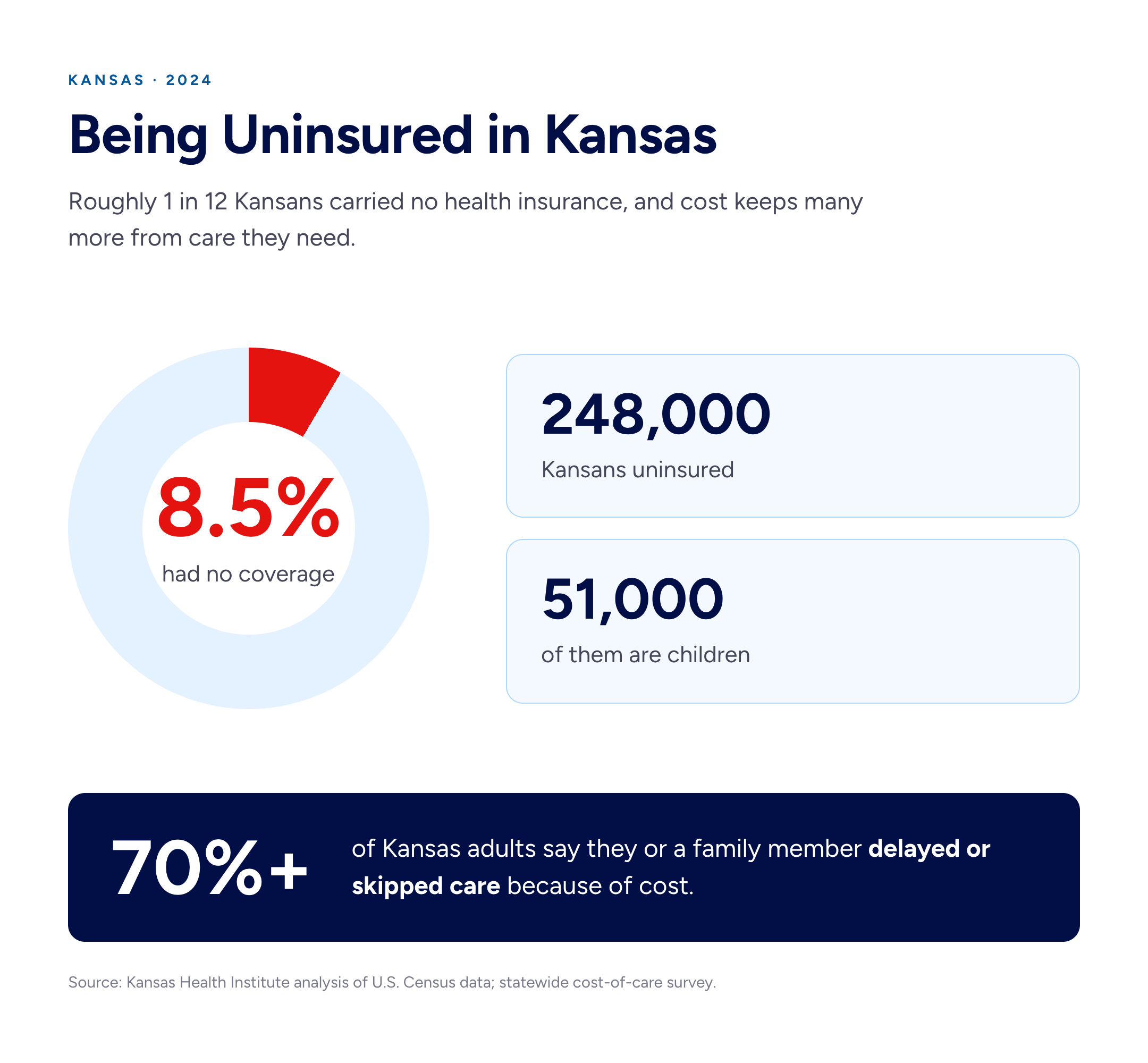
About 8.5 percent of Kansans, roughly 248,000 people including 51,000 children, had no health insurance in 2024. That figure comes from Kansas Health Institute analysis of Census data. More than 70 percent of Kansas adults in a recent survey said they or a family member delayed or skipped needed care because of cost.
Kansas has ranked among the lowest-cost states for a basic physician visit in older self-pay data. Real bills often climb higher once labs, facility fees, or specialist care enter the picture.
This guide lays out current ranges for primary care, urgent care, specialists, and emergency rooms in Kansas. It also shows the lowest-cost options available and the rights that keep bills from becoming surprises. The goal is practical numbers you can use when you call a clinic or schedule care.
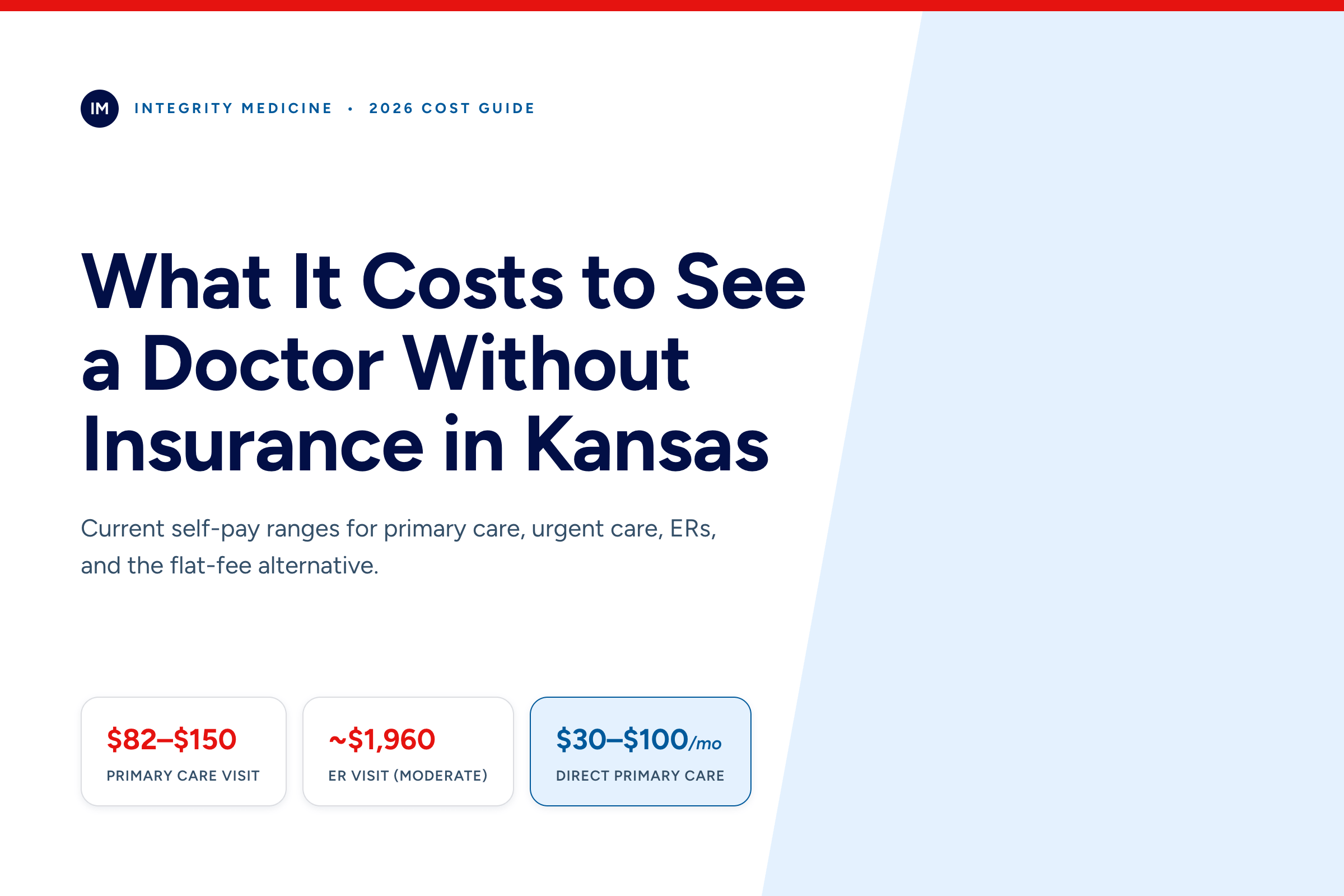
In Kansas, a basic primary care doctor visit without insurance typically costs between $82 and $150 according to available self-pay data and local clinic pricing, while national averages range from $100 to $300.
Older statewide self-pay claims data compiled by Sidecar Health placed a basic physician office visit in Kansas between $82 and $125. That data set covered claims from 2017 to 2019. A current named primary-care practice in the state lists a straightforward self-pay office visit at $150. That fee includes the examination, consultation, and many in-house tests. Sent-out labs, vaccines, and durable equipment are billed separately.
National guides place primary-care office visits without insurance in the $100–$300 range and specialist visits between $150 and $600. Urgent-care self-pay visits commonly run $150–$250. An average moderate-severity emergency-room visit in Kansas costs about $1,960 without insurance, according to 2026 data drawn from CMS sources.
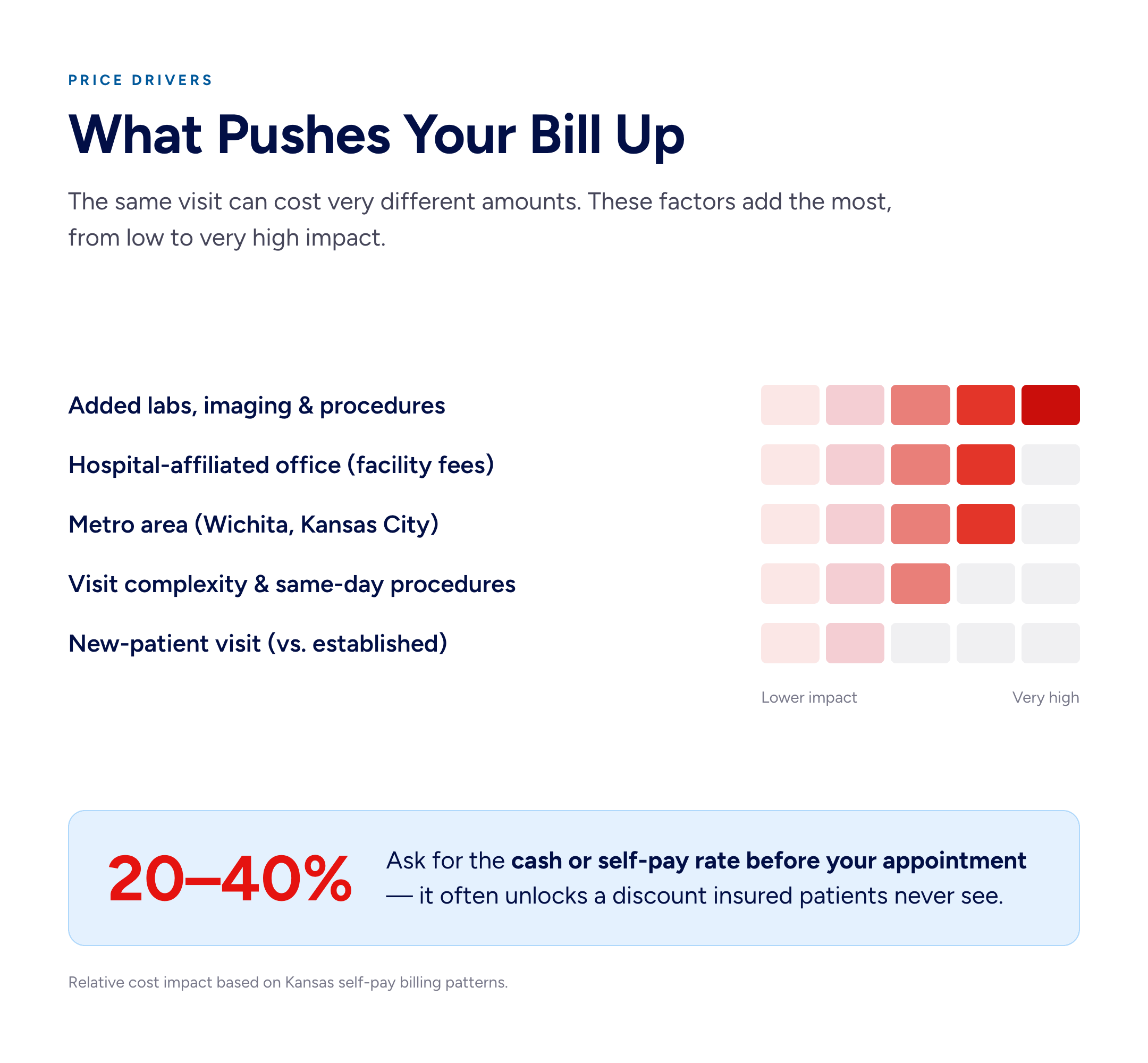
Labs, imaging, vaccines, and procedures are almost always billed separately and can add $25–$400 or more. New-patient visits cost more than established-patient visits. Hospital-owned practices frequently add facility fees that independent offices do not. For patients seeking more predictable primary-care costs, Direct Primary Care membership pricing offers a flat monthly alternative that covers unlimited visits.
Clinics in the Kansas City or Wichita metro areas often post higher facility-related charges than independent rural practices. Hospital-affiliated offices tend to bill more than freestanding primary-care groups.
Complexity of the visit raises the code and the price. A new-patient history, multiple problems, or procedures performed the same day all increase the total. Any diagnostic testing is billed on top of the visit fee.
Asking for the cash or self-pay rate before the appointment frequently unlocks a 20–40 percent discount that insured patients do not receive. Many offices will quote the self-pay price if you simply ask.
The difference between the listed charge and the cash price can be substantial. Asking early, before the service is rendered, gives you the best chance of locking in the lower number.
Federally Qualified Health Centers are required to offer sliding-fee discounts based on household income and size relative to the Federal Poverty Level. Patients at or below 100 percent of the Federal Poverty Level usually pay a nominal fee. Discounts continue up to 200 percent of the Federal Poverty Level.
Recent Kansas FQHC testimony and published schedules show nominal medical or behavioral-health fees in the $10–$50 range depending on the center and income tier. No one is turned away for inability to pay. Locate centers through the HRSA Find a Health Center tool or the Kansas Department of Health and Environment list. Systems such as Community Health Center of Southeast Kansas, GraceMed, Hunter Health, and others operate multiple sites across the state.
Retail clinics inside pharmacies handle many minor illnesses and immunizations for $60–$90. These can be a practical option for straightforward issues such as strep tests, basic wound checks, or vaccines when a full primary-care relationship is not yet in place.
Some free or charitable clinics exist in larger cities, though capacity is limited and wait times can be long. Always confirm current sliding-scale or free-clinic eligibility and required documents before the visit. Bring proof of income and residency when you apply for sliding-fee discounts. Many centers reassess eligibility annually.
For ongoing primary care rather than one-off visits, Direct Primary Care memberships provide unlimited visits for a flat monthly fee and often include discounted labs.
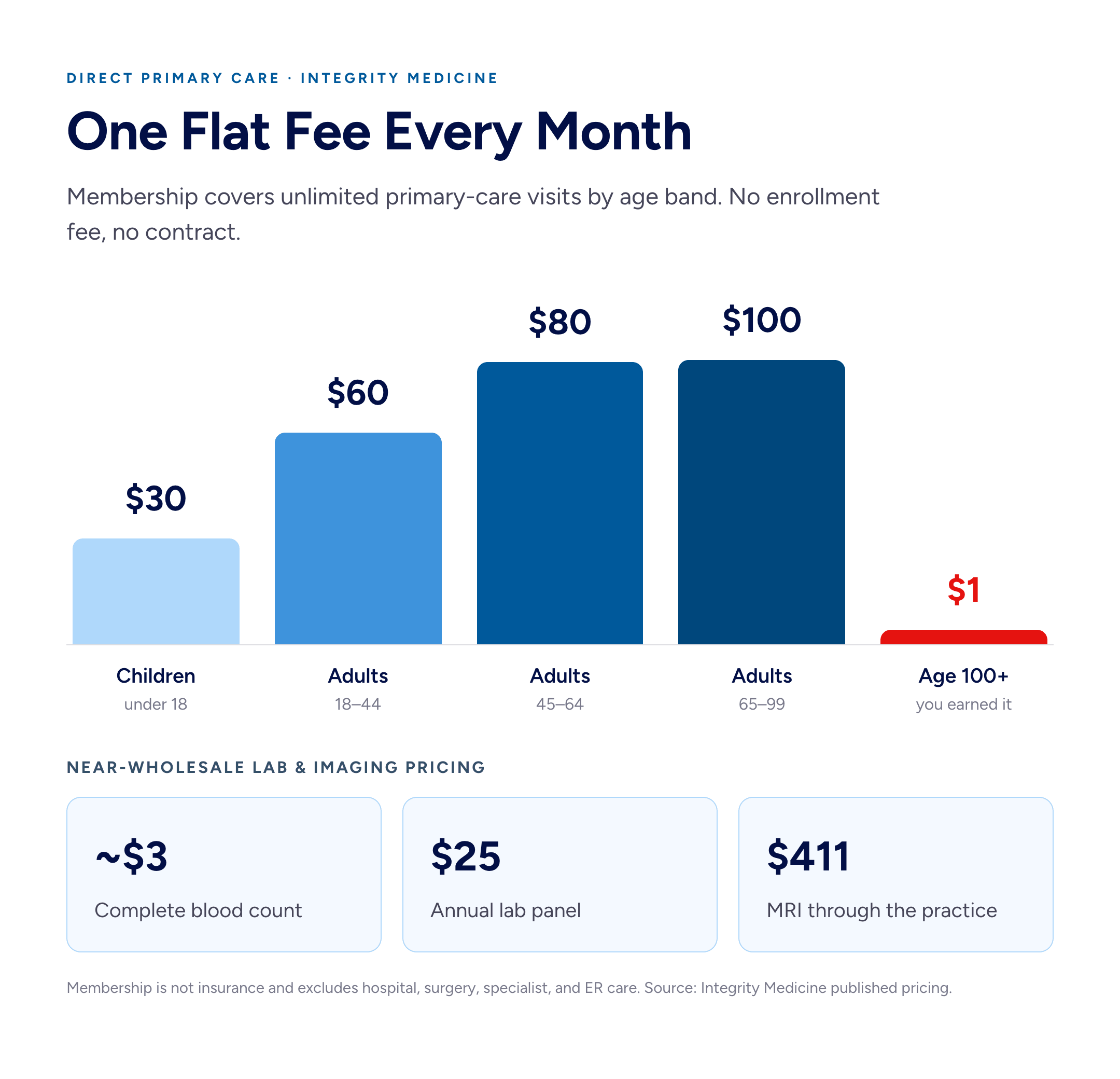
Direct Primary Care practices charge a flat monthly membership instead of billing insurance for routine visits. In Kansas, published rates commonly run $30 for children, $60–$80 for working-age adults, and up to $100 for adults 65 and older.
At Integrity Medicine the monthly membership is $30 for children under 18 (with a paid adult), $60 for adults ages 18–44, $80 for ages 45–64, $100 for adults 65-99, and $1 for adults 100 and older.
There is no enrollment fee and no long-term contract. Membership covers unlimited primary-care visits, preventive care, basic in-office procedures, and often discounted labs or medications at near-wholesale prices.
A complete blood count runs roughly three dollars. An annual lab panel of common tests costs $25-26. An MRI ordered through the practice has been available for $411. These prices are far below typical billed amounts.
Membership does not cover hospital stays, surgery, specialist care, or emergency-room visits. Over eighty-five percent of our patients still carry insurance. They use it for radiology outside the clinic, specialist care, hospital stays, and true emergencies. They simply stop billing insurance for primary care visits. The result is fewer surprise bills and less friction when something acute appears.
This model is especially useful for people managing chronic conditions who need regular follow-up without accumulating per-visit charges. Practices such as ours in Newton and Andover publish clear age-based fee schedules.
Pairing a Direct Primary Care membership with a high-deductible insurance plan or health sharing plan is a common approach for people who need primary care regularly but want predictable costs. Current Direct Primary Care membership pricing is available on our site.
Under the federal No Surprises Act, uninsured or self-pay patients are entitled to a Good Faith Estimate of expected charges for scheduled, non-emergency care. Request the estimate in writing. Providers must supply it within set time frames, usually one to three business days depending on how far in advance the service is scheduled.
If the final bill exceeds the estimate by $400 or more, you can dispute it through the federal patient-provider dispute-resolution process. Kansas hospitals and clinics must also maintain financial-assistance or charity-care policies. Nonprofit hospitals are required under IRS rules to offer reduced or free care to eligible low-income patients.
Always ask for an itemized bill and the cash-pay discount before services are rendered. Keep a copy of every estimate and every bill.
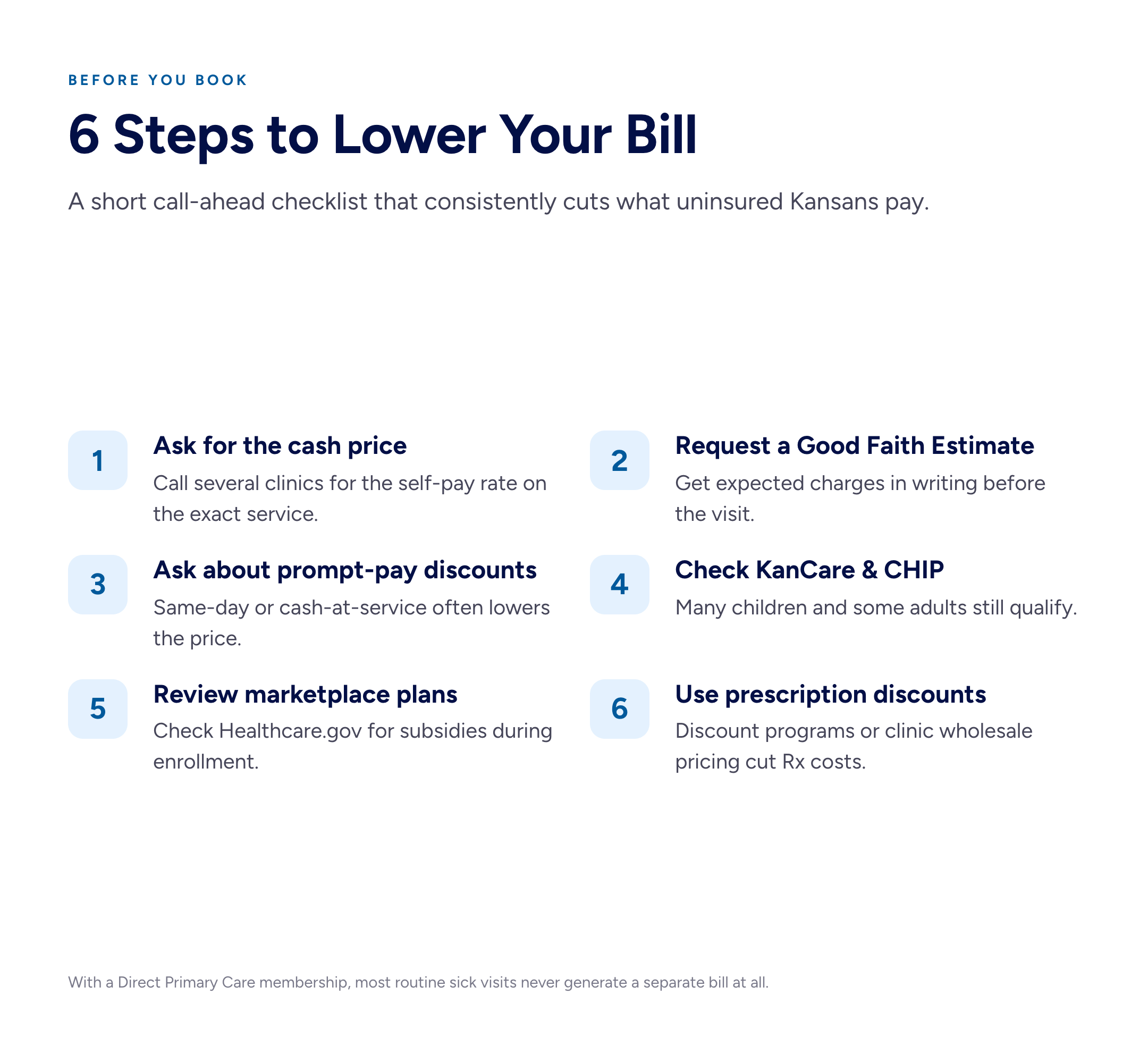
Call several clinics and ask for the self-pay or cash price for the exact service you need. Request a Good Faith Estimate in writing. Ask whether a prompt-pay or same-day discount is available. Inquire about payment plans before the visit.
Many independent practices will quote a lower cash rate if you make clear you are paying out of pocket at the time of service. Hospital-based clinics may have different policies, so the comparison is worth the few phone calls.
Check eligibility for KanCare (Kansas Medicaid) or CHIP even if you previously assumed you would not qualify. Kansas has not expanded Medicaid to the full ACA income limit, yet many children and some adults still meet existing criteria. Review marketplace plans on Healthcare.gov during open enrollment or a special enrollment period if income qualifies for subsidies.
For prescriptions, use discount programs or the clinic’s wholesale pricing when available. Keep records of every estimate and bill. If you already have a primary-care relationship through Direct Primary Care, most routine sick visits and minor injuries never generate a separate bill at all.
Patients from the Newton area can learn more about access at our Newton Direct Primary Care clinic. Those nearer Andover can see the same model at our Andover Family Medicine location. For a side-by-side look at how membership changes the cost of acute care, see our comparison of Direct Primary Care vs urgent care.
Older statewide self-pay data place a basic physician visit between $82 and $125. A current named primary-care practice lists $150 for an office visit that includes the exam and many in-house tests. National averages sit in the $100–$300 range. Labs and other services add extra cost.
Yes. Federally Qualified Health Centers must provide care on a sliding-fee scale based on income. Nominal fees for patients at or below 100 percent of the Federal Poverty Level commonly fall between $10 and $50. Use the HRSA locator or KDHE directory to find the nearest center.
A moderate-severity ER visit averages about $1,960. Complex or life-threatening cases climb much higher once tests, imaging, and procedures are added. Use urgent care or primary care for non-emergencies whenever possible.
It is a written list of expected charges that uninsured or self-pay patients can request before scheduled non-emergency care. Providers must supply it within specific business-day deadlines. Save the estimate; you can dispute a final bill that exceeds it by $400 or more.
Yes. Monthly memberships typically range from $30 for children to $60–$100 for adults depending on age and the practice. At Integrity Medicine the rates are $30 for children, $60 for adults 18–44, $80 for 45–64, and $100 for 65 and older. The fee covers unlimited primary-care visits and many basic services. It is not insurance and does not cover hospitals or specialists.
Yes. Many practices offer cash-pay discounts of 20–40 percent. Request the discount and a Good Faith Estimate before the appointment. Ask about payment plans and financial-assistance programs at hospitals.
Kansas remains one of the lower-cost states for basic physician visits in available self-pay data. The actual amount you pay depends on where you go, what is done during the visit, and whether you use the lowest-cost pathways available. Start with an FQHC if income qualifies, request a Good Faith Estimate everywhere else, and compare a few self-pay or Direct Primary Care options before you book. Checking KanCare or marketplace eligibility can change the picture for many households.
If you want to see how a membership model removes the per-visit bill for primary care, reach out to our team or review current pricing. The goal is the same whether you walk in with cash or with a membership card: clear costs and care that is actually available when you need it.