Newton: 316.283.6655
Andover: 316.202.9990
.jpg)
Newton: 316.283.6655
Andover: 316.202.9990
Direct Primary Care is a membership model where you pay your primary care doctor a flat monthly fee for unlimited primary care services. The practice does not bill insurance for those services. You get longer visits, same-day or next-day appointments, and direct access by text, phone, or email. Most people still keep a high-deductible plan for hospitals, specialists, and emergencies.
Patients who switch often describe the same frustrations: weeks-long waits, rushed appointments, and insurance paperwork that delays care. Direct Primary Care removes the insurance middleman from routine care so the doctor can focus on the patient.
This guide explains exactly what Direct Primary Care is, how the membership works, what it costs, how it compares with traditional and concierge models, and who benefits most.
Direct Primary Care (DPC) is a healthcare model in which patients or their employers pay a recurring flat fee, typically $50 to $150 per month, directly to a primary care practice. In return the practice provides comprehensive primary care without filing insurance claims for those services. The fee covers office visits, preventive care, chronic disease management, basic procedures, and direct communication with the physician.
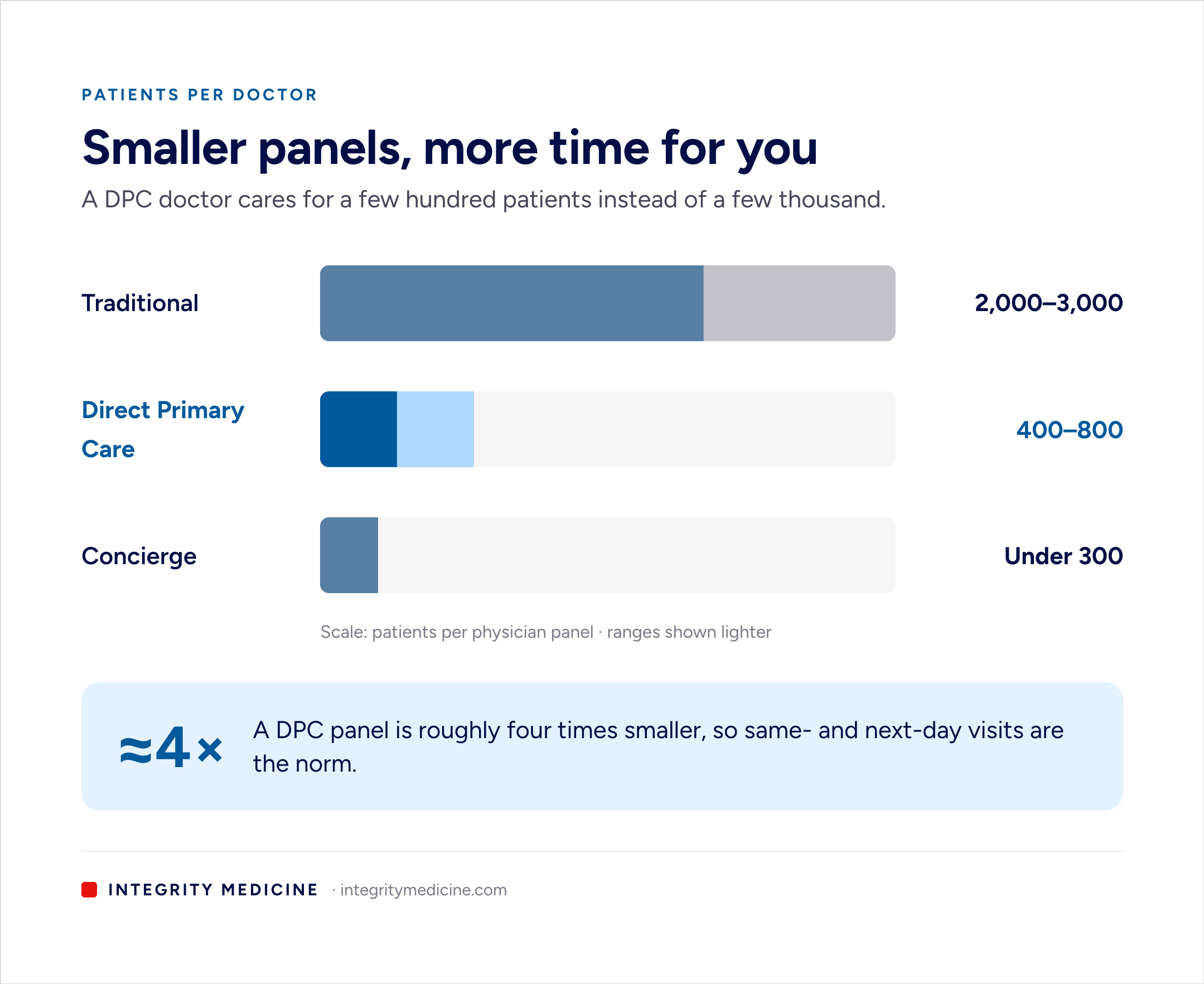
The American Academy of Family Physicians defines the model as one that charges a periodic fee covering most primary care services and bypasses traditional fee-for-service billing. Practices that follow the pure form of the model do not accept insurance, Medicare, or Medicaid for primary care. According to the 2024 AAFP Direct Primary Care data brief, the average patient panel size is around 400 and monthly adult fees most often fall between $50 and $100.
As a board-certified Internal Medicine physician, I founded Integrity Medicine in 2004 to practice medicine the way it should be practiced. By 2017 the insurance mandates and protocols were delaying the care patients needed. We converted fully to pure Direct Primary Care so we could remove those barriers. The result is a practice built around time with patients rather than billing codes. You can read more about our founding story and team.
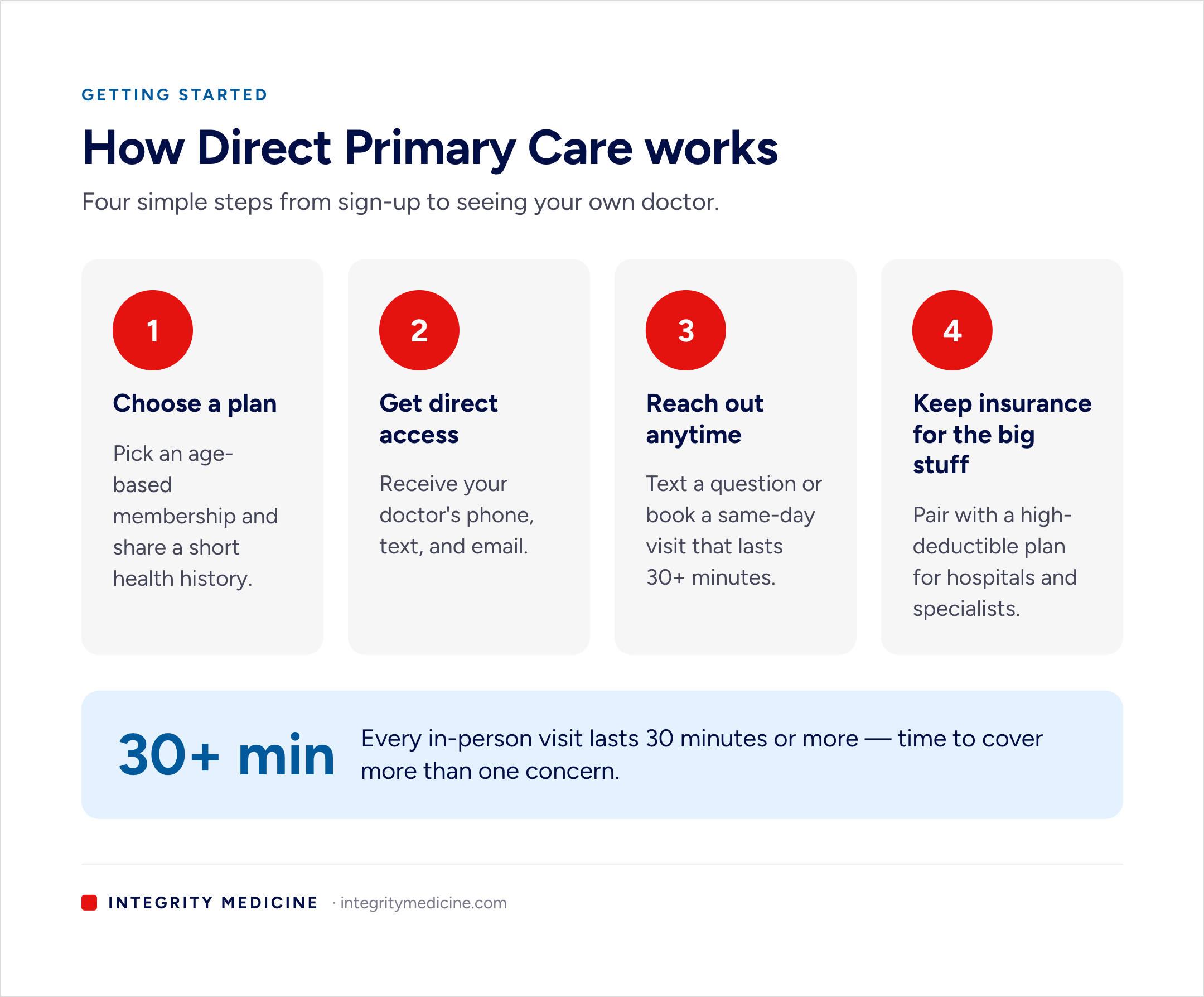
You enroll by selecting an age-based membership plan and completing a short health history. Once enrolled you receive your doctor’s direct contact information.
The monthly fee replaces per-visit charges and insurance billing for primary care. Most practices schedule same-day or next-day appointments because each physician limits the patient panel to a few hundred people instead of two thousand or more.
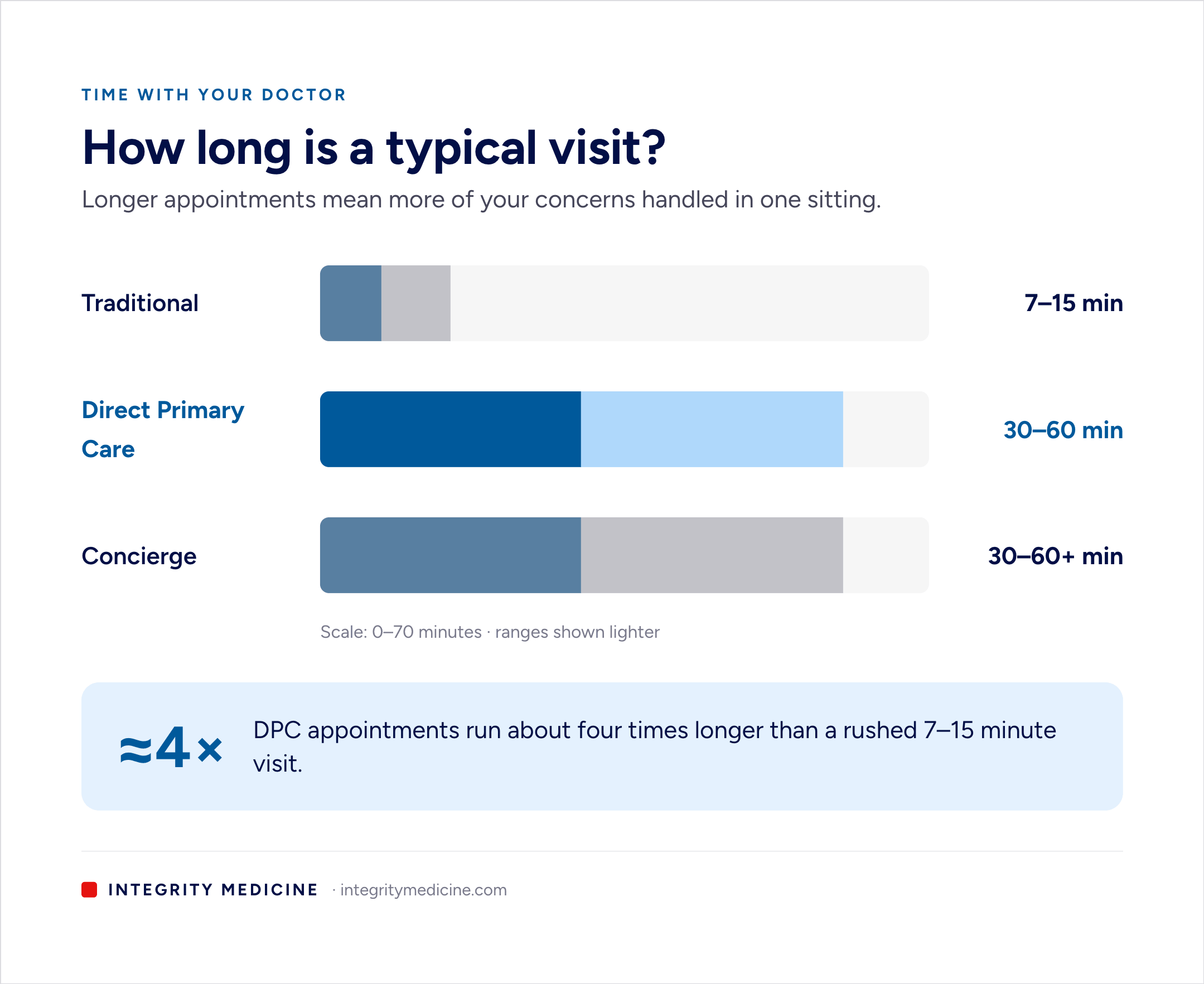
You can text or call your doctor with questions. Many issues resolve without an office visit. When you do come in, visits last 30 minutes or longer so the doctor can address multiple concerns in one session.
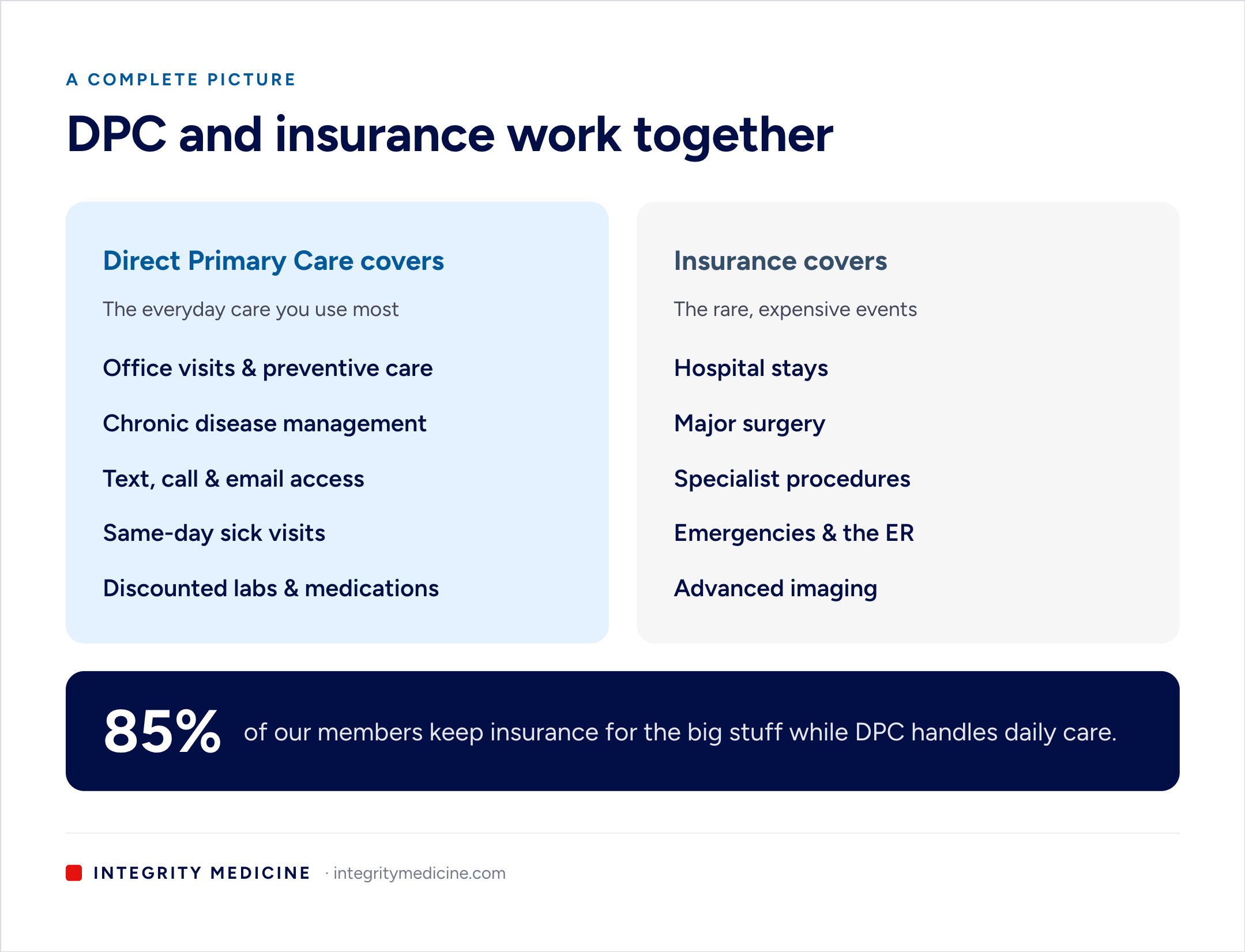
For anything beyond primary care, hospital stays, major surgery, or specialty procedures, you use a separate high-deductible health plan or similar coverage. The two pieces work together. Direct Primary Care handles the care you use most, while the insurance covers the rare expensive events.
Over 85 percent of our patients still carry insurance for those bigger needs. The membership simply takes the friction out of the primary care they use every day.
A standard Direct Primary Care membership covers:
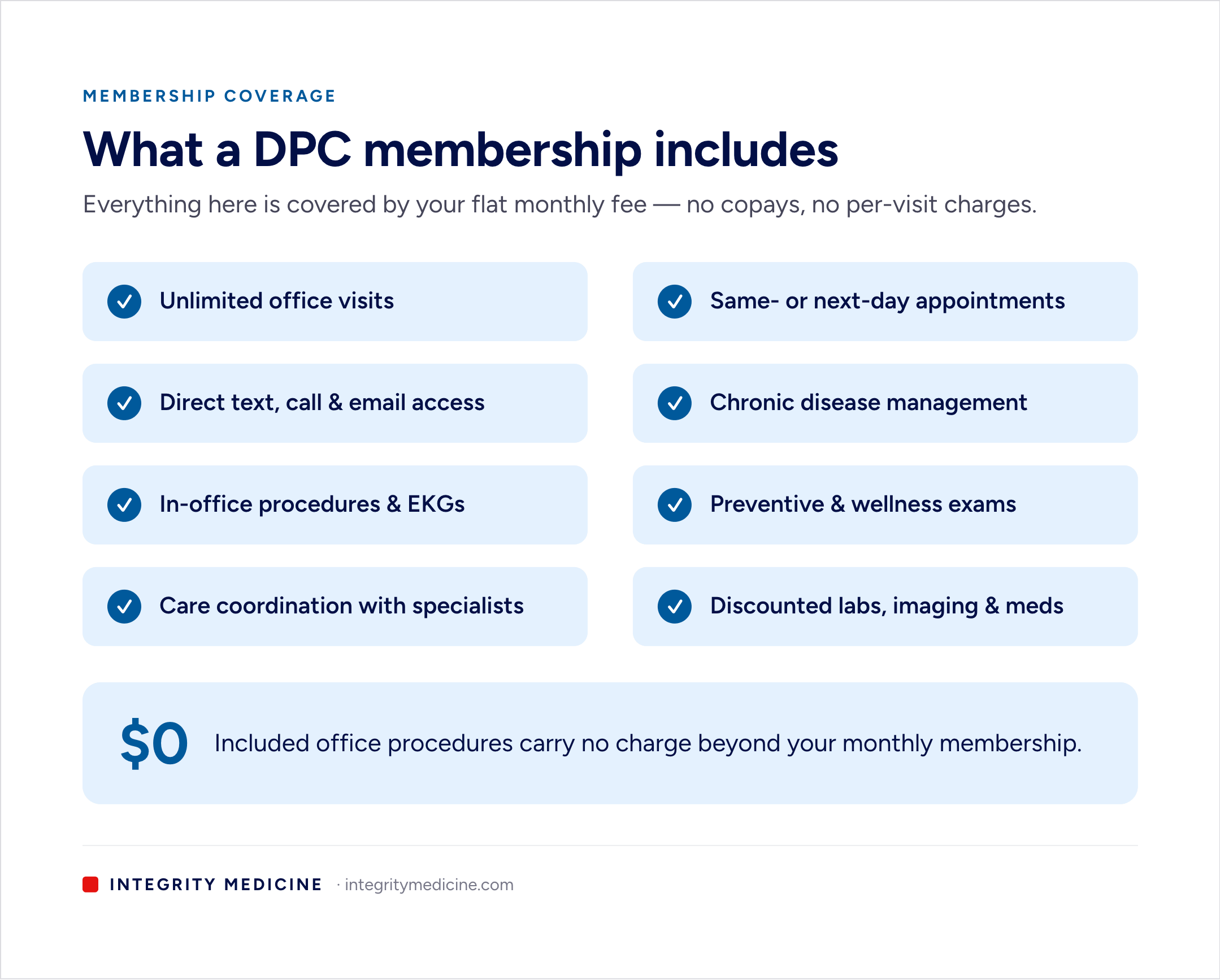
At Integrity Medicine the membership also includes a long list of procedures at no extra charge. These include pulmonary function testing, allergy testing, pap smears, well-woman and well-man exams, school and sports physicals, Nexplanon and IUD insertion or removal, mole and wart removal, joint and trigger point injections, biopsies, abscess drainage, laceration repair, and many others.
We also provide ongoing chronic disease management under the same membership, so patients with diabetes or hypertension can be seen as often as needed without extra bills.
Medications filled through the practice cost about 15 percent of standard retail prices. That is typically 85 percent cheaper than buying them elsewhere.
Services outside the membership, hospital care, advanced imaging ordered outside the office, or specialty procedures, are billed to your insurance or paid at cash rates. For a full picture of what is covered, see our overview of what a Direct Primary Care membership covers.
National data from the American Academy of Family Physicians shows most adult memberships fall between $50 and $100 per month. Children’s rates are usually lower. Some practices charge a one-time enrollment fee.
We publish transparent age-based rates on our pricing page:
There are no copays, no deductibles for covered services, and no surprise bills for the primary care you receive. Families often find the predictable monthly cost lower than the combination of premiums, copays, and missed-work time under traditional insurance-driven care.
As of January 1, 2026, qualifying Direct Primary Care fees are eligible for payment from a Health Savings Account up to $150 per month for an individual or $300 per month for a family when paired with a high-deductible health plan. This change is confirmed in IRS guidance under Notice 2026-05.
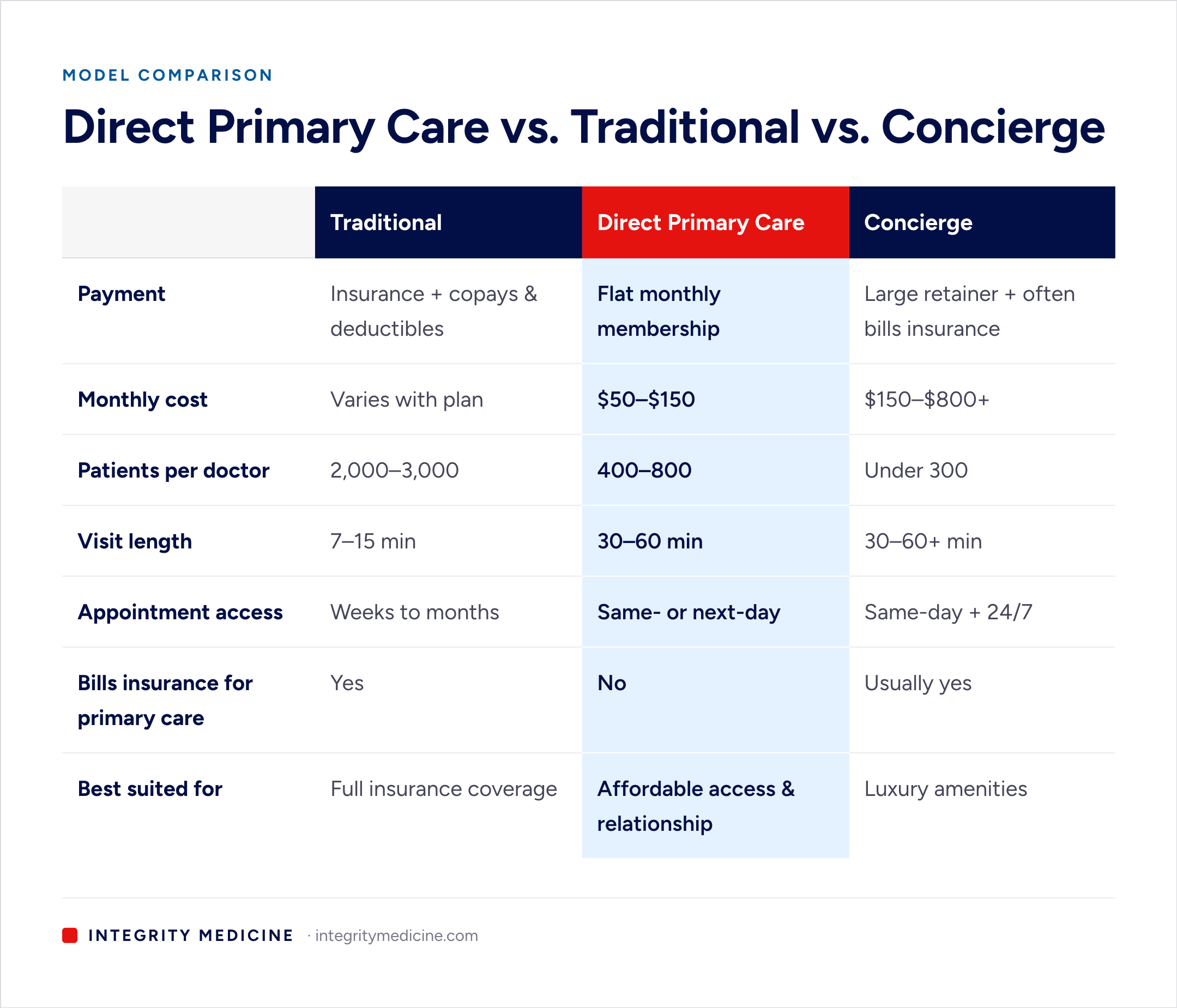
The key distinction is that pure Direct Primary Care practices rely solely on the membership fee and do not bill insurance. Concierge practices typically charge a large retainer on top of continued insurance billing. Traditional practices depend almost entirely on volume and insurance reimbursement.
For a closer look at how Direct Primary Care compares with urgent care for everyday needs, see our comparison of Direct Primary Care vs urgent care.
No. Direct Primary Care is not health insurance and is not a substitute for it. More than half of U.S. states have passed laws that explicitly define DPC agreements as non-insurance arrangements so they fall outside insurance regulation.
You still need coverage for emergencies, hospitalizations, surgeries, and specialist care. Most members pair Direct Primary Care with a high-deductible health plan or a health-sharing ministry. The combination keeps primary care simple and affordable while protecting against catastrophic costs.
Many patients ask whether they still need insurance after joining. We cover that question in more detail here.
Patients gain more time with a doctor who knows them. Appointments are longer and waits are short. Communication is direct. Many report fewer unnecessary emergency-room visits and better control of chronic conditions because care is continuous rather than episodic.
Physicians gain relief from billing paperwork and prior-authorization battles. Smaller panels and predictable revenue reduce burnout. AAFP data show high physician satisfaction in Direct Primary Care practices.
Members tell us the practical differences matter most. Texting a simple question often saves an unnecessary visit or a long wait. Removing the insurance provider from the middle of the relationship feels like the best choice they have made for their personal health care. When they do need to be seen, they never have a long wait.
Potential drawbacks exist. You pay the membership even in months you do not visit. Geographic availability varies. The model does not cover major medical events, so insurance remains necessary. Some critics note that shrinking panels can reduce overall primary-care capacity if many physicians leave traditional practices.
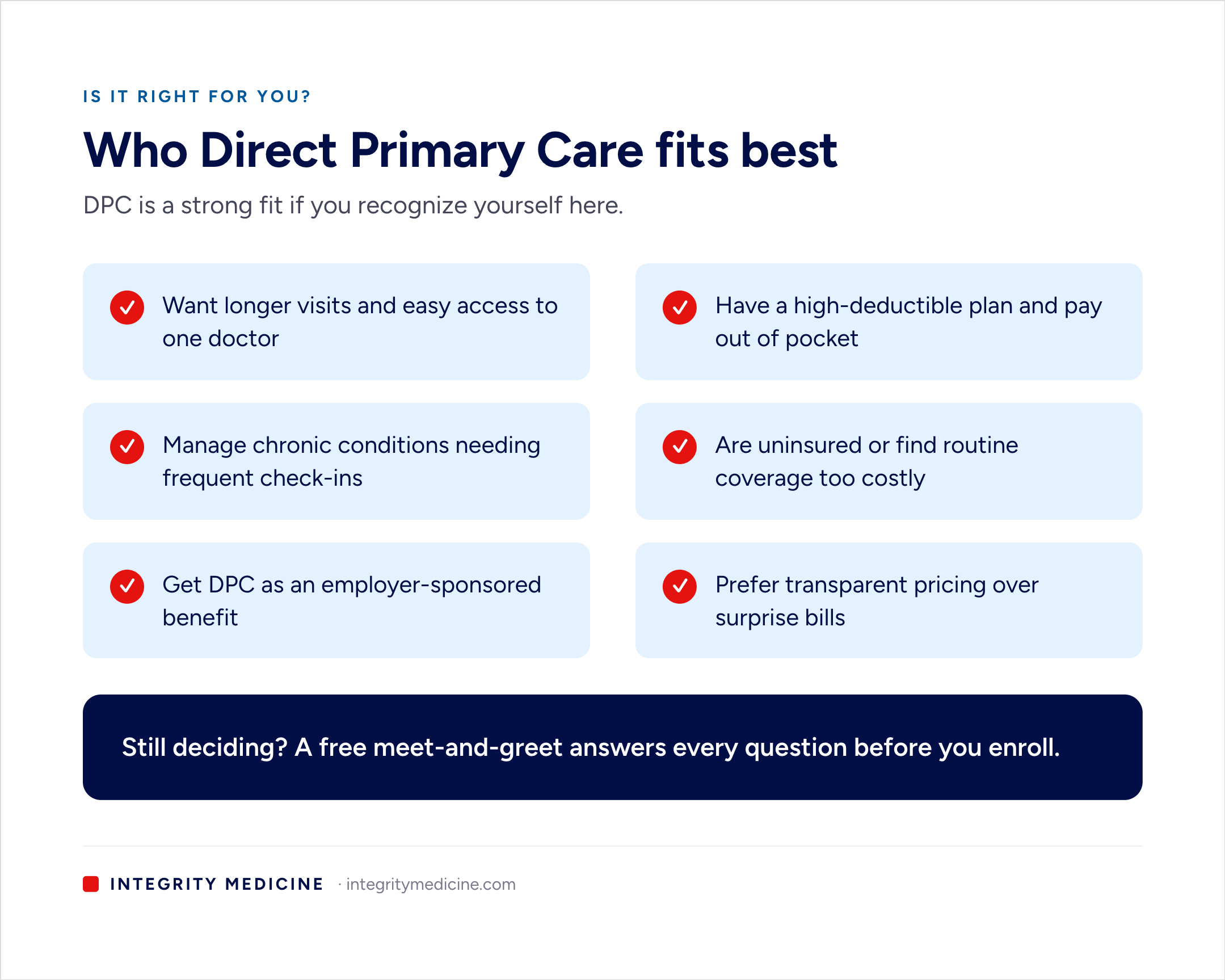
Direct Primary Care works well for people who:
It may be less ideal if you need frequent specialty care, live in an area with no Direct Primary Care options, or prefer every service to run through a single insurance card.
Yes. Starting January 1, 2026, the IRS allows Health Savings Account funds to pay qualifying Direct Primary Care membership fees up to $150 per month for an individual or $300 per month for a family. The practice must meet the statutory definition of Direct Primary Care, and the member must be enrolled in a high-deductible health plan.
This change makes the monthly fee tax-advantaged for many families already using HSAs. Full details appear in the IRS guidance on expanded HSA benefits.
Start with the DPC Alliance physician directory or the DPC Frontier mapper. Search by ZIP code and read the practice website for exact fees, included services, and whether the practice is pure or hybrid.
Ask these questions:
Schedule a free meet-and-greet. The conversation itself shows how accessible the doctor will be.
In Newton and Andover, Kansas, we offer pure Direct Primary Care with transparent age-based pricing, a long list of included procedures, and direct physician contact. Families across Harvey and Butler counties use the model for both routine and chronic care. You can learn more about our Newton location, our Andover location, family medicine in Andover, or schedule a free meet-and-greet.
No. Concierge practices usually charge several thousand dollars a year and still bill insurance for many services. Direct Primary Care charges a lower monthly fee and typically does not bill insurance for primary care.
Most adult memberships range from $50 to $100 per month according to AAFP data. At Integrity Medicine we charge $60–$100 for adults and $30 for children under 17, with no additional copays for covered services. See our full pricing for details.
Probably. Direct Primary Care covers primary care only. You need separate coverage for hospitalizations, emergencies, and specialty care. A high-deductible insurance plan or a good health sharing plan pairs well with the membership. Over 85 percent of our patients still carry insurance for those needs.
Yes. As of 2026, qualifying Direct Primary Care fees up to $150 per month (individual) or $300 per month (family) can be paid with HSA funds when you have a high-deductible health plan.
Your Direct Primary Care doctor coordinates the referral. The specialist or hospital bills your insurance or offers a cash rate. The membership itself does not cover those services. We maintain continuity for our patients at Newton Medical Center when hospital care is needed.
For people who value time with their doctor, predictable costs, and easy access, the model often saves both money and frustration compared with traditional high-deductible arrangements. Calculate your expected primary-care visits, current out-of-pocket spending, and the membership fee to decide.
Direct Primary Care replaces insurance billing for routine care with a simple monthly membership. You get longer visits and same-day access. You get a doctor who has time to know you. Pair it with a high-deductible plan for major medical needs and the combination covers most families’ real-world requirements.
If you are ready to see whether the model fits, start with a conversation. Schedule a free meet-and-greet at our Newton or Andover clinic and ask every question you have. The answer is usually clearer after you talk with the doctor who will actually care for you.
You can also review our full membership details, learn about Direct Primary Care for employers, or read more about our team and founding story.