Newton: 316.283.6655
Andover: 316.202.9990
.jpg)
Newton: 316.283.6655
Andover: 316.202.9990
Kansas business owners face the same squeeze every year. Premiums climb. Deductibles rise. Employees still wait weeks for a primary care appointment or lose a full day of work just to get seen. Many small teams try the cheapest insurance plan available and discover access is the real problem. Direct Primary Care changes the equation for the day-to-day care that keeps people productive.
This page shows exactly what employer Direct Primary Care costs at our Kansas practice, how it works for companies from five employees to one hundred fifty, how workplace injuries can be handled without raising your workers’ compensation rates, and the access culture that keeps employees from sitting in waiting rooms. You will leave with concrete numbers and a clear next step.
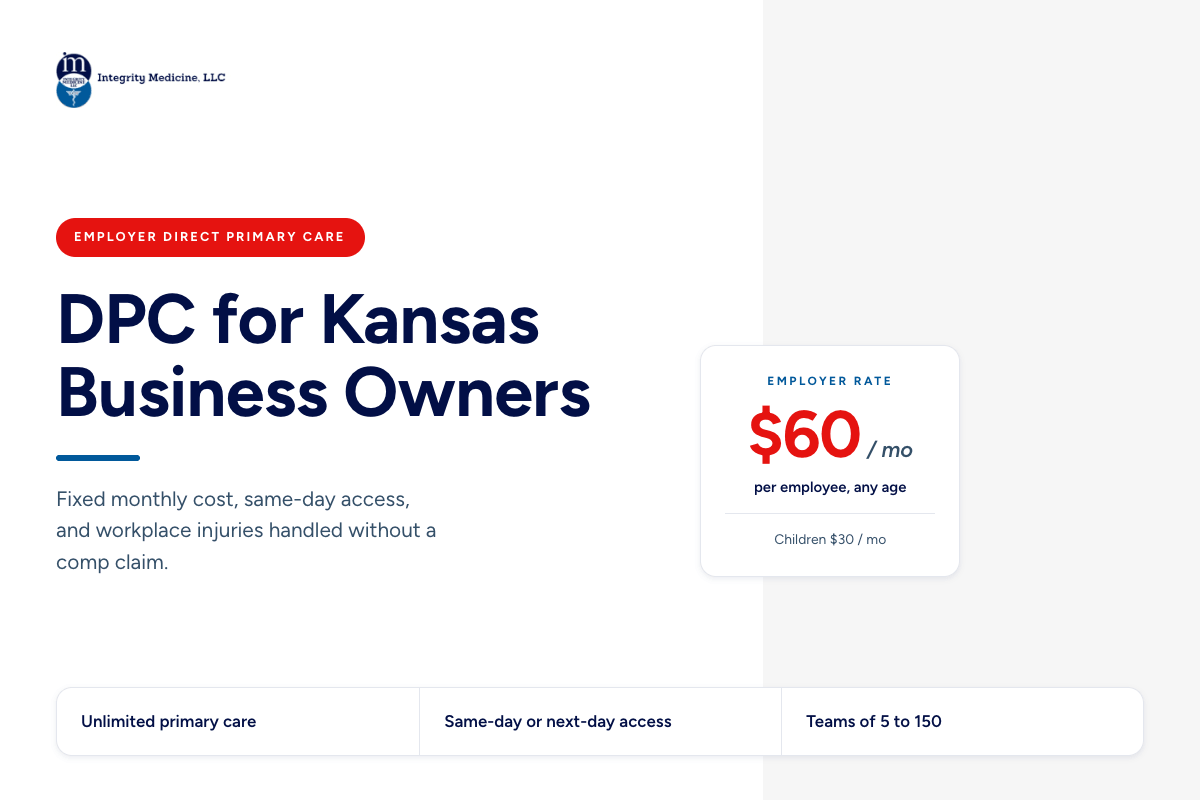
Employer membership at Integrity Medicine is sixty dollars per employee per month, regardless of age. Dependent children cost thirty dollars per month. The fee covers unlimited primary care visits, same-day or next-day access for acute needs, direct communication with the physician, and in-office procedures. There are no per-visit copays and no insurance billing for primary care.
Multi-generational families or family-run businesses can use the same employer rate by treating themselves as a business group. The minimum is five adult members on a shared account with auto-debit on the first of the month. Many groups give themselves a simple team name such as Roeser Farms, or Roeser Family Group.
.webp)
Labs and imaging are cash-priced at a fraction of typical insurance rates. Medications are available at wholesale cost. Employees can walk in without a wallet or purse. Charges accumulate and auto-debit monthly.
Over eighty-five percent of our members still carry traditional insurance for specialists, hospital care, and radiology outside the clinic. Direct Primary Care handles the primary care portion so the insurance plan does what it does best.
A ten-employee company pays six hundred dollars a month for adult memberships. That number is fixed and known in advance. Details on our employer Direct Primary Care program are available if you want the formal structure.
You can also review how much Direct Primary Care costs in Kansas for the full math or see our membership pricing page.
Schedule a free meet-and-greet if you want to discuss how these numbers would work for your team.
.webp)
Prices change on a regular basis. Check with your local provider or insurance. Prices here are an example of what the differences between cash price with Integrity Medicine and insurance pricing often look like.
The employer contracts directly with the clinic. Employees enroll and receive the same access as individual members. I and the other doctors personally schedule nearly all of our own appointments.
A patient can text their doctor with urgent concerns or just send an email if something is not urgent. Often the issue resolves by message or a prescription called to a local pharmacy without a visit. When an exam is needed, the slot opens the same day or the next.
Our current employer clients range from five-person mom-and-pop operations to one-hundred-fifty-employee companies. Common industries include construction crews of eighty to one hundred, honey producers of fifty to one hundred, churches with staff in the service area, and manufacturing operations around Hesston.
The model scales to the size of the team without requiring a large benefits department.
Membership is additive. It does not replace major medical coverage. Employees keep their insurance cards for everything outside primary care. We do not bill insurance for the membership services, which removes the administrative friction that drives up traditional primary care costs.
Most of our patients check in and never sit down. A staff member is already walking them back. Our team has run internal competitions to see how many patients can be seen without a single person waiting in a chair. Default appointments last thirty minutes and run longer when the problem requires it.
Here’s a quick example of how that speed and availability helps people get the care they need.
Teachers in Newton often have to take a full day off for a short appointment because of substitute rules. Nurses work hospital shifts that make daytime visits nearly impossible. We handle many of these patients by phone and leave medication in an exterior lockbox for pickup after 5:00 p.m. When an in-person visit is required, it typically takes less than an hour rather than a full day of lost work.
We want to be urgent care for our people. That is how we work for your enrolled employees. One Friday a patient walked into the Newton location at 4:58 p.m. with a hand full of blood. The assigned physician had already left. I cleaned the wound, numbed it, and closed the laceration. The patient left at 5:35. The visit was included in membership. No emergency-room bill.
Another morning a patient texted about a wrist problem. He needed to leave by 1 p.m. for a Royals game. We ordered an X-ray at Newton Medical Center within minutes. The film was reviewed the same day and he made the game. No office visit was required and no full day of work was lost.
Distance is rarely the bottleneck. Communication by email or phone often finishes the problem before the employee ever leaves the job site or home. Patients from Hesston (fifteen to twenty minutes), McPherson, Hillsboro, and farther resolve issues this way every day. For same-day needs see our same-day sick visits approach.
.webp)
When a workplace injury can be treated safely in the clinic, we handle it without automatically filing a workers’ compensation claim. That protects the employer’s experience modification rate. Construction, manufacturing, and production companies feel this difference most directly.
Friday afternoon lacerations have become routine. We close them in thirty to forty-five minutes. The emergency-room equivalent often runs around two thousand dollars and generates a claim that can affect future premiums. The membership covers the visit for enrolled employees. The employer avoids both the immediate cost spike and the longer-term rate impact.
Not every injury belongs in primary care. True emergencies still go to the hospital.
For the large volume of minor-to-moderate workplace injuries that do not require the ER, the Direct Primary Care option keeps the claim off the books when medically appropriate. This pairs well with the differences we outline in Direct Primary Care vs urgent care.
.webp)
The model works especially well for:
Hesston businesses sometimes chase the lowest-cost insurance plan available and still cannot get employees in to see a doctor. That which is cheapest is not always the best value. Access and total cost of care matter more than the sticker price of the premium.
Employers in Harvey County, Butler County, Reno County, and surrounding areas already use the model. Patients come from Newton, Andover, Hesston, Halstead, Hillsboro, McPherson, and farther. Our Newton physicians round on their own patients in the hospital. That continuity is unusual in the area and matters when an employee is admitted. You can learn more about the team on our About page. See our Newton Direct Primary Care and Andover location for the local footprint.
.webp)
Over eighty-five percent of our members carry traditional insurance. They use it for specialists, hospital stays, advanced imaging ordered outside the clinic, and true emergencies. Direct Primary Care simply removes the primary care visits, most labs, and many medications from the insurance claim stream.
The combination with a high-deductible health plan is common. The membership covers the frequent, lower-cost care that would otherwise burn through the deductible. The HDHP protects against large claims. The employer gains predictable monthly primary care cost while employees gain access that does not require them to hit a high deductible first.
Employees do not need money at the desk for primary care visits. Parents can send a teenage employee or dependent without a wallet. The bill arrives as the monthly membership auto-debit. For longer-term conditions that affect productivity, our chronic disease management approach keeps people working.
.webp)
The first step is a free meet-and-greet. Bring questions about team size, current plan design, workplace injury volume, or specific employee needs. The conversation is not a sales pitch. It is a practical review of whether the model fits and how enrollment would work.
Once the decision is made, the employer signs a simple agreement. Employees complete short enrollment forms. Memberships begin on a clear date with auto-debit from a designated account. New employees can be added as they are hired. The same process works for family-as-business groups.
Doctors at Integrity Medicine personally make nearly all of their appointments. The system is designed so the physician, not a front-desk algorithm, decides urgency and fit. That is part of the access difference small teams notice immediately. Schedule a free meet-and-greet when you are ready.
Employer membership is sixty dollars per adult employee per month and thirty dollars per child. A ten-person adult team costs six hundred dollars monthly. Family groups of five or more adults can use the same sixty-dollar rate on a shared account.
No. Over eighty-five percent of our members keep their insurance for specialists, hospitals, and major claims. Direct Primary Care handles primary care, most labs, and many medications at transparent cash prices so the insurance plan is reserved for larger expenses.
Many minor-to-moderate injuries can be treated in the clinic without filing a workers’ compensation claim. That protects the employer’s experience modification rate. Serious injuries still go to the appropriate emergency setting. Construction and manufacturing employers use this option regularly.
Most acute needs are handled the same day or next day. Many issues resolve by email or phone without an office visit. Patients check in and are usually taken back immediately rather than waiting in a chair.
5 adults is the minimum to sign up for an employer membership or family-as-business groups. Current clients range from five-person operations to one-hundred-fifty-employee companies.
Yes. Hesston patients come every day. Communication by email or phone often resolves the issue before any drive is required. When an exam is needed, the fifteen-to-twenty-minute drive from Hesston or the forty-five-minute drive from McPherson still beats waiting weeks for an appointment closer to home.
Kansas business owners face rising premiums that still leave employees waiting, or cheap plans that deliver no real access. Direct Primary Care at sixty dollars per employee delivers unlimited primary care, same-day access, transparent cash pricing on labs and medications, and a practical way to handle many workplace injuries without automatic rate increases.
The model already serves construction crews, honey producers, Hesston manufacturing teams, churches, and small family businesses across Harvey and Butler counties. The next step is a short conversation to see whether the numbers and the access fit your team.
Schedule a free meet-and-greet or review the employer program details to start the discussion.