Managing Diabetes and Blood Pressure Through the Holidays (and Reaching Your Doctor Over Long Weekends)

November 23, 2026
Written by
Dr. Robert Roeser
•
Medically reviewed by
Dr. Robert Roeser
image of a doctor with a patient

Get Started with DPC Today

Schedule Free Meet & Greet

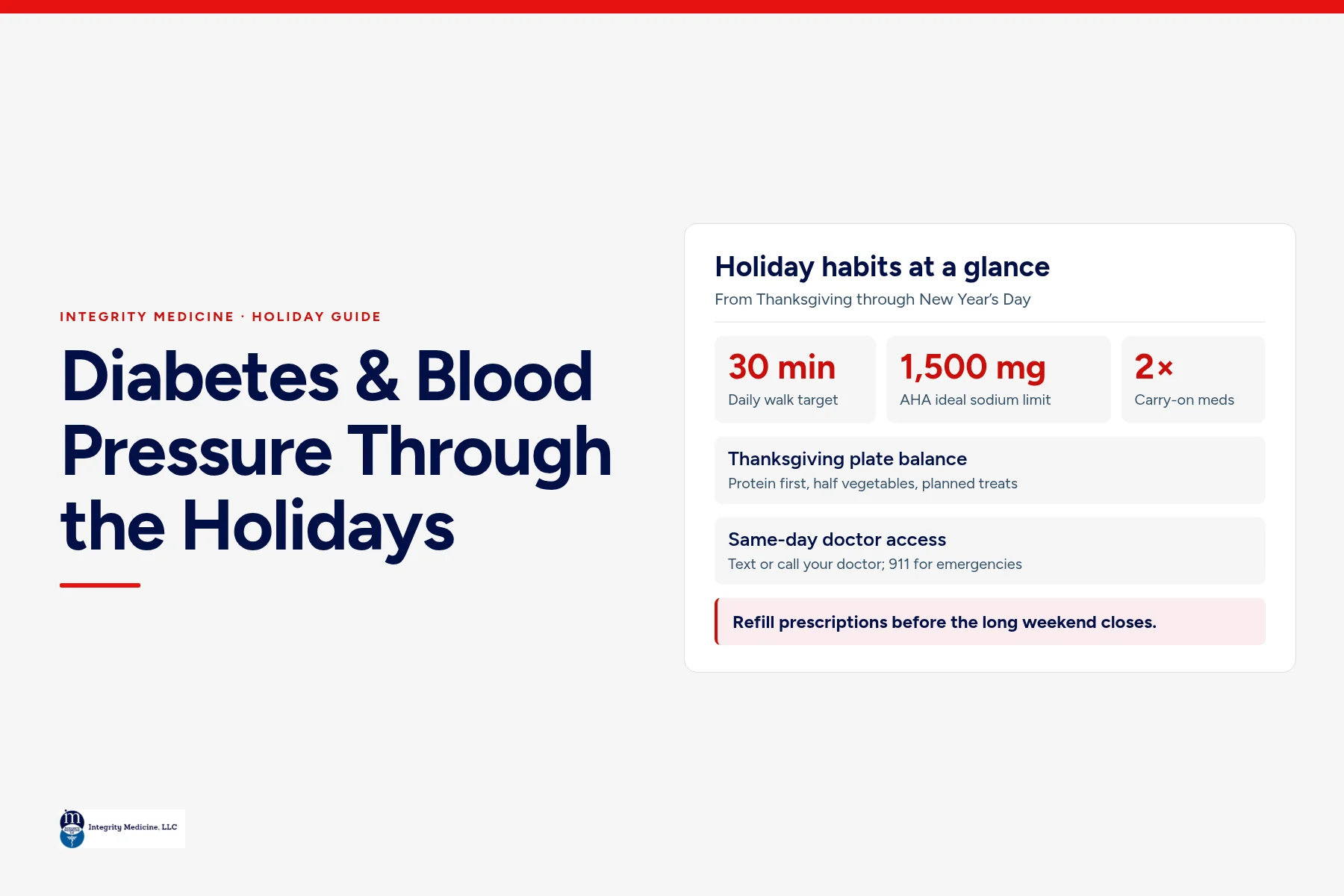
Managing diabetes during the holidays comes down to a few steady habits: eat close to your usual times, go easy on alcohol and salty dishes, keep taking your medications, and check your numbers more often than usual. Refill prescriptions before the long weekend, walk 30 minutes every day, and know how to reach your doctor.

Thanksgiving is Thursday, Nov 26, and the stretch through Christmas to New Year's brings big meals, late nights, and long drives to see family. Rich food, extra drinks, stress, and short sleep can push both blood sugar and blood pressure up during those weeks, and many of our patients manage both.

This guide sticks to the holiday weeks. Our year-round approach to managing chronic disease and diabetes has its own post.

Key takeaways
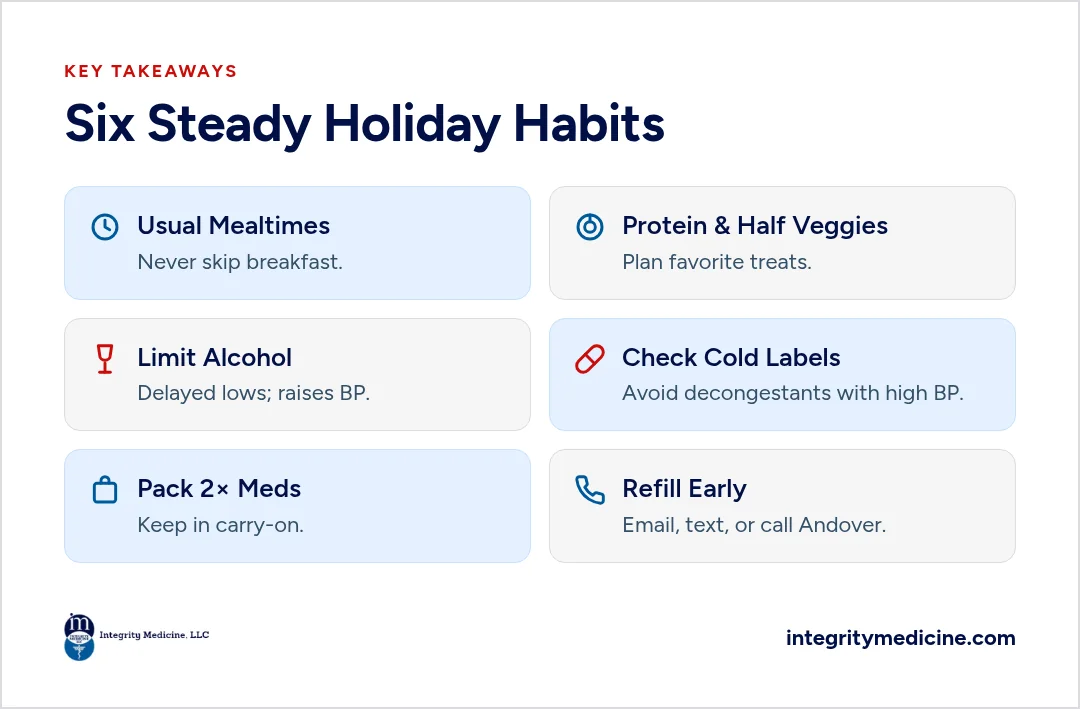
  • Eat close to your usual mealtimes, and don't skip breakfast to save room for dinner.
  • Eat the protein first. Fill half your plate with vegetables, and plan for the treats you love most.
  • Alcohol can drop blood sugar hours later and can raise blood pressure.
  • Check cold medicine labels for decongestants, which can raise blood pressure.
  • Pack twice the medication you think you'll need, in your carry-on.
  • Refill before the long weekend, and know how to reach us by email, text, or the Andover office line.
Six holiday habits: keep usual mealtimes without skipping breakfast, eat protein first and fill half your plate with vegetables, limit alcohol, check cold medicine labels for decongestants, pack 2x medication in carry-on, and refill early.

‍

How do I reach my doctor during the holidays?

Email is the right place for scheduling, refills, and anything that can wait until the next day or later. We answer those within 24 to 48 hours.

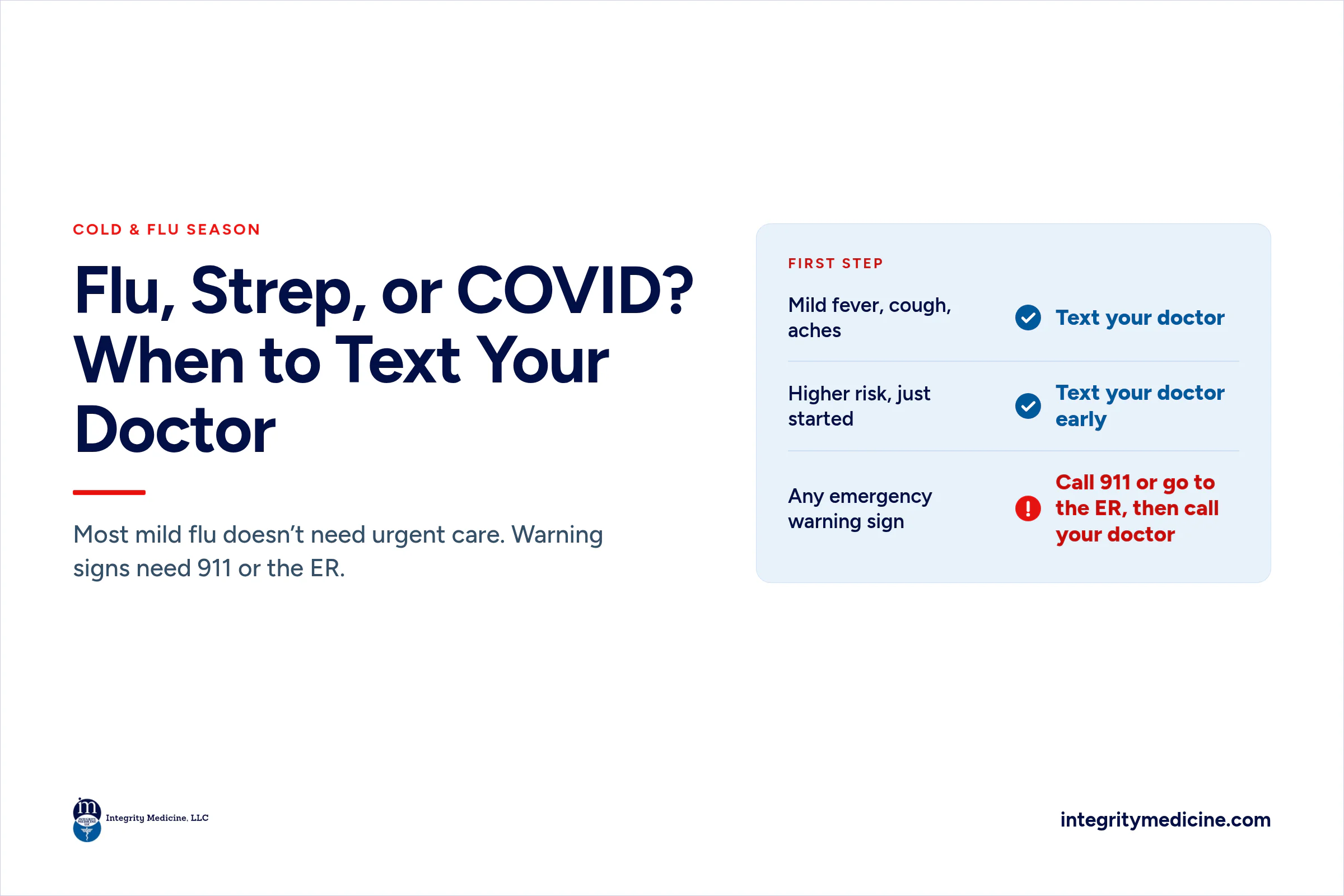
For a same-day need, text or call your doctor. At Integrity Medicine, a text usually gets a near-immediate reply. On a busy day it can take about 45 minutes, and if you need to be seen sooner, call the office. Posted hours are Monday to Friday, 8:30 AM to 5:00 PM, with a lunch break from 12:00 to 1:30 PM.

If you're facing a true emergency, such as chest pain, passing out, or you can't talk on the phone, please call 911 or go to the nearest ER right away so you get care quickly. Then call your doctor so they can work with the emergency team if necessary.

And please don't worry about bothering us. Some of our patients have held off on reaching out because they didn't want to be a bother. We're here to serve you and we'd always rather hear from you when you have a concern.

Holiday contact guide: email for refills and scheduling (24 to 48 hours); text for same-day questions (about 45 minutes on busy days); call the Andover office Mon-Fri 8:30 AM-5:00 PM; call 911 or go to the ER for emergencies, then call your doctor.

‍

How do I make sure I don't run out of medication over a long weekend?

Ask for refills before the office closes, not on the day you take your last pill, so there's time to get them ready.

  • Count what you have left of every daily medication, including insulin, test strips, CGM sensors, pen needles, and blood pressure pills.
  • Add the days you'll be traveling, plus a few extra in case weather or a canceled flight delays you.

The CDC also suggests checking, before a trip, how you'd get a refill if you needed one away from home.

Three-step refill checklist before the office closes: count insulin, pills, test strips, CGM sensors, and pen needles; add travel days plus extra buffer days for delays; check CDC guidance on getting refills away from home.

‍

When should I call my doctor or go to the ER over the holidays?

Call your doctor when your numbers stay off your usual range for more than a day, or you aren't sure how to adjust a medication. Please call 911 for chest pain, passing out, or if you can't talk on the phone. Call 911 as well when a blood pressure reading higher than 180/120 comes with warning symptoms, like chest pain or headache, or when someone shows signs of a stroke or a severe low.

‍

When to contact your doctor

  • Blood sugar readings that stay off your usual range for more than a day
  • More than one low in a short stretch, or lows you can't explain. The American Diabetes Association defines a low as below 70 mg/dL and treats it with the 15/15 rule: 15 grams of fast-acting carbohydrate, then a recheck in 15 minutes.
  • Home blood pressure readings that stay higher than usual for several days
  • A blood pressure reading higher than 180/120 that stays that high on a second check a minute later, with no symptoms. The American Heart Association says to contact your healthcare professional as soon as possible.
  • Questions about timing insulin or other medications around a late dinner or a time zone change

‍

When to call 911

  • Blood pressure higher than 180/120 with chest pain, shortness of breath, back pain, numbness, weakness, a change in vision, or difficulty speaking. The American Heart Association calls this a hypertensive emergency.
  • Any stroke warning sign: sudden loss of balance, vision changes, face drooping, arm weakness, or speech difficulty (American Stroke Association B.E. F.A.S.T.). Call even if the symptoms go away.
  • Someone with diabetes who is unconscious or can't eat or drink to treat a low. The American Diabetes Association says to call 911 if glucagon isn't available or no one there knows how to use it.
  • A fall where you hit your head, or bleeding that won't stop
Triage split: contact your doctor for blood sugar off range over 1 day, repeated lows under 70 mg/dL, high BP for days, or BP over 180/120 without symptoms; call 911 for BP over 180/120 with symptoms, B.E. F.A.S.T. stroke signs, or unconscious lows.

‍

How do you manage diabetes at Thanksgiving dinner?

Eat close to your usual times, and don't skip meals to save up for the big one. If dinner runs late, the CDC suggests a small snack at your usual mealtime and a little less when the meal is served.

  • Skipping meals can backfire. Going hungry all day makes overeating more likely, and it can throw off medications sized for normal meals.
  • Fill half your plate with vegetables. Then add protein, and leave room for the starches and sweets you care about most.
  • Plan your carb trades. Having pie? Go lighter on the rolls, stuffing, or potatoes.
  • Slow down. It takes at least 20 minutes for your brain to register that you're full, so wait before going back for seconds.
  • Walk after the meal. Even 10 minutes helps, and a lap around a cold Kansas neighborhood with the cousins counts.
Thanksgiving plate chart: half vegetables, protein first, and planned starches or sweets. Trade carbs if eating pie, wait 20 minutes before seconds, do not skip meals, and walk 10 or more minutes after eating.

‍

How does alcohol affect blood sugar and blood pressure?

Alcohol can cause a low blood sugar hours after your last drink, and drinking too much can raise blood pressure. Eat when you drink, and keep it moderate.

  • Delayed lows. The American Diabetes Association explains that your liver processes alcohol before it releases stored glucose, so a low can show up hours later, especially with insulin or sulfonylureas.
  • Being tipsy can look like a low. Slurred speech, drowsiness, and confusion can come from either, so tell someone with you that you have diabetes and check your blood sugar before bed.
  • The ADA defines moderate as one drink a day for women and up to two for men. One drink is 5 ounces of wine, a 12-ounce beer, or 1.5 ounces of spirits.
  • Skip the sugary mixers and the salt rim. Eggnog and sweet cocktails raise blood sugar, and a salt-rimmed glass adds sodium.
ADA moderate alcohol limits: 1 drink per day for women and up to 2 for men (5 oz wine, 12 oz beer, or 1.5 oz spirits). Eat when drinking, skip sugary mixers and salt rims, and check sugar before bed for delayed lows.

‍

Why does blood pressure go up during the holidays?

Salty holiday food, extra alcohol, stress, short sleep, and missed doses all push blood pressure up at the same time. Many cold medicines can add to it.

  • Sodium hides in holiday staples. Ham, gravy, canned soups, and packaged sides carry a lot of it. Federal guidelines recommend less than 2,300 mg a day, and the American Heart Association suggests 1,500 mg as an ideal limit for most adults.
  • Stress works against you. Stress hormones such as adrenaline and cortisol raise blood sugar, and stress has been linked to high blood pressure. Even a short walk to clear your head counts as taking care of yourself.
  • Sleep matters more than it seems. Even one night of disrupted sleep can increase insulin resistance, according to AHA News.
  • Routines slip. A pill organizer and a phone alarm keep blood pressure medicine on schedule when days look different.

‍

Are cold medicines safe if I have high blood pressure?

Many cold and flu medicines contain decongestants, such as pseudoephedrine or phenylephrine, which narrow blood vessels and can raise blood pressure. Check the label before you buy, and ask us or your pharmacist first.

The American Heart Association says people with uncontrolled high blood pressure or heart disease should avoid oral decongestants. Some pain relievers in combination cold products, called NSAIDs, can also raise blood pressure. Saline nasal spray, rest, and plenty of fluids are gentler places to start.

Daily sodium bar chart comparing the 1,500 mg AHA ideal limit and 2,300 mg federal limit, alongside holiday triggers like oral decongestants, NSAIDs, stress, and disrupted sleep versus saline spray, pill organizers, and short walks.

‍

How do I travel with insulin and diabetes medication?

Keep every medication and supply in your carry-on, and pack twice as much as you think you'll need. That's the CDC's advice.

  • Insulin, pens or syringes, pills, your meter or CGM supplies, and test strips
  • Glucose tablets or juice for a low, plus a snack if a meal runs late
  • A cooler with a gel pack for insulin on a long drive. Don't leave it in a hot or freezing car, or set it on ice.
  • A phone alarm for each dose, since travel days are when doses get missed

If you're flying, keep insulin out of checked bags, where it can get too cold. People with diabetes can bring more than 3.4 ounces of liquid medicine or juice through airport security, and can ask for a hand inspection of a pump or CGM.

‍

What if dinner is late or I cross a time zone?

Before you go, ask how to time your doses. Insulin and some diabetes pills may need adjusting when meals shift or you cross time zones, and the right change depends on your medications.

Travel checklist: pack twice your supplies in a carry-on with glucose tabs and snacks, use a cooler with a gel pack for drives, ask for CGM hand inspection, and avoid checked bags, direct ice, and hot or freezing cars.

‍

How often should I check my blood sugar and blood pressure over the holidays?

Check your blood sugar more often than usual when meals, activity, or travel change, and keep up your home blood pressure checks. The sooner you spot a pattern, the easier it is to correct.

  • Check more often around big meals and travel days, and before bed on nights you drink.
  • Write down your blood pressure readings and the time you take your medicine. The American Heart Association notes those records help your care team, especially in an emergency.

If something looks off, email your readings to us, or call our Andover clinic during posted hours at 316.202.9990.

Holiday monitoring schedule: check blood sugar more often around big meals, travel days, and before bed when drinking; write down home blood pressure readings and medication times; email logs or call Andover at 316.202.9990.

‍

Frequently asked questions

‍

What is the 3-hour rule for diabetics?

The 3-hour rule is an informal phrase people use in two ways. Some mean eating every 3 hours, and others mean waiting about 3 hours between doses of rapid-acting correction insulin so doses don't stack. Your doctor can tell you which, if either, fits your plan.

‍

Is 140/90 blood pressure normal in winter?

A reading of 140/90 falls in the American Heart Association's stage 2 high blood pressure range at any time of year. If your home readings sit there through the holidays, let us know so we can review your medication.

‍

Can I still eat holiday desserts with diabetes?

You can enjoy holiday treats with diabetes when you plan for them. Pick the ones you can only get this time of year, take a smaller piece, and trade out another carb.

‍

What should I do after a day when my numbers ran high?

Get back to your usual routine with the next meal, and don't beat yourself up. One off day happens to everyone this season. If your numbers stay high, reach out to us during posted hours.

‍

Let's get you through the season feeling good

We want you to enjoy every gathering this year, from Thanksgiving dinner to New Year's Day, with your numbers steady and your medications sorted. Our chronic care is built for this kind of ongoing, practical support.

If you're not a member yet and you'd like a doctor who knows your diabetes and blood pressure by name, we'd love to meet you. You can book a free meet-and-greet, or give our Andover clinic a call at 316.202.9990 to set one up.

‍

‍

Related Posts