Newton: 316.283.6655
Andover: 316.202.9990
.jpg)
Newton: 316.283.6655
Andover: 316.202.9990

Patients in our Newton and Andover clinics open an Explanation of Benefits and say the same thing almost every week. “But it was covered.” Then the bill still arrives. Many plans use timing rules that turn a covered service into a denial or a full deductible charge.
Most people also calculate only the copay and miss the real total of monthly premium plus deductible.
This page shows the patterns we see in real patient bills, the exact math that usually gets skipped, and the transparent cash prices available under Direct Primary Care.
“Covered” means the plan recognizes the service as a benefit. That recognition does not make the service free or even paid after a small copay.
For preventive services that carry an A or B rating from the U.S. Preventive Services Task Force, most plans must waive cost-sharing when the test is coded correctly and performed in-network. Diagnostic or monitoring tests fall under the plan’s medical management rules. You can still owe the full negotiated rate until the deductible is met.
We see this every week. A lab or mammogram ordered for legitimate clinical reasons still generates a balance because of how the claim was timed, coded, or covered.
Many plans apply frequency limits under the reasonable medical management techniques allowed by federal rules. Two patterns appear repeatedly in the Explanation of Benefits we review with patients at our clinics.
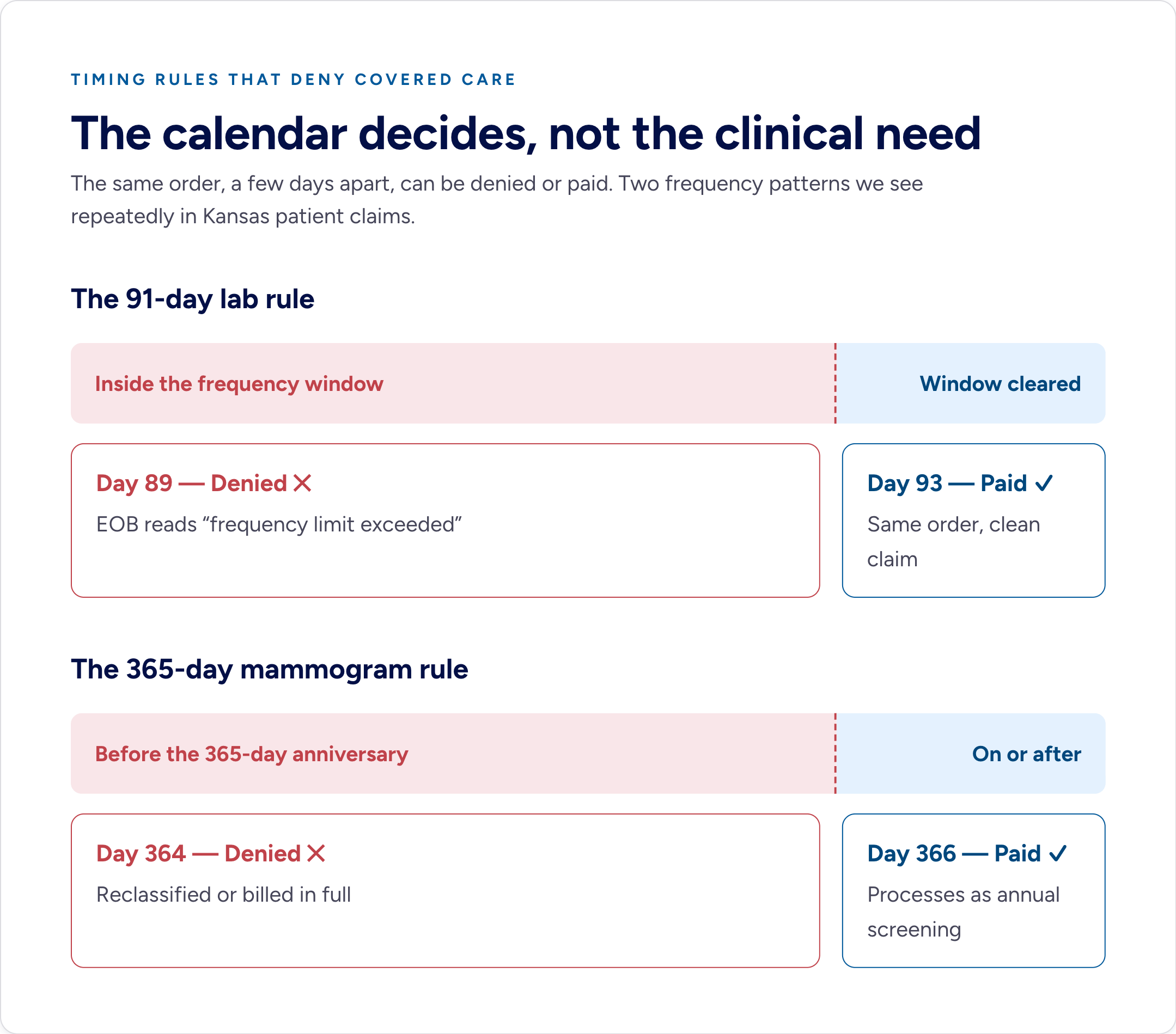
The 91-day lab pattern is the most common. Certain blood tests ordered fewer than 91 days after a prior claim of the same type are denied as exceeding maximum frequency. The denial code often reads “frequency limit exceeded” even when the doctor ordered the test for clear clinical reasons. We have watched patients receive the exact same lab order denied on day 89 and paid cleanly on day 93.
The 365-day-plus-1 mammogram pattern is almost as frequent. An annual screening mammogram scheduled one day before the 365-day anniversary of the previous study can be reclassified or denied. The patient receives a bill for the full amount or a large deductible share. The calendar, not the clinical need, decides the outcome.
These are not universal laws. They are common plan designs we observe in Kansas patient claims. The same service ordered a few days later often processes cleanly. Timing alone can decide whether “covered” equals paid or unpaid. When we review the EOB together with the patient, the frequency code is often the reason the balance remains.
The pattern is consistent enough that we now warn patients about it before ordering. If a lab is needed sooner than the plan’s frequency window, we explain the risk of denial and the cash option so there are no surprises.
Some patients have brought us denial letters that simply state “maximum frequency exceeded” with no further explanation. The appeal process is slow and often unsuccessful for routine monitoring.
That is why transparent cash pricing matters. When our price is $2.85 or $6, the timing rule becomes less of a barrier.
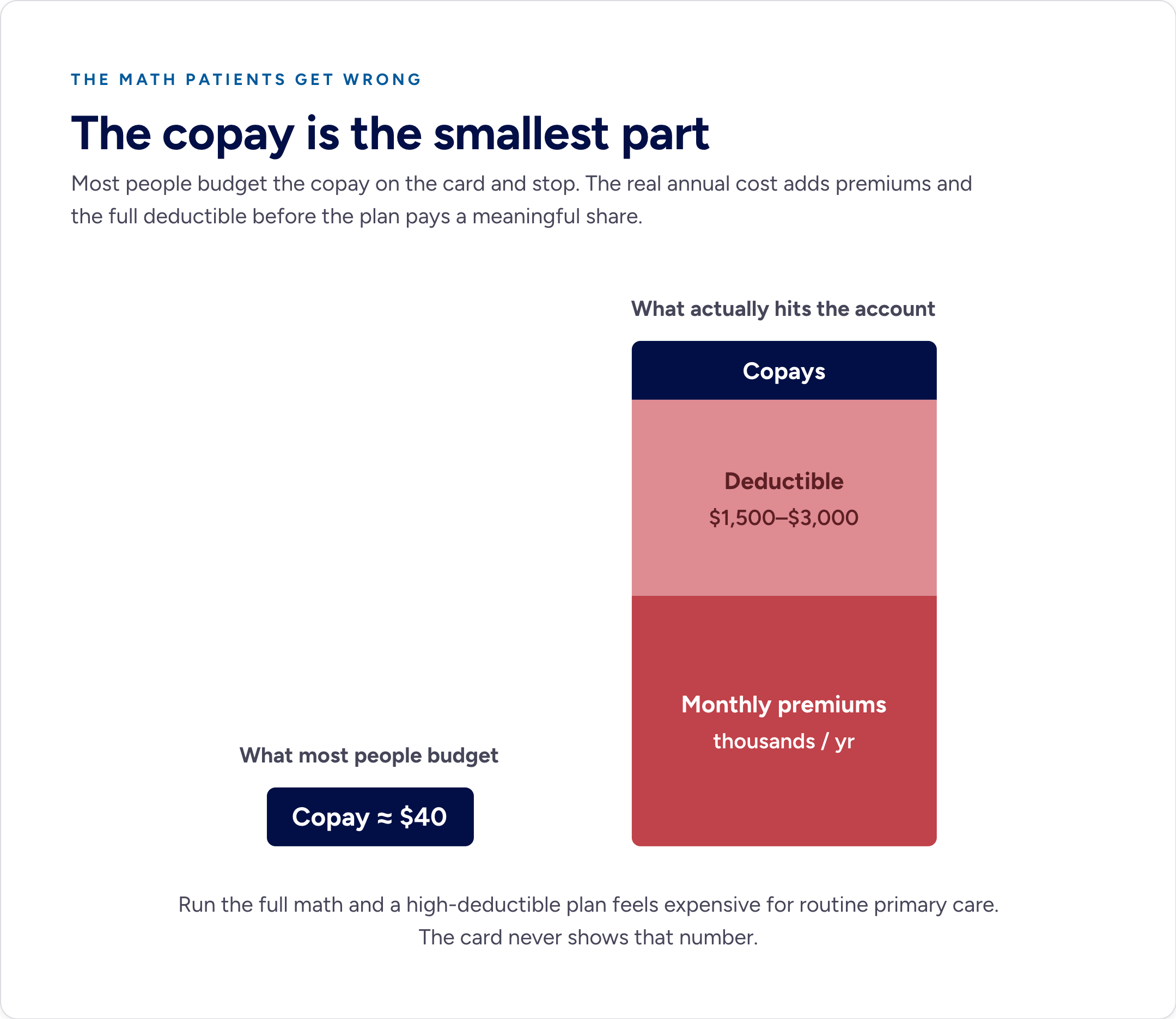
Most people look at the copay listed on their insurance card and stop there. They do not add the monthly premium or the full deductible that must be paid before most benefits apply.
A typical calculation we hear is “My visit is only $40.” The real annual picture is closer to several hundred (or thousand) dollars in premiums plus a $1,500 to $3,000 deductible before the plan pays any meaningful share of labs or visits. That is the number that actually hits the bank account.
Patients who run the full math quickly see why high-deductible plans feel expensive for routine primary care. The copay is the smallest part of the equation. They don’t do math with the right numbers.
When a patient sits down with us and we add the premium, the remaining deductible, and the out-of-pocket costs for the year’s labs and visits, the total almost always surprises them. The insurance card never shows that full number.
A family of four on a high-deductible plan can easily pay thousands of dollars a year in premiums alone before a single claim is filed. Our membership for that same family is a fraction of that amount and covers unlimited primary care visits plus the labs at the prices shown. The difference shows up every month, not just when someone is sick.
Here is what common tests actually cost in the three payment paths we see most often.
These Direct Primary Care prices are the negotiated rates we pass through to members. They require no deductible and no frequency clock. You pay the cash amount at the time of service or as part of membership pricing for included labs.
Independent labs already undercut hospital chargemaster rates. Our negotiated rates undercut the independent cash prices further because the practice eliminates billing overhead and negotiates volume directly. The same transparent pricing applies to the monitoring labs used in chronic disease management.
For a deeper side-by-side of total annual costs under traditional insurance versus membership, see our comparison of primary care with insurance versus Direct Primary Care.
Membership covers unlimited office visits with no copay and no deductible for primary care. Basic labs are available at the cash prices above. There is no 91-day clock and no coding fight over preventive versus diagnostic.
Age-based membership at Integrity Medicine runs $30 per month for children 0–17, $60 for ages 18–44, $80 for ages 45–64, $100 for ages 65-99, and $1 for ages 100 and older. Employer groups can access a $60 monthly rate.
Visits last 30 minutes by default. Same-week or same-day openings are the norm. You can see the full current membership pricing on our pricing page.
Most members keep a high-deductible insurance plan or health sharing plan for hospital and specialty care. More than 85 percent of our patients carry some form of insurance. Primary care, routine labs, and common in-office procedures move outside the insurance billing cycle entirely.
The timing rules and premium-plus-deductible math no longer apply to the majority of day-to-day needs. For more on what the membership includes, see what a Direct Primary Care membership covers.
You can review current membership details and schedule a free meet-and-greet on our Andover Direct Primary Care or Newton Direct Primary Care pages. If you want to see how access works in practice, read about our same-day sick visits or the comparison of Direct Primary Care versus urgent care.
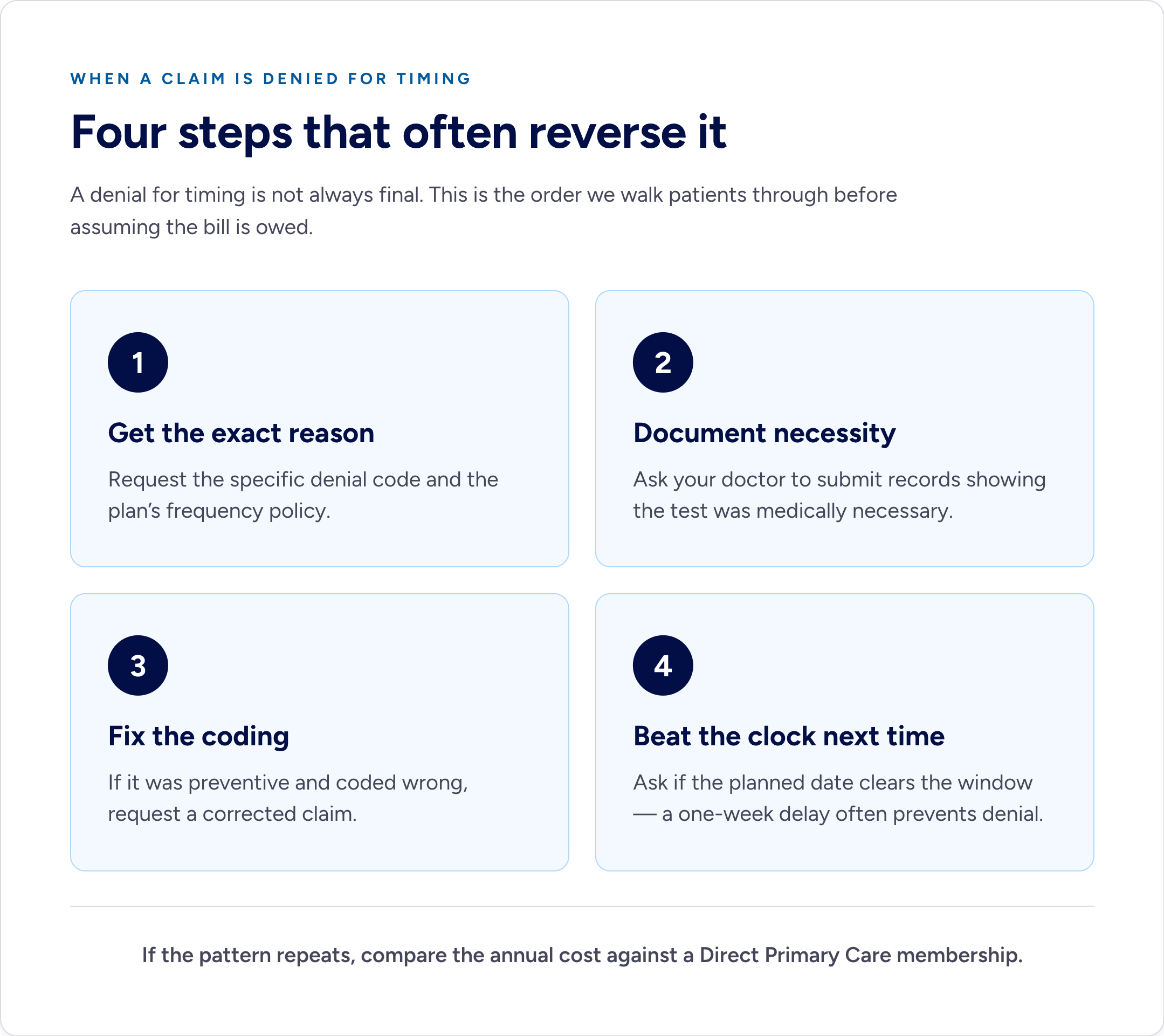
Request the exact denial reason and the plan’s frequency policy. Ask your doctor to submit clinical documentation showing medical necessity. If the service was preventive and coded incorrectly, request a corrected claim.
For future labs and imaging, ask the ordering office whether the planned date will clear the plan’s frequency window. A one-week delay often prevents the denial.
If the pattern repeats, compare the annual cost of staying inside the insurance cycle against a Direct Primary Care membership plus a high-deductible plan. The arithmetic is usually decisive. Many patients also find it helpful to review whether you still need insurance with Direct Primary Care.
Common individual tests range from $25–$100 at independent labs. A full annual panel often costs $85–$210. At Integrity Medicine the same tests run $2.85 for a CBC, about $6 for an A1C, and roughly $25 for a standard annual panel.
Preventive labs recommended by the USPSTF are covered at no cost-sharing when coded correctly and performed in-network. Diagnostic or monitoring labs are usually covered after the deductible and subject to frequency limits. Many plans still generate patient balances through medical management rules.
Common reasons include frequency limits exceeded (the 91-day pattern we see often), missing prior authorization, out-of-network lab, or coding that the plan classifies as non-preventive or not medically necessary. Request the specific denial code on the EOB.
Most plans follow USPSTF or HRSA intervals, commonly annual or biennial for average-risk women starting at age 40 or 50. Ordering one day before the 365-day mark can trigger a denial or reclassification under the frequency rules many plans use.
If you have not met your deductible, the insurance-billed rate is often higher than the independent-lab cash price. Direct Primary Care cash prices are lower still and require no deductible tracking.
Yes for hospital, emergency, and most specialty care. Direct Primary Care replaces the insurance billing cycle only for primary care visits, basic labs, and many in-office procedures. Most members pair membership with a high-deductible or catastrophic plan.
Timing rules and the full premium-plus-deductible math are where patients lose the most money on routine care. Direct Primary Care takes both out of the equation.
Schedule a free meet-and-greet at our Newton or Andover clinic to see the exact membership pricing and lab menu for your age and family. You can start on the contact page or the location pages linked above. If you want to compare the full annual cost picture first, the insurance versus Direct Primary Care comparison walks through real patient scenarios.
Learn more about our practice on the About page.